
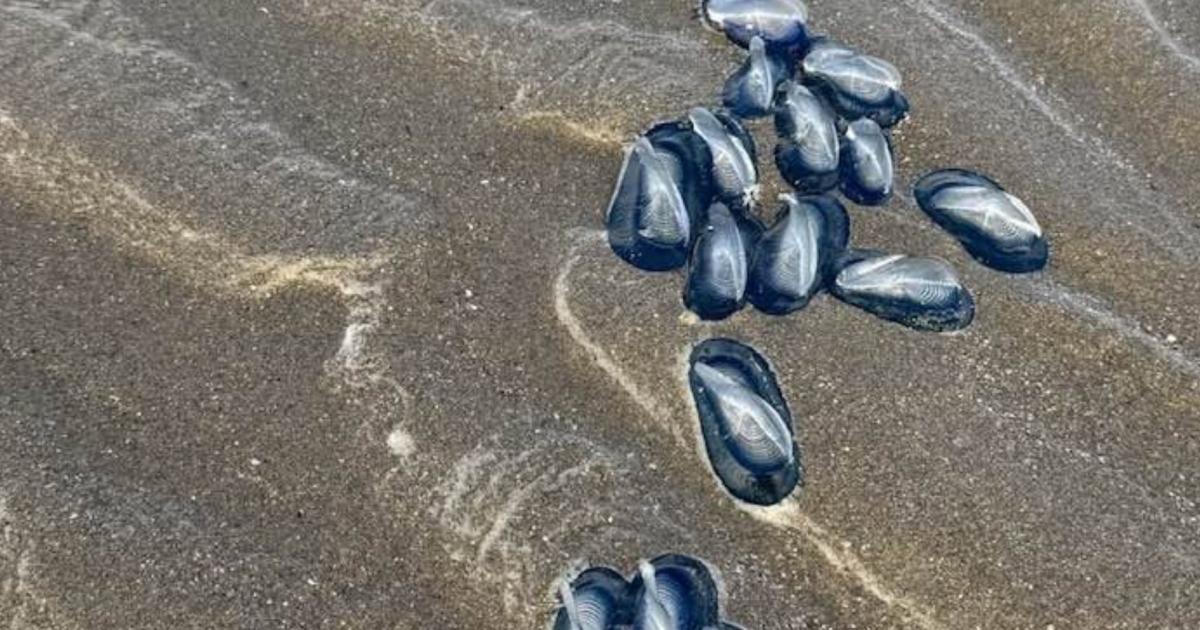
Pembrokeshire beaches are seeing arrivals of Velella velella, also known as by-the-wind sailors, which look like translucent blue discs and are often mistaken for sea glass or plastic.
Despite their delicate appearance, experts are urging people to admire the creatures from a distance.
The Wildlife Trusts describes the species as an “incredibly strange and beautiful” marine animal, and their arrival on Pembrokeshire beaches offers a rare chance to see creatures that normally spend their lives far offshore.
By-the-wind sailors are colonial organisms made up of many tiny animals working together.
They are related to the Portuguese man o’ war but are not true jellyfish.
Each has a small, sail-like structure that allows it to drift across the ocean surface, powered by the wind.
Recent sightings of thousands of the creatures have been reported at Poppit Sands, a popular spot at the mouth of the Teifi estuary and the starting point of the Pembrokeshire Coast Path.
While less dangerous than the Portuguese man o’ war, Velella velella are not entirely harmless.
Marine experts warn that stranded by-the-wind sailors can still sting, even after being washed ashore. Their stinging cells remain active and, while the toxins are generally considered mild, they can cause irritation if they come into contact with sensitive areas such as the eyes, lips or face. Some people may also experience tingling or skin irritation after handling them.
Children and dog walkers should avoid touching them directly if they come across them on the beach.
The mass strandings are caused by a combination of strong winds and shifting ocean currents, which can push large numbers of the creatures onto the shore.
Wildlife experts say these strandings can happen in the hundreds or even thousands.
Velella velella spend most of their lives drifting in open water, feeding on plankton and other tiny organisms.
Beachgoers are encouraged to take photographs and admire the creatures from afar.
Their arrival offers a rare glimpse of an unusual marine species, but one that is best left where nature put it.