
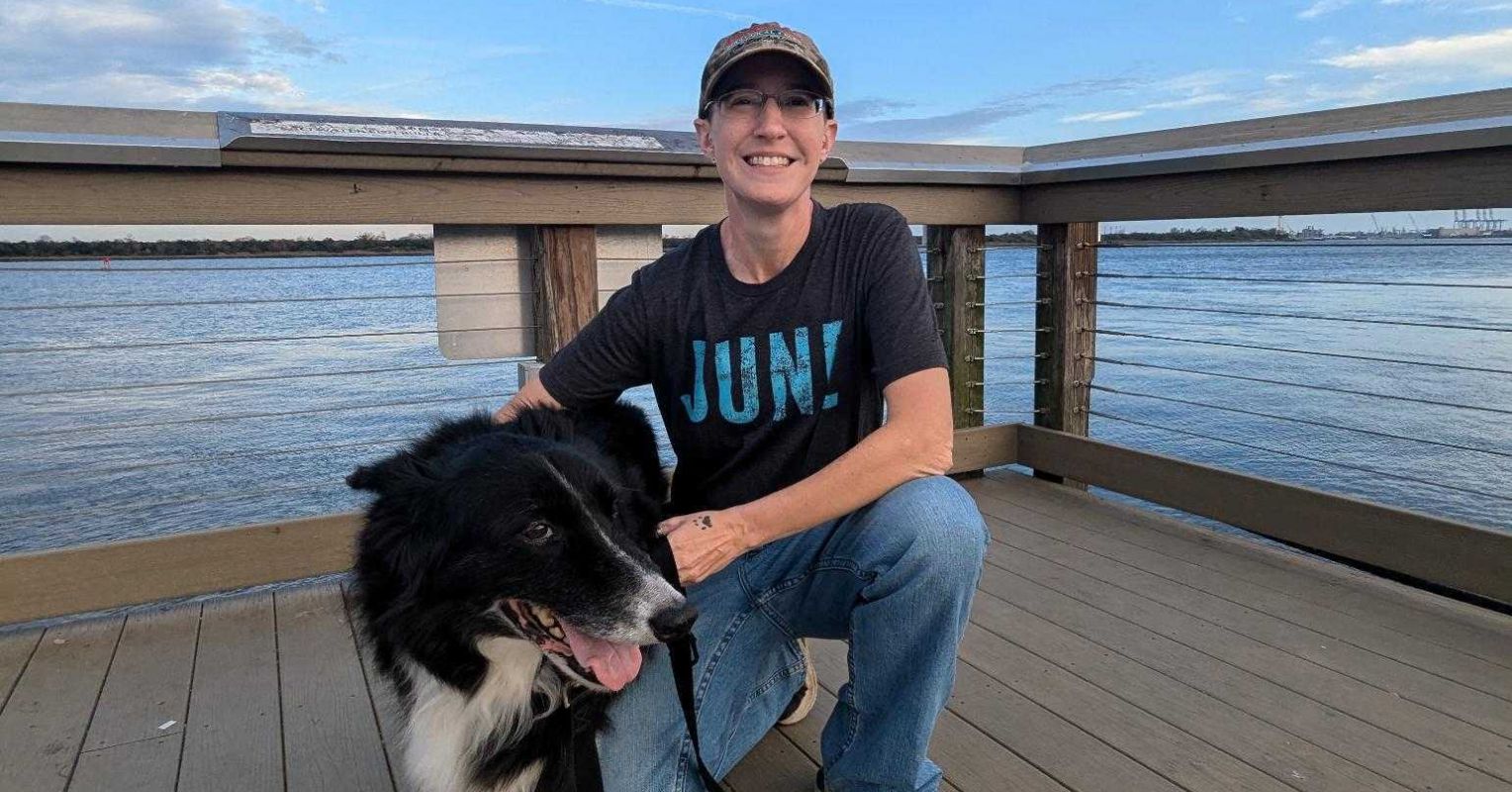
The Game She Hated Without Knowing Why
You probably know the game: A sibling gets as close to your face as possible without technically touching, and says, with great satisfaction: “I’m not touching you.”
For most children, it’s annoying. For Jordan Davis, it was unbearable. She never understood why until she was an adult.
“I never knew why I hated it so much,” she tells me. “Now I know it’s because I don’t like being touched. I’m sensitive to that.”
Jordan is the founder of the Canine Stroke Foundation, an advocate for animal health, and someone who has spent most of her life being told she was difficult. She is also, as of recently, a person with a name for what she has been experiencing since childhood: AuDHD, the co-occurrence of autism and attention deficit hyperactivity disorder.
The diagnosis came unexpectedly. There was no crisis or collapse. It came from a face-to-face conversation with her mother.
The “Eureka” Moment
Jordan’s mother is a doctor and one of the most clinically informed people in her life. Yet when her mother was diagnosed as autistic in her 70s, it was the first time either of them began to understand Jordan.
“I immediately thought I needed to be assessed, because we are so similar,” Jordan says. “She talked about a lifetime of bad memories due to social misunderstandings. It all made sense to her finally. I needed that clarity as well.”
Autism has a strong hereditary component. A parent’s diagnosis frequently illuminates a child’s own experience, even when that child is already an adult. What makes Jordan’s story unusual is the direction. Usually, it is a child’s diagnosis that prompts a parent to recognize similar traits in themselves. For Jordan, it happened the other way around: Her mother’s diagnosis gave her a way to understand experiences she had spent decades struggling to explain.
“We often get accused of being mean or rude when that was never the intention,” Jordan says. “As I read more about autism, I recognized so many characteristics in myself.”
Her mother, a physician, had not considered the possibility when Jordan was young. The reason may sound familiar to people who have encountered the challenges of neurodivergent diagnosis: “I was verbal and a good student, so neurodivergency was never considered.”
Understanding Autistic Meltdowns Misinterpreted as Bad Behavior
Autistic meltdowns are not tantrums. They are involuntary responses to sensory or emotional overload, and Jordan spent years not knowing that was what was happening to her.
Bright lights. Loud noises. Being touched. Being misunderstood.
“After a while of it, I would ‘melt down.’ I always feel like the worst person in the world afterwards, so I try hard not to get to that point.”
The person experiencing meltdowns has no more control over it than someone has over a stress-induced migraine. But they look, from the outside, like bad behaviour. And they are treated as such.
“No one ever tried to explain or address what was happening,” Jordan says. “Punishment for that behavior won’t change the behavior. It’s involuntary.”
Her advice to adults caring for children like her is simple: “Find the cause. Ask your child what they are feeling. Ask if sounds, lights, or physical sensations are making it worse. Once you understand triggers, it’s easier to avoid them.”
The Medication Problem Nobody Warned Her About
For Jordan, getting a diagnosis brought another set of difficulties.
Shortly after her AuDHD diagnosis, she developed alpha-gal syndrome: an allergy to mammalian products triggered by a tick bite. Alpha-gal syndrome affects hundreds of thousands of people globally, and its implications for medication access are poorly understood even within healthcare settings. Most pharmaceutical capsules contain mammalian-derived gelatin and many active ingredients are processed using mammalian byproducts. For people with alpha-gal syndrome, identifying mammalian-derived ingredients in medications can be complicated, and exposure can trigger a systemic allergic reaction.
Jordan found this out the hard way.
She was abruptly taken off duloxetine without a grace period to switch to an alpha-gal-safe alternative. The withdrawal was severe: “Brain zaps. The lack of energy was unbearable. I felt like I was dying.” Eventually, an allergist found a workaround: the pellets inside the capsule, taken without the gelatin shell, with famotidine to counteract remaining mammalian byproducts. Half a dose later, her symptoms resolved.
But the problem didn’t end there. “No doctor or pharmacist has been willing to call the manufacturer for me,” she says. “I was told medications were safe, and when I took them, I broke out into hives.”
She recently left an emergency room after discovering staff had not checked whether the medications they were about to inject contained mammalian products. “I asked if they checked. They said they did not. I left.” [Jordan’s experience is specific to her medical circumstances and should not be taken as advice to stop or change medication. Moreover, it is not a reason to avoid medication: it is a reason to ask better questions of the system providing it.]
What Clarity Feels Like
Jordan is now pursuing a graduate certificate in veterinary science. She plans a master’s degree after that. The difference, she says, is that she now knows how she learns, what she needs, and what she can ask for.
“I had a perfect GPA until the stress became too much for me to function,” she says of her earlier studies. Lectures were difficult because of auditory processing problems. Other students, lights and even the temperature could become overwhelming. Without a diagnosis, she didn’t have the accommodations that might have helped. Over time, those difficulties slowly accumulated until it broke something.
The diagnosis didn’t undo the difficulties she had experienced. But it helped her understand why some things had been so difficult.
“Learning about yourself can help you cope with the world in every way,” she says. “The battle is never over. You will continue to learn about yourself and how to keep yourself grounded your entire life.”
The insight she describes as most impactful is surprisingly simple: “Realizing I’m not actually a bad person.”
The meltdowns, the perceived rudeness, the years of guilt for things she could not control—a diagnosis did not undo any of those experiences, but it gave her a different way to understand them.