
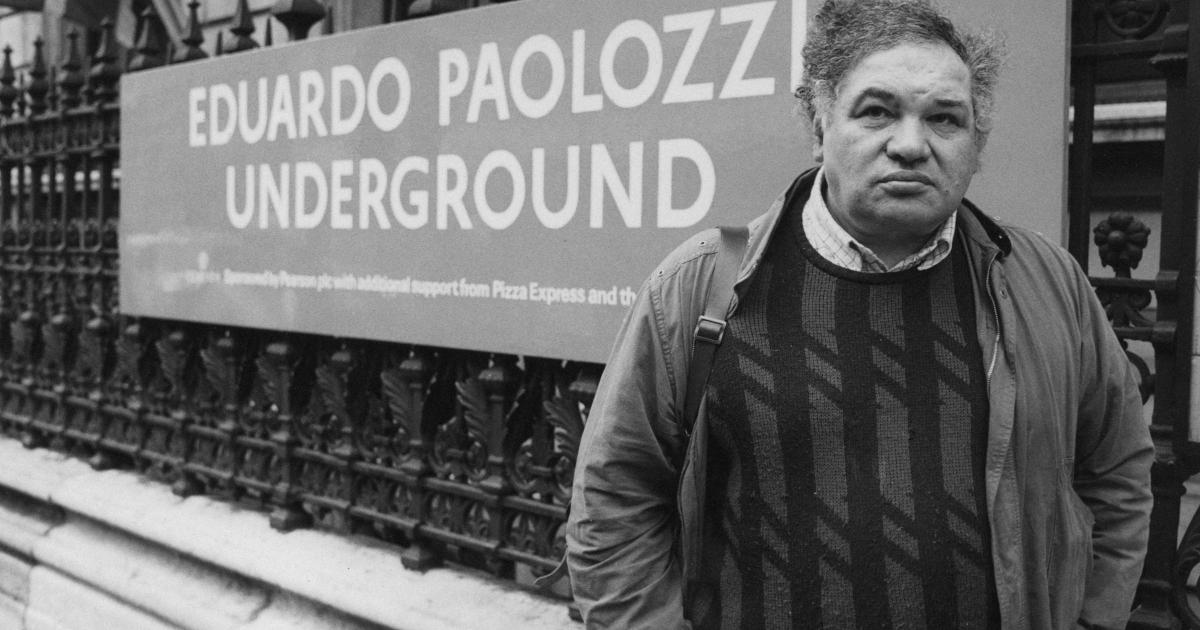
Frequently, he took objects from skips and welded them into new contexts.
“Our culture decides, quite arbitrarily, what is waste and rubbish,” he said. “But … I like to make use of everything. I can’t bear to throw things away – a nice wine bottle, a nice box. Sometimes I feel like a wizard in Toytown, transforming a bunch of carrots into pomegranates.”
The writer J G Ballard said that, in the event of a Holocaust, one could reconstruct the 20th century from Paolozzi’s works. And these works were created by a man whose childhood revolved round an ice cream parlour and confectionery in Albert Street, just off Leith Walk, in Edinburgh.
Proletarian Leith was where Eduardo Luigi Paolozzi was born on 7 March 1924, the eldest of two children. His father, Rodolfo, had come from Italy in 1921 to marry Carmela, daughter of Carlo Rossi, who had settled in Edinburgh.
It was the confectionery wrappings in Rodolfo and Carmela’s shop that first inspired Eduardo’s imagination. The boy spent every summer with his grandparents in Montecassino and grew up bilingual. He also grew up with a confused sense of identity. His father admired Mussolini, and during these summers Eduardo also attended fascist youth camps, where he acquired a predilection for badges and uniforms.
When Italy declared war in 1940, Eduardo, having finished secondary education at Holy Cross Academy, was arrested as an enemy alien.
During his internment at Edinburgh’s Saughton Prison, his father, grandfather and uncle drowned with 443 others when the SS Arandora Star, carrying them to forced exile in Canada, was sunk by a German U-boat.
The Write Stuff
AFTER his three-month internment, Eduardo helped with the family business while also, despite his late father’s ambition for him to become an engineer, attending evening classes in calligraphy and lettering at Edinburgh College of Art.
Called up in 1943, he spent more than a year with the Pioneer Corps, mostly bivouacked on a Slough football pitch. During this frustrating conscription, he discovered a book that inspired his subsequent career: The Foundations of Modern Art by Amedee Ozenfant.
Read more
Demobilised after feigning insanity, he enrolled first at Ruskin School of Art, Oxford, and subsequently at Slade School of Art, at that time evacuated to the same city.
Broadening his horizons away from earlier ambitions to become a commercial artist, he considered himself “school of Picasso”, which sat ill with the traditional Slade, where students protested against the surrealists.
But, as the Guardian has noted, Picasso’s influence was “plain in the primitivistic sculptures, energetic drawings and elegant, cubist-derived collages which Paolozzi produced as a student”.
In 1947, after a successful one-man exhibition at London’s Mayor Gallery, Paolozzi moved to Paris to learn more about the modern movement. Provided with letters of introduction to several famous artists, he lived for two years in a small room, making plaster reliefs and rudimentary collages from American adverts, cheap novelette covers and scientific illustrations. Though chiefly for his own amusement, these were inspired by Dada photomontage and later came to be considered important early examples of pop art.
With his main work attracting little interest, he returned to London dispirited in 1949, establishing a studio stuffed with a variety of objects and materials while also inhabiting an isolated cottage on the Essex coast where he’d moved after marrying in 1951.
Figures of fun
SOON, he was commanding public attention, with prints combining crudely outlined figures with fragmentary diagrams of machine parts, while his roughly cast sculptures similarly combined bronze heads with nuts, bolts, toys and scrapyard junk.
Paolozzi made fountains for the 1951 Festival of Britain and 1953 Hamburg Garden Show. An exhibition of his work in the British pavilion at the Venice Biennale in 1952 established him in the forefront of a new generation of sculptors.
That year, he helped found the Independent Group, which met at the Institute of Contemporary Arts to discuss new ideas. Paolozzi’s inaugural lecture featured random images from pulp literature and collages made from magazines given to him by American servicemen in Paris. This was later seen as another seminal moment for the pop art movement.
Paolozzi’s work was shown at New York’s Museum of Modern Art in 1959, while 1960-62 took him to Hamburg Art School where, as a visiting professor, he had the “Fifth Beatle”, Stuart Sutcliffe, as one of his students.
In Hamburg, he discovered the delights of shipbreakers’ yards, collecting discarded junk and machine parts, which at first he cast in bronze but later welded and covered in bright colours.
He was also printmaking, in 1965 creating a masterpiece of pop art, As Is When, 12 collages employing fragments of texts, abstract patterns, pictures of aeroplanes and Disney characters in a homage to, obviously, the philosopher Wittgenstein.
While the 1960s were particularly rewarding for Paolozzi, by 1971 his work was perceived as repetitive and unoriginal, and his retrospective at the Tate that year was a critical flop.
But he bounced back, particularly during sojourns in Germany, a country he loved and where, as well as teaching, he created beautiful abstract prints and wooden reliefs.
Commissions for public works multiplied, both in Germany and Britain. He made ceiling panels and a window tapestry for Cleish Castle, Fife; the aforementioned Hunterian doors; a futuristic head for Euston Station; colourful glass mosaic decorations for Tottenham Court Road underground station, his most extensive work; 12 monumental mosaic panels for the Kingfisher Shopping Centre in Redditch; a large sculpture for Royal Bank of Scotland HQ in Edinburgh; a bronze figure of Isaac Newton in the piazza of the British Library; and The Manuscript of Monte Cassino, an open palm, a section of limb and a human foot at the top of Leith Walk.
Winging it
OH, and he designed the cover for Red Rose Speedway, the second album of Paul McCartney’s post-Beatles band Wings.
Knighted in 1981, towards the end of his life Eduardo Paolozzi’s emotional attachment to Edinburgh became increasingly evident. He offered a large quantity of works to various galleries, while others were later donated to Edinburgh University’s School of Informatics.
After suffering a near-fatal stroke in 2001, he died aged 81 in a London hospital on 22 April 2005.
Scotland’s then culture minister, Patricia Ferguson, described him as “one of Scotland’s true international icons”. His first inspiration had been sweetie wrappers in an ice cream parlour. But as he later said: “Inspiration is where you find it.”