
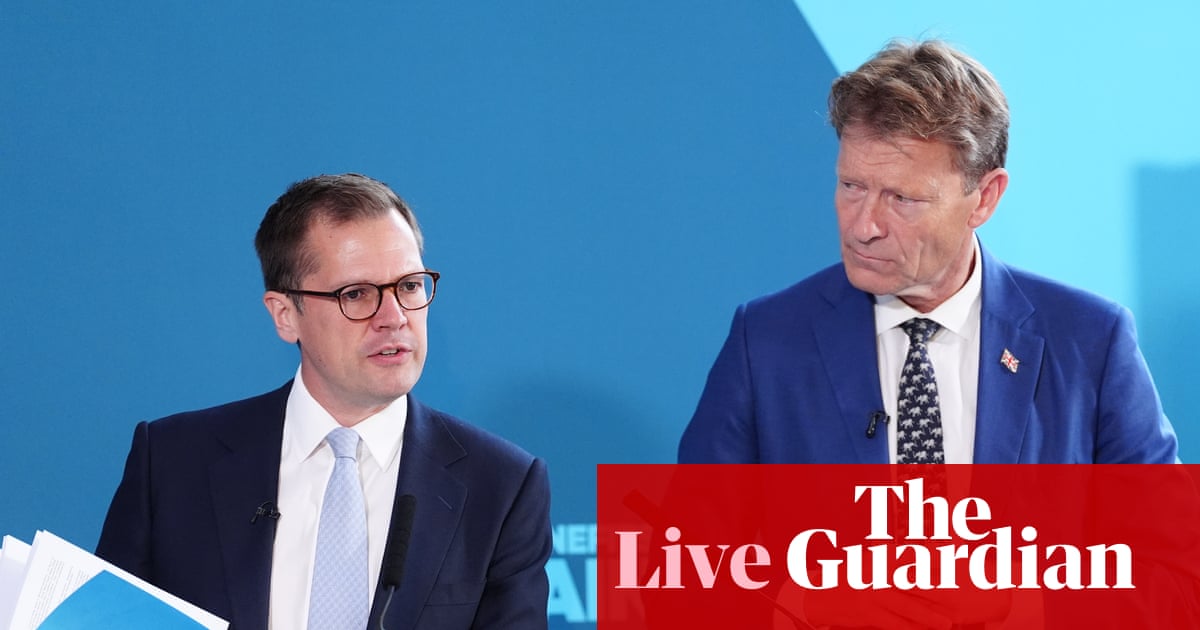
Long-term benefit claimants will have to clean up high streets if they want to keep benefits, Jenrick says
Robert Jenrick went on to say that long-term benefits claimants will be made to clean up their local high street and do charity work or face having their benefits taken away.
He said as part of the party’s “welfare to work” policy, long-term claimants, who are fit to work, will be forced to do 20-hours of work a week in the community.
The scheme would be run by their local councils and those who do not put work placements in will have their funding cut, he said.
Speaking at the event in central London, the former Conservative cabinet minister said:
double quotation markThey’ll work to clean up high streets and parks, to beautify neglected places, to carry out minor repairs, to staff libraries and community centres to perform many other tasks from the list that we’ve published today.
We’ll also embrace local charities and community groups and ask them to help us and take part. If claimants refuse to participate or fail to show up, they’ll face penalties.
Let me speak very plainly. If people who are capable of work refuse, then they’ll get nothing. That’s fair.
Updated at 07.06 EDT
Key events
Closing summary
Reform UK’s Treasury spokesperson, Robert Jenrick, said long-term benefits claimants will be made to clean up their local high street or face being stripped of their benefits under controversial changes to the welfare system.
The proposal was announced alongside others that Jenrick claimed would save £50bn in spending. It includes seeing disability and sickness payments withdrawn or changed, and foreign nationals being banned from claiming almost all types of benefits in the UK, including EU nationals.
During the same press conference, Reform UK’s deputy leader, Richard Tice, urged people concerned about the climate crisis to stop being “doom and gloom”, as it could see an improvement in English wine. Tice briefly acknowledged climate change is “real”, but said there was no proof net zero policies would halt it – and to think it can be stopped is “arrogant”.
“Tice’s words show that a party bankrolled by fossil fuel interests will keep denying the climate crisis for its funders’ benefit even when its impacts are undeniable,” Amy Cameron, Greenpeace UK’s programme director, said in response to his comments.
Andy Burnham exchanged messages with someone impersonating Donald Trump’s chief of staff, the Guardian understands.
Thousands more homes could be built within 10 minutes of transport hubs, including on green belt sites, as part of changes to government planning rules in England.
Under the government’s new National Planning Policy Framework, there will be default approval for homes being built around railway stations in a bid to increase housebuilding numbers. There will also be new minimum expectations for how much housing should be built in these areas.
Thanks for following along. We are closing the blog now, but you can read more of our UK politics coverage here.
Amelia Casey-Rerhaye
While the UK awaits rain to ease the drought conditions covering most of the country, Phil Garrigan, chair of the National Fire Chiefs Council, warns the danger is not over yet.
At least 1,132 wildfires have been recorded so far in 2026, according to the National Fire Chiefs Council, and while Garrigan praises the public’s response to the government’s emergency alert, he goes on to urge people to “remain vigilant” and says public support is “critical” as firefighters continue efforts to keep the country safe.
Many have criticised the government alert issued on Friday, saying it doesn’t properly tackle the issues at hand and pressure is mounting on Andy Burnham to take more radical action facing the challenges of the climate crisis.
The housing secretary, Angela Rayner, has been speaking to the media on a visit to the West Midlands. She acknowledged that wildfires are becoming more frequent, describing the devastation seen over recent weeks as “absolutely horrendous”.
She said:
double quotation markWe’re seeing a pattern here with the wildfires. We’re seeing a pattern with climate.
We have introduced £100m more equipment and we’ve got specialist fire crews now that look at wildfires, and they have been pushed by what’s happened.
Rayner added that the government is continuing to “assess the situation with water”. She said:
double quotation markWe’re also pushing the water companies to tackle leakages and investment in our infrastructure that we haven’t seen for a number of decades.
We want the water companies to do more and we’re pressing them to do more. And, of course, we’re assessing the risks to make sure that we have the appropriate water supplies that people need.
Andy Burnham has issued a temporary GB-wide ban on the sale of disposable barbecues and brought in the military to help deal with wildfires. But his government has been criticised for being too slow to react to the extreme heat, apparently not seeing the climate emergency as a political priority.
Emma Howard Boyd, the former head of the Environment Agency who is now a professor in practice at the Grantham Research Institute on Climate Change and the Environment, has urged the government to “act with urgency” to prepare the country for a hotter climate, by cutting emissions while investing in the resilience of the country’s homes, infrastructure, farms and public services.
Updated at 10.42 EDT
Thom Yorke, Romy and Brian Eno among 200 musicians urging PM to reject new North Sea drilling Lauren Almeida
More than 200 musicians including Massive Attack and Brian Eno have written to Andy Burnham urging him to reject plans for more oil and gas drilling in the North Sea.
The letter, signed by 211 artists such as Bobby Gillespie, Olly Alexander and Paris Paloma, called on the prime minister to reject the Rosebank oilfield, warning that the project would fail to lower energy bills or provide energy security as most of the oil was likely to be exported.
Other performers who put their name to the missive include Radiohead’s Thom Yorke, Ed O’Brien and Philip Selway; the Cure’s Robert Smith; Bobby Gillespie of Primal Scream; Alexis Taylor of Hot Chip; Anoushka Shankar, Kevin Rowland, Anna Calvi, Jacob Collier, David Gray, the electronic duo Bicep and the xx singer Romy.
Climate activists from Greenpeace and Uplift protest against new drilling in the Rosebank and Jackdaw fields. Photograph: Andrew Milligan/PA
The government’s consultation on the project, which lies about 80 miles north-west of the Shetland Islands, closed on Monday. Ministers will now decide on its future as well as that of the Jackdaw gasfield off Aberdeen, whose consultation concluded a week ago.
Adura, the company behind both projects, has said the projects would result in £10.8bn in investment and support 3,500 jobs at the peak of construction, with 880 employees over its production lifetime.
However, environmental activists argue that extracting fossil fuels from the UK’s largest remaining untapped oilfield will accelerate climate chaos. Estimates suggest Rosebank could produce more than 250m tonnes of CO2 over its lifetime, equivalent to 70% of the UK’s annual emissions. You can read the full story here:
ShareReform denying climate crisis for its funders’ benefit, Greenpeace says
Greenpeace has reacted to Richard Tice claiming at the Reform press conference earlier today that there was no proof net zero policies would halt the climate crisis and saying that it was “arrogant” to think it could be stopped. Tice also urged people concerned about the climate emergency to stop being “doom and gloom”, as it could see an improvement in English wine. In reaction to the remarks, Amy Cameron, Greenpeace UK’s programme director, said:
double quotation markTice’s words show that a party bankrolled by fossil fuel interests will keep denying the climate crisis for its funders’ benefit even when its impacts are undeniable.
Reform should try telling nurses fainting on shifts, farmers losing their crops and people running from burning homes to enjoy the hot weather and see what reaction they’ll get.
There’s only one way to stop this extreme weather: cutting emissions from fossil fuels. Things will only get from bad to worse if we listen to the politicians being paid to deny it’s even happening.
Rejecting North Sea drilling licences, increasing the windfall tax on fossil fuel companies to pay for adaptation measures and planting more trees are just some of the measures the government could help implement to address the climate emergency, which campaigners say Andy Burnham is not taking seriously enough.
Reform has said it will scrap net zero policies in order to protect jobs in the oil and gas sector and to bring down the cost of energy bills. The cancellation of the target of reaching net zero greenhouse gas emissions by 2050 would remove obligations to cut carbon and dismantle the cornerstone of climate policy. Reaching net zero CO2 emissions is essential to limit global warming, but Reform have tried to discredit the ambition as they frame it as ideological and extreme.
Reform has received £24m from oil and gas interests and a further £2.4m has been donated by people who have disputed basic scientific facts about climate change, according to a report published by the climate investigations platform DeSmog in April.
Updated at 10.06 EDT
 Vikram Dodd
The public overestimate how many minority ethnic people are killers, as well as how many foreign national offenders there are, a new study has found.
The research from King’s College London tested knowledge and perceptions of crime at a time when radical right parties are trying to link offending to ethnicity and nationality to gain votes.
YouGov’s survey of 1,800 people in England and Wales found that people thought 55% of convicted killers were from an ethnic minority, when the real percentage is 35%.
They also thought just 45% of homicides were committed by white people, when the real figure is 64%.
Reform voters were furthest from the truth, believing 70% of killers were from ethnic minorities – 10% more than voters of any other party. You can read the full story here:
When asked if climate change is real during the Q&A section of today’s event, Richard Tice, Reform UK’s deputy leader, sought to downplay the catastrophic effects of the climate crisis, including on crops, animal habitats and human health. Tice suggested that we should adapt to the ‘changing’ climate and celebrate a boom in English sparkling wine. You can watch him say that here …
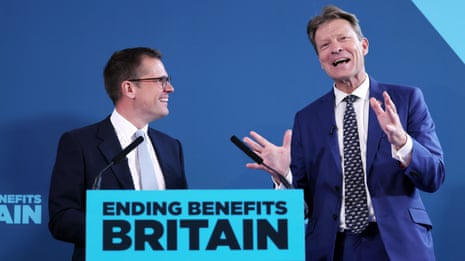 Not all ‘doom and gloom’: Reform’s deputy leader downplays climate crisis – videoShare
Angela Rayner has visited the burnt-out remains of homes in the West Midlands gutted by a wildfire last week.
The housing secretary could be seen walking among the shells of houses at Quarry Park Road, Stourbridge, after the blaze which destroyed 19 homes.
The remains of houses on Quarry Park Road in Stourbridge. Photograph: Joe Giddens/PAShare
The contest for the leadership of the Labour party in Scotland will be between Michael Marra and Joe Fagan, after Monica Lennon was unable to secure enough backing to advance to the final run-off.
Lennon accused the party of being “stuck in the past” in a statement, saying:
double quotation markScottish Labour is stuck in the past. We are not listening to all of our members, the wider movement that built us or the millions of Scots who won’t vote for us.
This leadership contest should have been a wide debate, rooted in courage, humility and the imagination to become a modern political party for workers and working class communities in Scotland.
Our values mean nothing without vision, conviction and committed action. We must be a party where people can believe in fair work and a healthy planet; where women’s rights and LGBTQ rights are a shared struggle; where engaging in debate about Scotland’s place in the UK and the global community is a strength, not a weakness.
Scottish Labour MSP, Monica Lennon. Photograph: Jeff J Mitchell/Getty Images
Marra and Fagan will take part in a month-long contest to replace Anas Sarwar after he was made a UK government minister and sent to the House of Lords.
ShareRichard Tice suggests we should ‘adapt’ to the climate crisis, arguing we ‘can’t stop it’
When asked if climate change is real during the Q&A section of the press conference, Reform UK’s deputy leader, Richard Tice, sought to downplay the catastrophic effects of the climate crisis, including to crops, animal habitats and human health, that we saw amid the extended period of hot and dry weather this summer. Tice suggested that we should adapt to the ‘changing’ climate rather than actively pursue policy intervention.
Tice told journalists at the Reform UK press conference:
double quotation markOf course climate change is real. But where is the evidence that net zero is going to stop it. Where is the evidence? There isn’t any.
Climate change has always happened – it always will. Maybe the smarter thing to do is to adapt to it than think arrogantly that you can stop it.
I am old enough to remember 1976 this feels a bit to same. That was 50 years ago. I think when it is a bit warm, let’s enjoy it.
And if it means that English wine and sparkling wine gets better and better – fantastic! That means we can take on the French, fantastic! Lets celebrate some of things rather than just be sort of doom and gloom about it.
Updated at 09.17 EDT
Jenrick says that councils that fail to implement “work placements” properly and “in full” will risk cuts to their funding. He claims Reform UK’s plans to remove disability benefits from millions of people and almost all benefits from foreign nationals will save about £50bn in total.
He said without the changes, the cost to the welfare system will rise further, culminating in what could be a “genuine national debt crisis”.
According to a 2024 report by the Resolution Foundation, pensioners were the only group to benefit from radical changes to the welfare system made by the Tories since 2010. The Conservatives’ 14-year overhaul of social security shifted spending away from children and housing to supporting elderly people.
A huge chunk of the ‘welfare bill’ comes from spending on pensioners, mostly due to the largely politically uncontested triple lock on the state pension and the growing pensioner population. Reform UK has said it would cut the benefits bill by billions of pounds in order to keep the triple lock on state pensions if the party came into power.
As a reminder, before his high-profle defection to Reform earlier this year, Jenrick held senior positions in the Conservative governments he now regularly criticises.
He was immigration minister as part of Rishi Sunak’s government before his resignation from the post in late 2023, served as health minister between September and October 2022, the housing secretary between July 2019 and September 2021, and was the exchequer secretary to the Treasury between January 2018 and July 2019.
ShareJenrick claims new ‘return to work’ system will cut disability claims by 40%
Robert Jenrick said staying on benefits is consigning claimants “to a life on welfare”, which he argues wastes people’s “potential” and places a huge burden on the taxpayer.
A high number of benefit claimants are in work and many people are unable to find work despite trying hard to land job. There are also deeper problems in the economy like worsening health and a dysfunctional housing market that Jenrick misses in his analysis.
Reform’s treasury spokesperson went on to say that the party will introduce a new system of “return to work cover” which he says will cut disability claims by 40%.
Explaining the proposal, which he claims will not come at any extra cost to businesses, Jenrick said:
double quotation markFor the first two years of an employee being signed off sick they will remain on their employer’s books, receiving payments based on welfare rates.
Employer’s national insurance contributions will be cut nationally to offset those costs, giving the employers who know their workers best an incentive, firstly to look after them well when they are in work and then to help them back into work if they are off sick – rather than just passing the bill to the taxpayer and forgetting about their workers.
Speaking about those unable to return to work, Jenrick said: “Cash support above standard universal credit rates will be reserved for severe cases and those who need additional help beyond living costs will receive it in-kind through disability support accounts, and the most vulnerable will continue to be supported through personal independence payments.” He said people unable to return to work will go through a single disability- needs assessment, replacing the more complicated existing system.
Updated at 07.03 EDT