
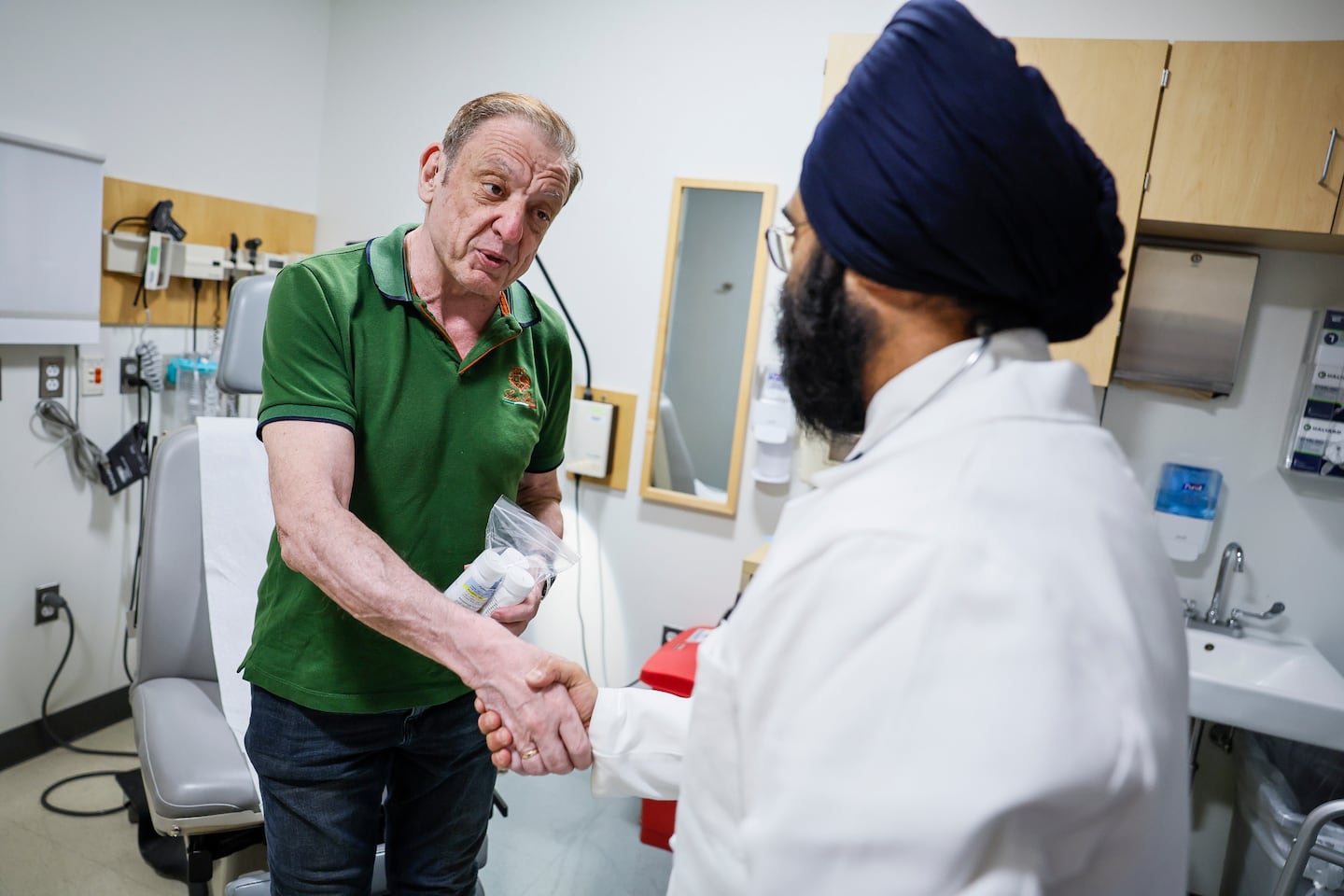
Lazar Mandinov stared at the small plastic bag containing three white pill bottles.
“It’s a miracle,” said Mandinov, 67, on a Friday earlier this month. He had waited two weeks for this visit to Mass General Brigham, where he’s been receiving care since being diagnosed with Stage 4 pancreatic cancer in December.
The bag contained a month’s worth of a new pancreatic cancer drug — an experimental pill that has been hailed as a breakthrough treatment for an infamously lethal cancer. Results from a late-stage clinical trial showed the medication could double the life expectancy of people with advanced disease and keep tumors from growing twice as long as standard chemotherapy.
Mandinov is among the first people in the country to receive the drug, called daraxonrasib, outside of a clinical trial. The medication is awaiting approval from the Food and Drug Administration but is being made available for free to more patients who qualify through an expanded access program.
“The results have been nothing short of historic, landmark, you pick your biggest word,” said Dr. Harsh Singh, an oncologist at Mass General Brigham Cancer Institute who is part of Mandinov’s care team and has been involved in the development of daraxonrasib. “We have never had a treatment like this for pancreatic cancer.”
A breakthrough decades in the making
While pancreatic cancer is considered rare, with roughly 70,000 people diagnosed each year, it often isn’t caught until it has reached an advanced stage, which is what can make it so deadly. Once the cancer has spread, its five-year relative survival rate is about 3 percent, according to the American Cancer Society.
“What we’ve had to treat pancreatic cancer for many years is mostly just chemotherapy,” said Dr. Brian Wolpin, director of the Hale Family Center for Pancreatic Cancer Research at Dana-Farber Cancer Institute and a principal investigator of the daraxonrasib trial.
For nearly 50 years, scientists and doctors have known about one of the disease’s main drivers: mutations to a group of genes that fuel the growth of tumors.
One of those mutations, known as KRAS, is found in more than 90 percent of pancreatic cancers as well as some lung and colorectal cancers.
“When it’s mutated, it can’t really turn itself off,” Wolpin said. “It just keeps signaling to the cell to grow, even when it should not.”
Researchers knew they needed to target the protein created by the mutated gene. But the smooth-surfaced molecule, which has been described as a “greasy ball,” seemed impossible to attack.
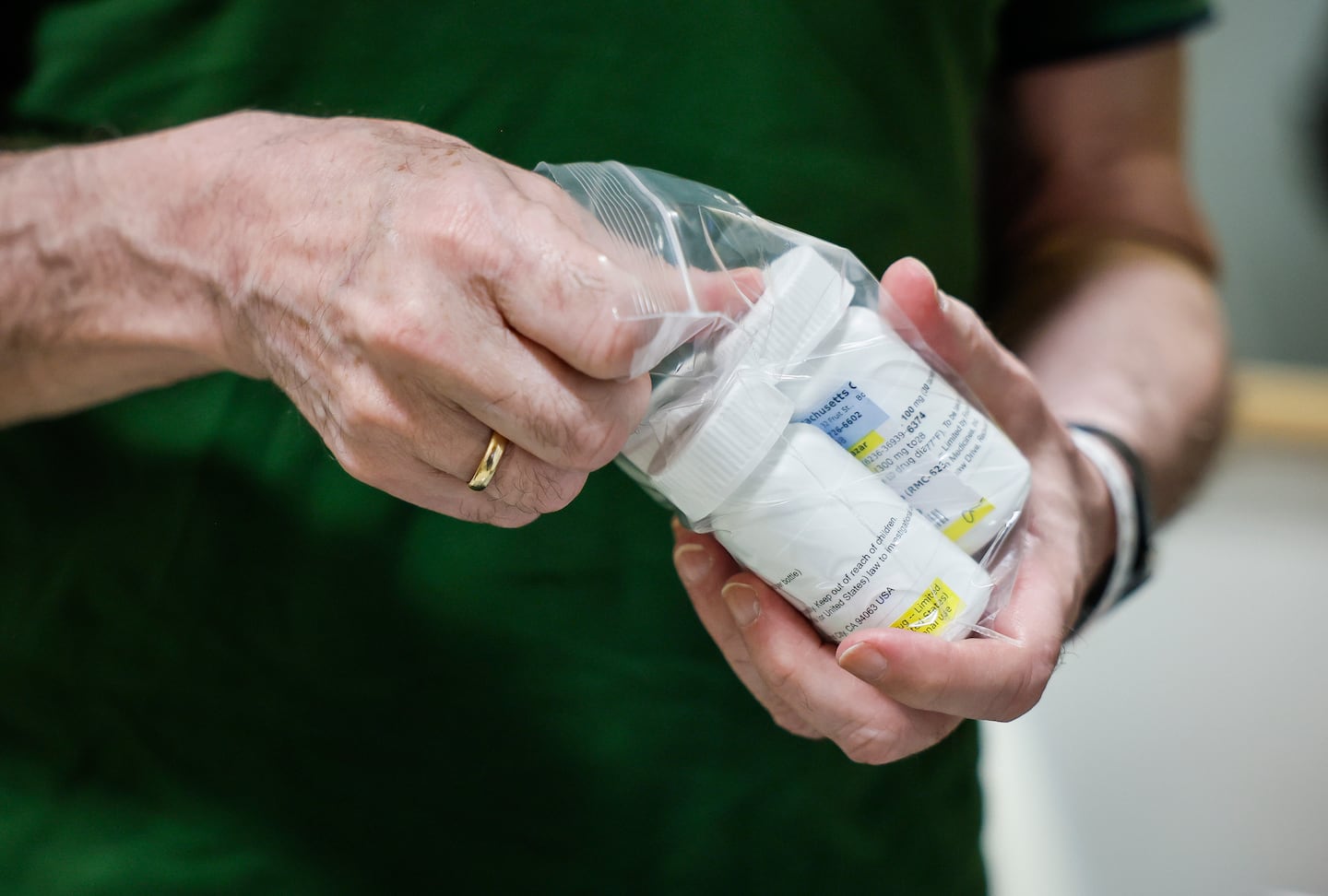 Bottles of an investigational pancreatic cancer drug were held by Mandinov.Erin Clark/Globe Staff
That didn’t stop them from trying.
Over decades, scientists — with support from the National Institutes of Health and the Howard Hughes Medical Institute, a nonprofit research organization — chipped away at the challenge.
A major break came in 2013 when Kevan Shokat, a researcher at the University of California San Francisco, found a chink in the protein’s armor where another molecule could wedge itself.
Meanwhile, Harvard scientist Greg Verdine discovered that molecular glues found in nature could bind drugs to the protein, revealing another way to effectively target it.
Daraxonrasib, which is being developed by the California-based Revolution Medicines, uses the molecular glue approach to help attach to the mutated proteins and block the signals that tell cancer cells to grow. In a trial of 500 patients with pancreatic cancer who had been treated with chemotherapy but saw their disease progress, people who took the pill lived a median of 13.2 months, compared with 6.7 months for those who continued receiving chemotherapy alone. The drug also kept tumors in check for a median of 7.2 months, compared with 3.6 months for the group that did not receive it.
When Wolpin presented the latest clinical trial results at a major cancer conference earlier this year, he received a standing ovation.
Mandinov’s back started hurting in October.
At the time, Mandinov, a cardiologist, thought his frequent workouts were to blame. But then he started to notice the pain, deep in his body, when he would recline or lie on his back.
“This was the first sign that kind of rung a bell in my brain that there might be something with the pancreas,” he said.
The big “red flag,” he said, came a few weeks later.
One night, shortly after falling asleep, Mandinov said he woke up drenched in sweat with intense upper abdominal pain. He was nauseous and salivating so much that saliva was running out of his mouth.
“This was the very first time when I said this must be cancer, nothing else,” he said.
An MRI revealed he had pancreatic cancer that had spread to his liver.
He started chemotherapy, and the treatments were working, but after 10 cycles the drugs were taking too much of a toll. He joined an early trial of another experimental drug that also targets the cancer-causing protein, but the medication made him too sick to continue.
Then he heard about daraxonrasib. People from around the world were calling him about it.
“Once you see the data, you don’t need to be expert in any particular field to understand that this is a game-changer,” said Mandinov, who works for a global clinical research organization.
 Lazar Mandinov, in the prayer room of his home in Newton. Mandinov, who is Eastern Orthodox, said he goes to this room to be alone and pray.Christian Kantosky for The Boston Globe
For Rob Martell, who runs a brewery in Searsport, Maine, access to the drug brings “peace of mind.”
“I feel like I’m being extended,” said Martell, 58.
Martell’s symptoms began two years before he was diagnosed last summer.
“I was going to the doctor, and I kept telling them something is wrong,” he said.
He had pain near the top of his stomach that would travel down to his kidneys. Sometimes he felt dizzy. He completed a battery of tests and scans, but doctors still couldn’t find a problem.
Then, a blood test showed he was diabetic. That didn’t make sense, Martell said. He was active, not overweight, and maintained a healthy diet.
His doctor recommended he get another scan.
“Boom, that’s when they found the tumor,” he said.
Martell figured he had about four months to live, based on how long his mother and a friend survived after also being diagnosed with pancreatic cancer.
He started receiving care at Dana-Farber, beginning with chemotherapy. But after his first round, he felt the treatment was “unsurvivable.”
Modifications to his chemotherapy regimen allowed him to tolerate more rounds. His tumor shrank and surgery seemed promising. But then doctors found cancer in his liver.
His doctors decided to try daraxonrasib and he started the daily three-pill regimen in July.
The night after his first dose, Martell said he didn’t need opioids to sleep. The next day, he didn’t feel any pain.
He has experienced some of the known side effects from the medication, including gastrointestinal symptoms and an acne-like rash on his head, neck, and shoulders, but, Martell said, “I can feel it working.”
Despite daraxonrasib’s success, experts say research into pancreatic cancer treatments must continue.
“This is not a cure,” said Dr. Ryan Holstead, a medical oncologist at UMass Memorial Medical Center. “This helps prolong survival.”
People can develop resistance to daraxonrasib and other similar medications, meaning their cells will eventually learn to evade the drugs.
Research is ongoing to look at how these drugs could be combined with other cancer-fighting therapies, such as chemotherapy. Meanwhile, scientists are also studying other technologies such as vaccines and mRNA immunotherapies.
But even if the drug doesn’t cure cancer, having more time is critical for patients, Martell said.
“There’s always something in the pipeline that they’re working on next,” he said. “If this can hold whatever off and they release something new, I can then jump onto that. I don’t know how long I can ride it, but I’m going to ride it as long as I can.”
At MGB, Mandinov was eager to take his first dose.
“It’s a great day,” Singh, the oncologist, said with a smile as he handed over the bag of medication.
Mandinov shook three pale blue pills from the bottle into his hand, tossed them into his mouth, and gulped them down with a swallow of water.
Allyson Chiu can be reached at allyson.chiu@globe.com. Follow her on X @_allysonchiu. Emily Spatz can be reached at emily.spatz@globe.com. Follow her on X @emilymspatz.