
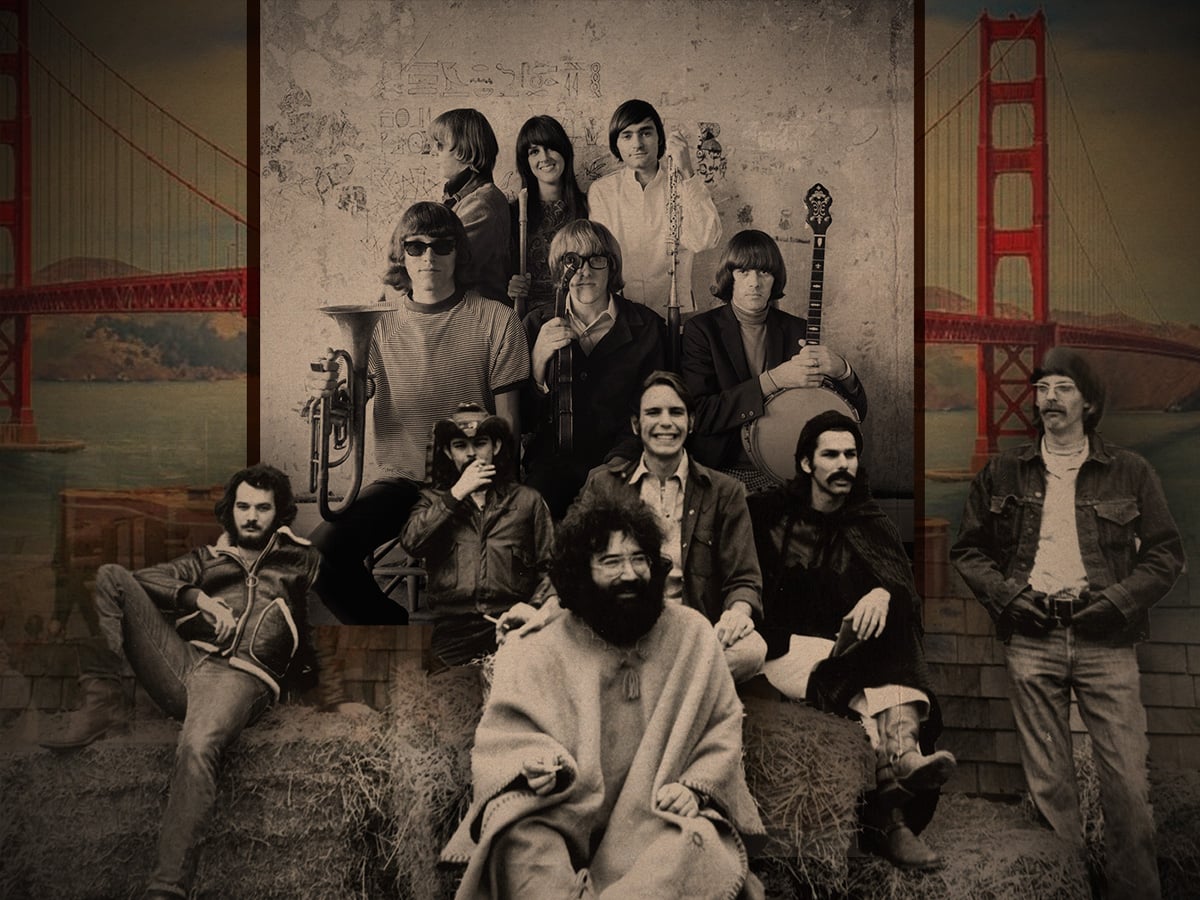
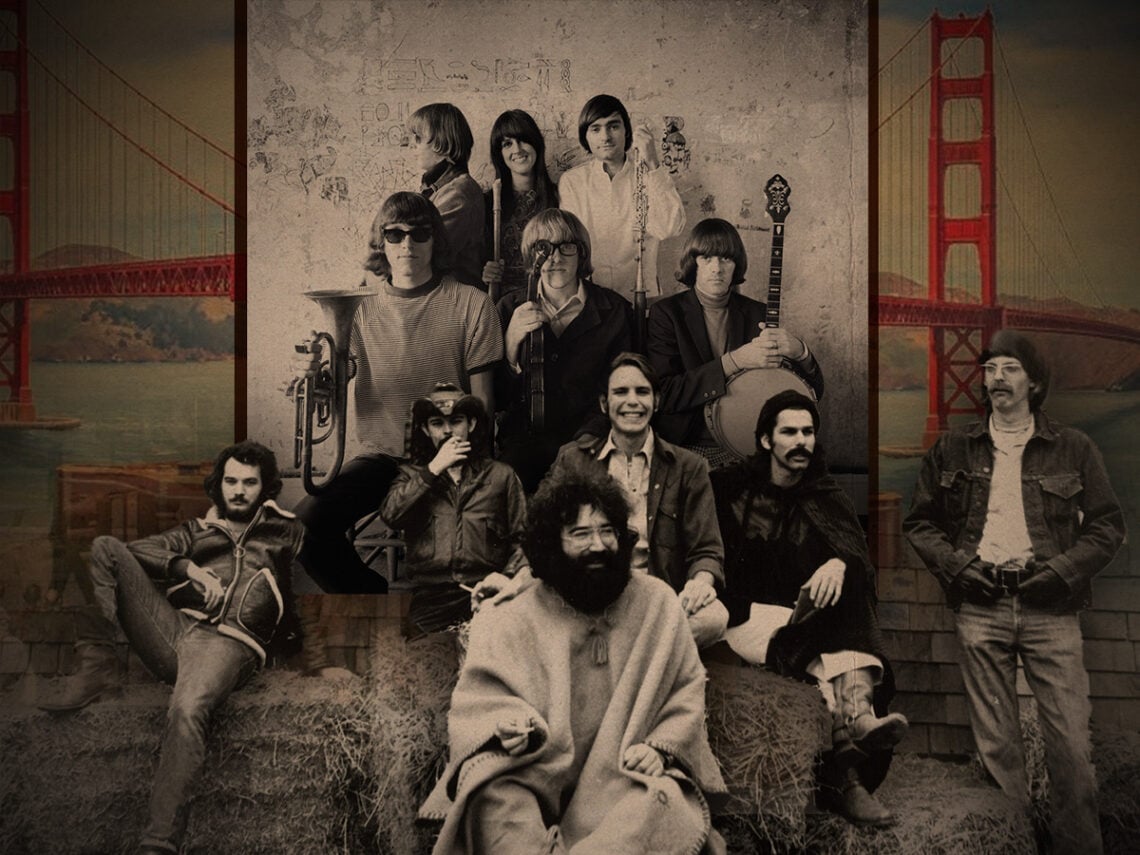
Credit: Far Out / Herb Greene / RCA Victor
Tue 18 August 2026 0:30, UK
“We would all like to be able to live an uncluttered life,” Jerry Garcia said during an impromptu press conference in 1967, “A simple life. A good life”.
A day earlier, the Grateful Dead had been busted by the cops for pot possession, with Bob Weir, Ron ‘Pigpen’ McKernan, and several members of the band’s management taken into custody. Garcia hadn’t been at their communal home at 710 Ashbury Street during the raid, but as a show of solidarity, he decided to invite the press there the next day to defend not merely the Dead’s recreational drug taking, but their entire worldview.
“What we’re thinking about is a peaceful planet,” he explained, “We’re not thinking about power. We’re not thinking about revolution or war or any of that… [We’re thinking] about moving the whole human race ahead a step.”
By most accounts, though, the San Francisco hippie dream that had culminated in the ‘Summer of Love’ earlier that year wasn’t based so much on progress, in the technological or political sense, but in a rejection of modernity in many ways.
Free love, psychedelics, Eastern philosophy, and the old-fashioned trading of goods and services, rather than a reliance on cash-based capitalism, were at the core of the movement, along with plenty of New Age mysticism about the Age of Aquarius. The Timothy Leary slogan of “turning on and dropping out” relied on a big presumption, however, that the young people of America would all adopt this new lifestyle for high-minded reasons, when in reality, even a lot of the poets, artists, and bands leading the scene were just young people with a typically selfish motivation to have fun.
 Credit: Far Out / AP News
“At the time we were all just kind of hanging out and doing what we did,” Jefferson Airplane singer Grace Slick told Life magazine in 2015, “making music, taking drugs, screwing each other, having a good time, because there is nothing quite as wonderful as being in your 20s in the ’60s. There was no Aids. Anything you got, a sexually transmitted disease, could be cured. I know because I got them. I went in the hospital for four days once, a bunch of IVs and stuff, and then you get out, and you’re OK.”
Slick first met the Grateful Dead in 1965 when she was still singing in her first San Francisco band, The Great Society. She was already 26 by this point, hardly a wide-eyed teenager, but she’d fully embraced the communal experiment of the San Francisco music scene, where a lot of the bands lived together and happily fraternised with one another, sharing instruments, food, drugs, beds, and partners.
“It was this kinda pleasant free-for-all for what we called ourselves: ‘freaks’,” Slick said, “You know, because we were freaks compared to the straight nation”.
Slick was recruited to become the new vocalist for the Jefferson Airplane in 1966, and after scoring big hits with ‘White Rabbit’ and ‘Somebody To Love’, the band invested in its own answer to the Grateful Dead’s house, collectively buying an old 17-bedroom mansion with massive Greek columns, located at 2400 Fulton Street across from Golden Gate Park. Incredibly, they would continue to own the place for the next 18 years, but it was the parties of the late ‘60s, frequented by everyone from the Dead to the Doors to Janis Joplin, that became the stuff of legend.
“The top floor of the Big House looked like a salon from a fancy turn-of-the-century house of ill repute,” Slick wrote in her 1998 memoir, Somebody to Love, “Lots of small rooms (for getting a quickie?) around a central area (which one of these girls would you like?) and one large bedroom (for the Madam?), where Paul [Kantner] took up residence. From Home of Tramps to [opera singer] Enrico Caruso’s residing there on the night of the big earthquake of 1906, the Big House had seen it all.”
Slick, who admitted to sleeping with all of her bandmates aside from Marty Balin, saw no need to draw any lines when it came to the movement of various drugs through the house, either. One local cocaine dealer, in fact, was allowed to take residence in the house’s basement, where he set up an ‘office’ to serve the band’s needs as both a handyman and mind-expander. This included the installation of two “jumbo-sized” nitrous oxide tanks.
“The members of the band would go down there from time to time and sit in a circle on the floor around the big blue metal totems,” Slick recalled, “while our road manager, John Scheer, adjusted the six-spigot contraption on the top that allowed a group of people to get high, all at the same time. The laughing gas made us dizzy enough to pass out, so staying on the floor was a less painful way of enjoying the experience.”
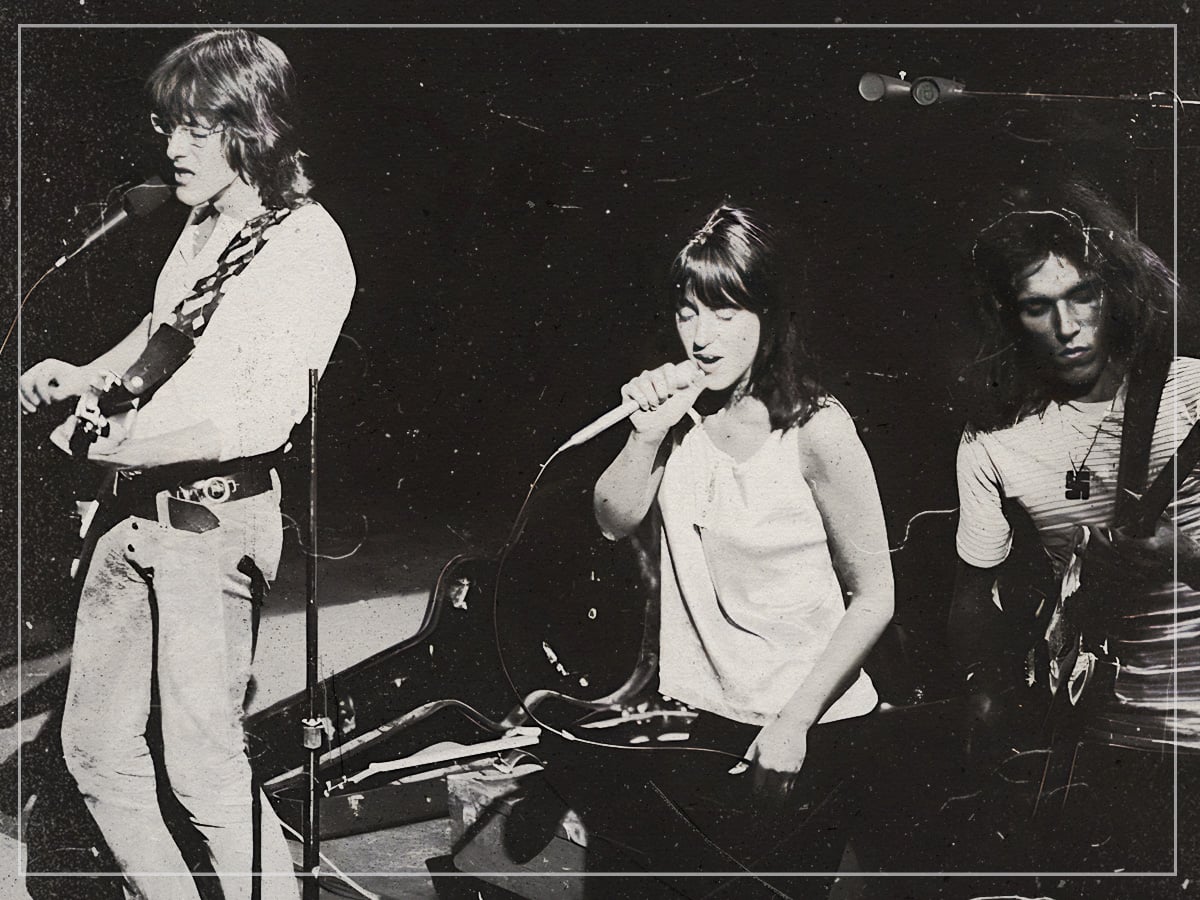 Credit: Far Out / Alamy
There were other, less classically hippie-ish ways to pass the time with their friends, including outdoor barbecues with the Dead and Quicksilver Messenger Service, in which the various musicians would take turns firing guns at nearby trees or wooden police barriers.
“We were deaf for about a week. So you know that’s really stupid, when you’re a musician, to deafen yourself”, Slick mused sagely. She also once pulled her gun on an unsuspecting David Crosby, who’d wandered into the Airplane house one night and was mistaken for an intruder. Fortunately, she recognised him just before nearly pulling the trigger.
There were plenty of contradictions in how the Airplane, the Dead, and the other successful San Francisco bands handled their fame; promoting a world of minimalism and naturalism while also living to extreme interpersonal and financial excess on a regular basis. More than 50 years later, though, the eventual failure of the Haight-Ashbury hippie dream is far less interesting to people than the elements that created it.
In the past century, arguably no other peaceful effort to fully rewire the values of Western society has managed to recruit as many young people as this movement did between 1967 and 1969, and it remains an interesting source of civic pride in San Francisco, despite the fact that the local press barely covered the Haight-Ashbury bands when they were actually making their mark.
As longtime San Francisco music critic Joel Selvin told SF Gate in 2023, “The [San Francisco] Chronicle, outside of [critic and Rolling Stone co-founder] Ralph Gleason, ignored the rock scene entirely. There are no photos, no coverage of anything. It was kids, you know, underground radio. It meant nothing to the mainstream media.”
