
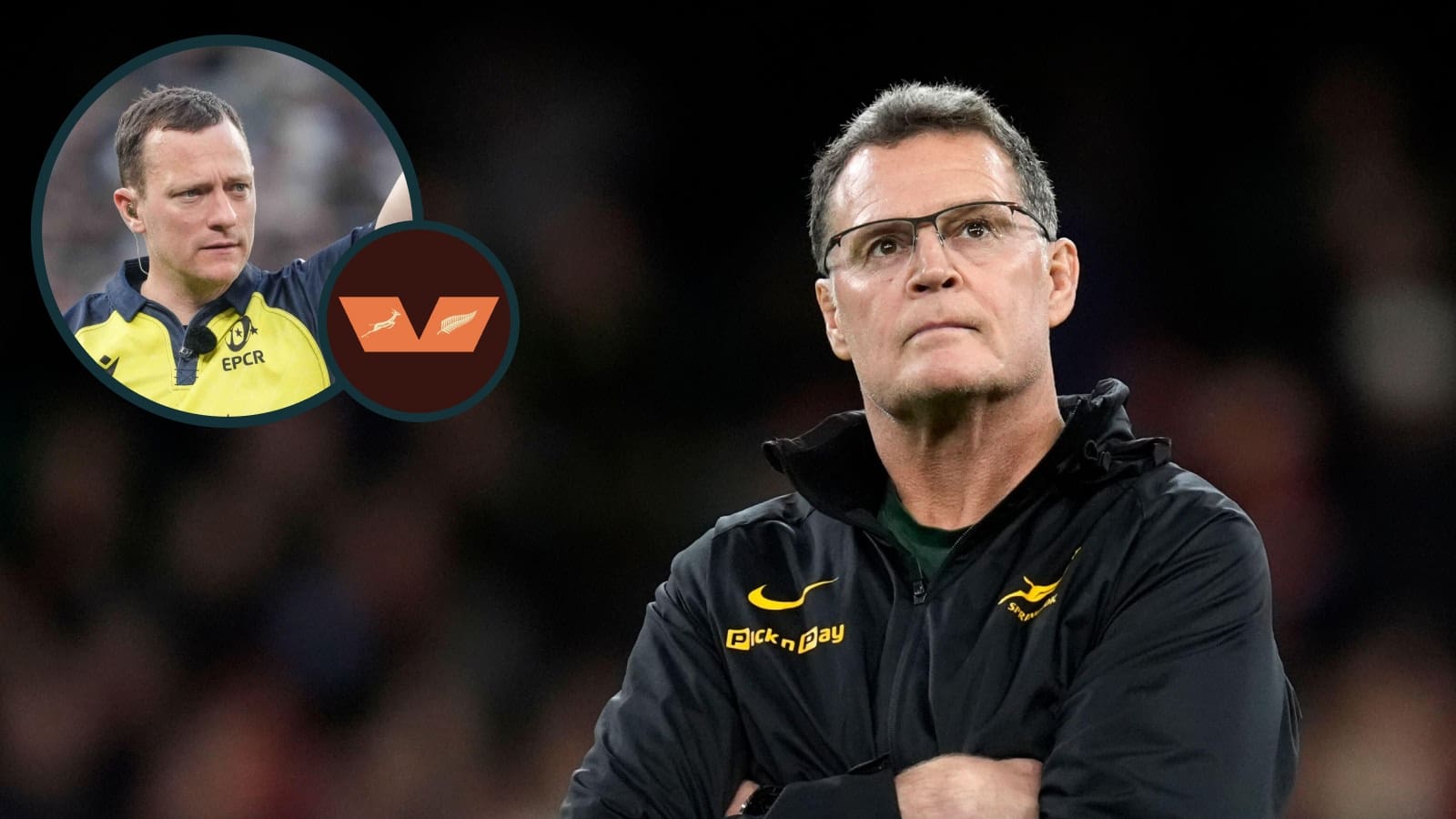
Rassie Erasmus says that coaches are frustrated by World Rugby’s decision over meetings with referees before Test matches.
Previously, coaches were allowed to schedule meetings with match officials before games in order to gain clarity around certain laws. They would take up this opportunity to warn the referee about some tactics that they would be using.
Erasmus will have done so when the Springboks debuted the midfield mauls last year. However, these meetings no longer take place in the same way, with World Rugby insisting that both head coaches must be present. This means that there cannot be an element of surprise as the opposition coach will obviously be alerted by the plans.
Rassie Erasmus on World Rugby’s decision to stop referee meetings
Speaking ahead of the opening Test match of Rugby’s Greatest Rivalry against the All Blacks, the Springboks boss revealed that he rejected the opportunity to have a meeting with the refereeing team.
“There’s definitely frustration among the coaches that you can’t have meetings with the referee if both teams don’t agree, and it’s now at a stage where you almost accept that both teams’ coaches aren’t always going to agree to a pre-match meeting,” he explained.
“I myself this week said no we don’t need one because it doesn’t help now, after they played four games, and now we wanted to sort out things in three training sessions.
“We had to look at what they put on AMS, and that’s a central system, and then sort of learn from what the answers are from World Rugby, and I don’t think it’s a tactic; it’s an obvious thing: if you want to get something out, you have to get it out here because you can’t really talk to the referee.
“Sometimes there are small things which you’d normally alert referees in meetings and say, ‘Listen, we might do a midfield maul; just be aware of that and know the law’. Now you can’t because you have to have the meeting with the other coach; you can’t say, ‘We might do a front peel in the lineout, maybe don’t stand there when we do the front peel because you might not see if it’s obstruction or not’.”
There is a gap now
Erasmus says that the removal of these meetings has created a ‘gap’ between the coaches and match officials, with the former now forced to express their views in the media instead of going directly to referees.
Dave Rennie and the All Blacks insisted they want to speed the game up, with the Springboks and other South African teams being accused of trying to slow the game down.
“So, I think teeing up the referees with things you want to do is very difficult, and I totally understand why the All Blacks voice some of their concerns. If they genuinely believe we slow down the game, they can’t say it’s a meeting with us being present and we are arguing with them,” he continued.
“It’s a very natural thing to do in the media now. I feel, and I know a lot of international coaches feel that way – it’s very clear what you must do and what you can’t do – it’s in place, and we understand that it’s there. I don’t understand why it’s like that, but I think there’s definitely a gap now between coaches, scrum coaches, and referees, and small tactical things – then you voice your opinion in the media. That’s the only option.”
Want more from Planet Rugby? Add us as a preferred source on Google to your favourites list for world-class coverage you can trust.
Jaco Peyper’s verdict
Erasmus was joined at the press conference by former referee Jaco Peyper, and he explained that the reasoning for SA Rugby laws advisor’s presence was to address the narrative of the Boks trying to slow the game down.
“My opinion is New Zealand has played four matches, and there’s certainly been a narrative out there which I think is very technical around the speed of the game, the slowing down of the game, and Jaco is better able to answer those questions because he helps us with all those technical things around laws and so on,” the head coach said.
Addressing the narrative, Peyper said, “I think the main thing is that over the five games that we’ve played, we’ve not had one piece of feedback that we slow down the game.
“Maybe New Zealand have played against teams who are in pre-season mode. It’s like playing those Super Rugby warm-ups in January; maybe there’s something there, but I mean we certainly haven’t got negative feedback around it.”