
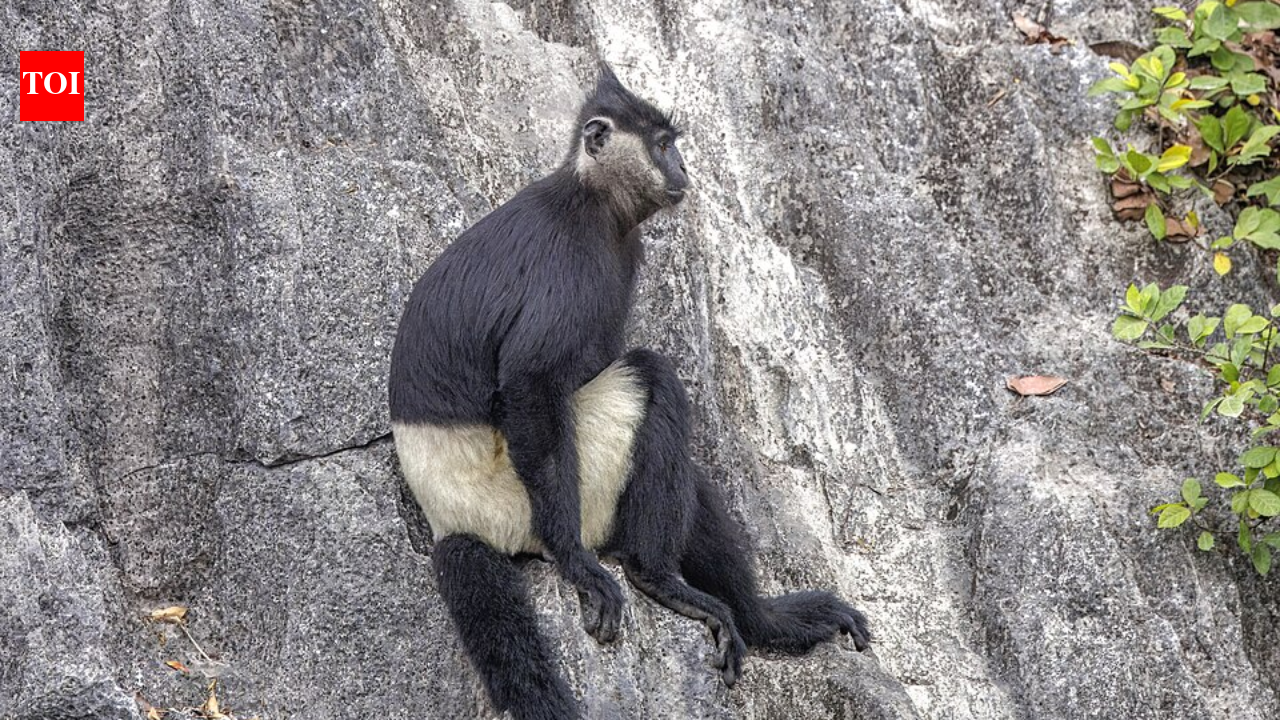
 A rare glimpse of family life among one of Vietnam’s most endangered monkeys has emerged from the limestone mountains of the country’s north. A family of Delacour’s langurs has been photographed at Van Long Nature Reserve, where an adult was captured beside a young infant while an adolescent moved across the rocky landscape nearby. The black-and-white primates live in small, scattered groups among the limestone karst forests of northern Vietnam, and their numbers have fallen sharply as hunting, quarrying and habitat loss have reduced the places where they can survive. Their distinctive appearance makes them recognisable, but seeing several generations together is far less common. The photograph, taken by Fauna & Flora’s Rob Small, offers a rare look at a species that now occupies only fragments of its former range. With conservation teams working alongside local communities to protect the remaining habitat, Van Long has become an important refuge for these elusive monkeys.
Delacour’s langur adaptations and life in Vietnam’s limestone habitat
As per the BBC, the Delacour’s langur is built for the unusual terrain it calls home. Its body is largely black, with a sharply contrasting area of white fur around the thighs, while a long, dark tail helps with balance as the animals move across rocks and between vegetation. They also have upright hair around the head and neck and prominent white whiskers on the cheeks. According to Earth.org, a Hong Kong-based environmental publication, young langurs are born with orange fur, which gradually becomes black at around four months before the adult pattern develops later.Van Long Nature Reserve is particularly important because its limestone landscape provides the cliffs, caves, forest and rocky surfaces the langurs use. The monkeys are mainly active during daylight and spend much of their time on the ground and among rock formations rather than high in the forest canopy. Earth.Org notes that troops can use particular caves repeatedly, with some shelters apparently remaining associated with the same groups over generations. The newly photographed family therefore represents more than an attractive wildlife encounter; it is a glimpse of a social group living within a very restricted habitat.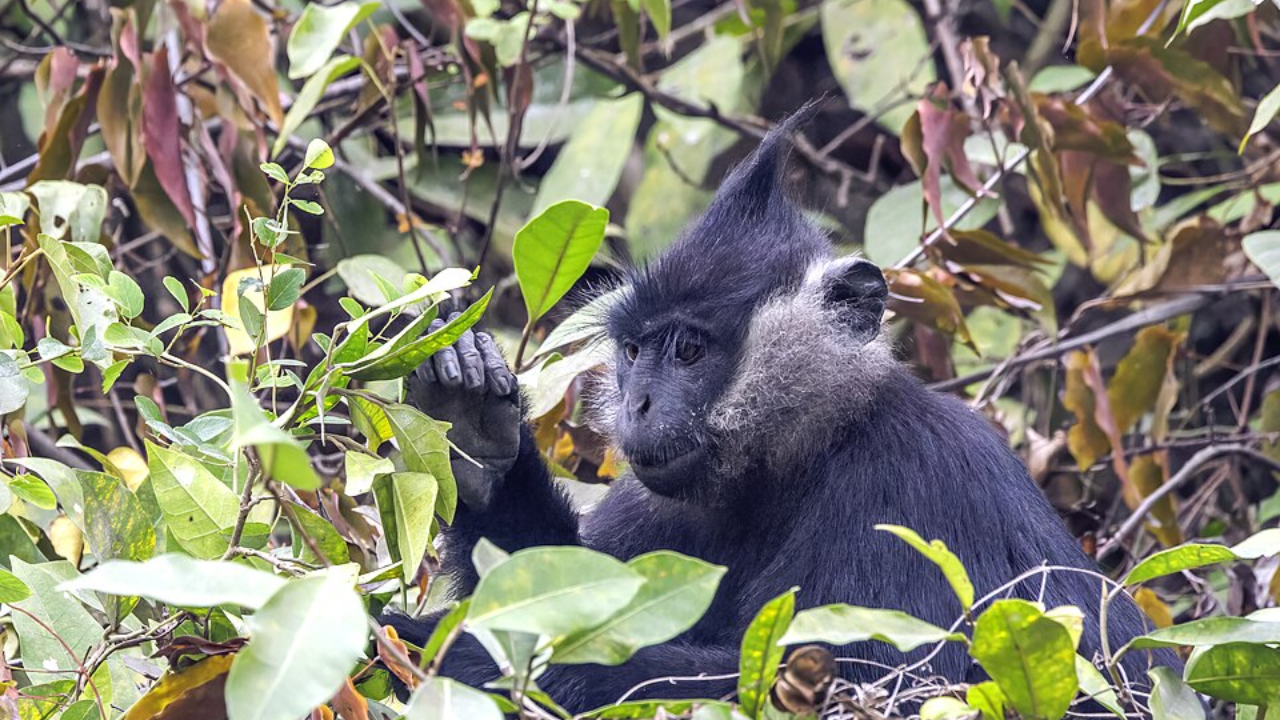
PC: Wikipedia
How many Delacour’s langurs are left in the wild
The exact population figure attached to Delacour’s langur varies between sources and surveys. Fauna & Flora’s conservation material describes a global population of around 200 individuals, with an estimate of 234 to 275. The figures reflect the difficulty of surveying small, fragmented groups spread across rugged limestone country rather than a species that is easy to count. Surveys between 2012 and 2015 estimated 234 to 275 individuals, with a large proportion found around Van Long. Their social groups are small as well.Troops typically contain about 10 animals, including an adult male, several females and younger monkeys. Historically, groups of around 30 were recorded, but those larger gatherings have become much less common as the species has declined. That makes a photograph showing an adult, infant and adolescent particularly useful as a record of a functioning family group in one of the species’ remaining strongholds.
Why limestone quarrying threatens Delacour’s langur habitat
Delacour’s langurs have suffered from the loss and fragmentation of their specialised habitat. The monkeys are closely tied to limestone karst forests, meaning that damage to these rocky landscapes can remove both feeding areas and places where the animals shelter. The species experienced a decline of more than 80 per cent over three decades, with poaching, habitat loss and fragmentation among the main pressures.Limestone quarrying presents a particularly difficult problem because the mountains themselves are the habitat. Quarrying for cement, construction materials and roads can remove sections of karst forest altogether, while also disturbing surrounding areas. The destruction of these landscapes can eliminate the small caves, forest patches and other microhabitats on which wildlife depends. Hunting and limestone quarrying are serious threats, and has been working with government authorities and local partners to reduce pressure on the remaining habitat.
Van Long Nature Reserve shows how conservation can help Delacour’s langurs recover
Van Long has become an important example of what sustained protection can achieve. The reserve’s langur population rose from roughly 50 animals to an estimated 176–184 over about two decades, helped by community protection efforts and measures aimed at reducing poaching. Local people were recruited into patrol work, while some former hunters found alternative roles linked to tourism and conservation. As per Fauna & Flora, conservation work includes supporting patrol teams that involve former hunters, while working with government bodies and other local partners to protect habitat and address the pressure created by quarrying. Fauna & Flora also discovered a separate population in Ninh Binh Province in 2016, a finding that highlighted the importance of protecting remaining fragments of limestone forest outside the main reserve. Surveys found 73 animals across 13 groups in that population.For the family photographed at Van Long, the immediate scene is simple: an adult, an infant and an adolescent negotiating the rocky landscape. But the wider picture is much harder. Delacour’s langurs survive in scattered pockets of northern Vietnam, and their future depends on keeping those pockets intact. The work now taking place around Van Long and other remaining habitats is aimed at giving those small groups enough protected space to persist, rather than allowing them to disappear one limestone forest at a time.