
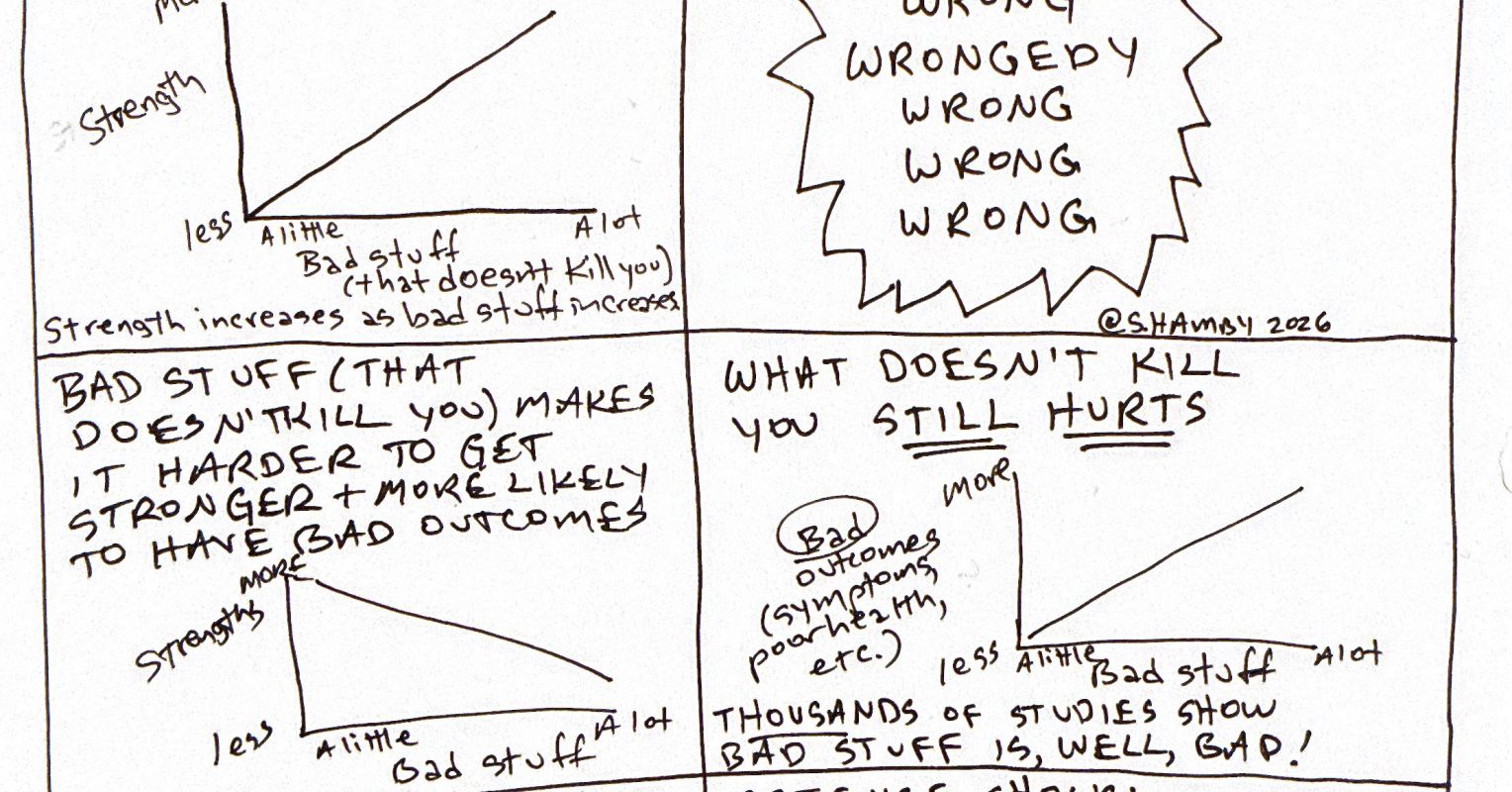
“What doesn’t kill you makes you stronger.” That was Friedrich Nietzsche’s idea, way back in his 1888 book Twilight of the Idols.
As someone who studies trauma and resilience, I hear this idea all the time, and people often repeat it to me as if it is fact.
But 1888 was a long time ago. Some readers of Psychology Today might know that was before psychology truly took off as a scientific discipline, which didn’t happen in earnest until the second half of the 20th century.
This was a data-free hypothesis. It’s been a sticky one, admittedly. Nietzsche’s idea fits in with the concepts of “rugged individualism” and the “self-made” person that are so popular among certain segments of society, especially in the capitalist countries of the global north.
If you think about it for even a second, as a scientific hypothesis, this idea starts to fall apart almost immediately. The more really bad things in your life (that stop short of killing you), the stronger you are? How would that even work? Studies support the exact opposite finding—the more bad stuff in your life, the harder it is to acquire strengths and the more likely you are to experience negative outcomes, from post-traumatic stress disorder to heart disease.
I wrote my first book for a general audience, Stronger Than You Think: Building Lifelong Resilience, to share the latest information on trauma and resilience. You can get stronger, but not from the traumatic experiences of your life. You get stronger by adding more good things to your life—even if you have experienced a lot of trauma—more meaning, more loving relationships, more connections with the natural world.
Now, I’m trying something new. I’ve started a series of resilience comics that share key ideas about what really helps people overcome trauma, get strong, and find pathways to good lives.
The idea behind the comics is to communicate important resilience ideas in smaller chunks that might be more appealing to younger people, visual learners, or others looking for short messages that counter some of the misinformation out there, even if the misinformation comes from famous 19th-century philosophers!
I hope you enjoy.