
Introduction
Today we are reviewing the AMD Ryzen 7 5800X3D 10th Anniversary Edition, a re-release of the processor that kicked off AMD’s 3D V-Cache dominance back in 2022. The original 5800X3D was the first desktop chip to include an extra 64 MB of additional L3 cache on top of the compute die, and it instantly became the fastest gaming CPU you could buy on Socket AM4. Four years later AMD is bringing it back—same 8-core Zen 3 silicon, same 96 MB of total L3 cache—but this time as a limited 10th Anniversary Edition and, more importantly, at a much lower price. Reviving the 5800X3D might look like AMD selling nostalgia, but it makes real sense given today’s market: with DDR5 prices up nearly 5x on the back of the AI-inferencing boom, DDR4 platforms are popular again, and a lot of gamers are still sitting on an AM4 board with memory.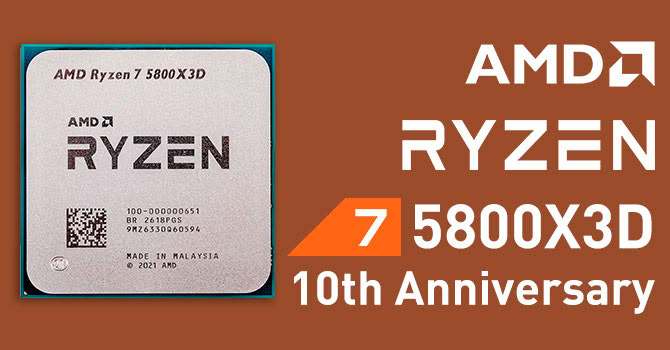
The headline change is price. The original 5800X3D launched at $450; the 10th Anniversary Edition has settled at just $340, which makes it a relatively affordable entry into X3D gaming on Socket AM4. Additionally, AMD includes a Carbice carbon-fiber thermal pad with the 10th Anniversary Edition—a dry, pad-style TIM that AMD is positioning as a cleaner, longer-lasting alternative to thermal paste. We’re always skeptical of such goodies, and especially when the claim is that it can handle the cache-stacked chip design well enough that AMD themselves chooses to bundle it. Several reports online talked about terrible temperatures, others about a long burn-in-time needed, so we’ll be putting it to the test, and run the pad through many heat-up and cool-down cycles later in this review.
Under the hood, nothing has changed from the 2022 part. AMD configured the Ryzen 7 5800X3D with a 3.40 GHz base frequency and a 4.50 GHz maximum boost. The 8-core/16-thread chip is built on the Zen 3 microarchitecture using TSMC’s 7 nm process, and carries 512 KB of L2 cache per core plus 96 MB of shared L3—32 MB on-die plus 64 MB on a stacked 3D V-Cache die, addressed as a single contiguous cache. TDP stays at 105 W, exactly like the original. In terms of I/O, you get a dual-channel DDR4 memory interface and 24 lanes of PCI-Express Gen 4, so no Gen 5 support.
The Ryzen 7 5800X3D drops into any Socket AM4 motherboard with a BIOS update, spanning everything from AMD 300-series to 500-series chipsets—AMD kept even its oldest boards on the support list, so almost anyone with an existing AM4 system has a drop-in path to the fastest gaming CPU the platform will ever get, without touching their memory, cooler, or motherboard. That upgrade case is the easy one to make. The harder question is whether buying into a dead-end DDR4 platform still makes any sense in 2026, when AM5 is the real path forward for everything that comes after this—that is exactly what we’ll try to untangle over the course of this review.
AMD Ryzen 7 5800X3D Market Segment Analysis PriceCores/
ThreadsBase
ClockMax.
BoostL3
CacheTDPArchitectureProcessSocketIntel Core i5Core i5-12400F$1706/122.5 GHz4.4 GHz18 MB65 WAlder Lake10 nmLGA 1700Core i5-13400F$2506+4/162.5/1.8 GHz4.6/3.3 GHz20 MB65 WRaptor Lake10 nmLGA 1700Core i5-12600K$3106+4/163.7/2.8 GHz4.9/3.6 GHz20 MB125 WAlder Lake10 nmLGA 1700Core i5-13600K$3206+8/203.5/2.6 GHz5.1/3.9 GHz24 MB125 WRaptor Lake10 nmLGA 1700Core i5-14600K$2506+8/203.5/2.6 GHz5.3/4.0 GHz24 MB125 WRaptor Lake10 nmLGA 1700Intel Core Ultra 5Core Ultra 5 245K$1806+8/144.2/3.6 GHz5.2/4.6 GHz24 MB159 WArrow Lake3 nmLGA 1851Core Ultra 5 250K Plus$2206+12/184.2/3.3 GHz5.3/4.6 GHz30 MB159 WArrow Lake Plus3 nmLGA 1851AMD Ryzen 5Ryzen 5 8500G$1506/123.5 GHz5.0 GHz16 MB65 WPhoenix 24 nmAM5Ryzen 5 5600X$1806/123.7 GHz4.6 GHz32 MB65 WZen 37 nmAM4Ryzen 5 5600$1506/123.5 GHz4.4 GHz32 MB65 WZen 37 nmAM4Ryzen 5 7600$2106/123.8 GHz5.1 GHz32 MB65 WZen 45 nmAM5Ryzen 5 7600X$1706/124.7 GHz5.3 GHz32 MB105 WZen 45 nmAM5Ryzen 5 9600X$1806/123.9 GHz5.4 GHz32 MB65 WZen 54 nmAM5Intel Core i7Core i7-12700K$3408+4/203.6/2.7 GHz5.0/3.8 GHz25 MB125 WAlder Lake10 nmLGA 1700Core i7-14700K$3808+12/283.4/2.5 GHz5.6/4.3 GHz33 MB125 WRaptor Lake10 nmLGA 1700Intel Core Ultra 7Core Ultra 7 265K$3008+12/203.9/3.3 GHz5.5/4.6 GHz30 MB250 WArrow Lake3 nmLGA 1851Core Ultra 7 270K Plus$3108+16/243.7/3.2 GHz5.5/4.7 GHz36 MB250 WArrow Lake Plus3 nmLGA 1851AMD Ryzen 7Ryzen 7 3800X$1008/163.9 GHz4.5 GHz32 MB105 WZen 27 nmAM4Ryzen 7 5700G$2108/163.8 GHz4.6 GHz16 MB65 WZen 3 + Vega7 nmAM4Ryzen 7 5700X$2208/163.4 GHz4.6 GHz32 MB65 WZen 37 nmAM4Ryzen 7 7700$2808/163.8 GHz5.3 GHz32 MB65 WZen 45 nmAM5Ryzen 7 7700X$2408/164.5 GHz5.4 GHz32 MB105 WZen 45 nmAM5Ryzen 7 9700X$3108/163.8 GHz5.5 GHz32 MB65 WZen 54 nmAM5Ryzen 7 5800X$2208/163.8 GHz4.7 GHz32 MB105 WZen 37 nmAM4Ryzen 7 5800X3D$3408/163.4 GHz4.5 GHz96 MB105 WZen 37 nmAM4Ryzen 7 7700X3D$3308/164.0 GHz4.5 GHz96 MB120 WZen 45 nmAM5Ryzen 7 7800X3D$3508/164.2 GHz5.0 GHz96 MB120 WZen 45 nmAM5Ryzen 7 9800X3D$4508/164.7 GHz5.2 GHz96 MB120 WZen 54 nmAM5Ryzen 7 9850X3D$4908/164.7 GHz5.6 GHz96 MB120 WZen 54 nmAM5Intel Core i9Core i9-12900K$4308+8/243.2/2.4 GHz5.2/3.9 GHz30 MB125 WAlder Lake10 nmLGA 1700Core i9-13900K$6108+16/323.0/2.2 GHz5.8/4.3 GHz36 MB125 WRaptor Lake10 nmLGA 1700Core i9-14900K$4708+16/323.2/2.4 GHz6.0/4.4 GHz36 MB125 WRaptor Lake10 nmLGA 1700Intel Core Ultra 9Core Ultra 9 285K$5008+16/243.7/3.2 GHz5.7/4.6 GHz36 MB250 WArrow Lake3 nmLGA 1851AMD Ryzen 9Ryzen 9 5900X$28012/243.7 GHz4.8 GHz64 MB105 WZen 37 nmAM4Ryzen 9 7900$43012/243.7 GHz5.4 GHz64 MB65 WZen 45 nmAM5Ryzen 9 7900X$32012/244.7 GHz5.6 GHz64 MB170 WZen 45 nmAM5Ryzen 9 7900X3D$70012/244.4 GHz5.6 GHz128 MB120 WZen 45 nmAM5Ryzen 9 9900X$33012/244.4 GHz5.6 GHz64 MB120 WZen 54 nmAM5Ryzen 9 5950X$43016/323.4 GHz4.9 GHz64 MB105 WZen 37 nmAM4Ryzen 9 7950X$51016/324.5 GHz5.7 GHz64 MB170 WZen 45 nmAM5Ryzen 9 7950X3D$70016/324.2 GHz5.7 GHz128 MB120 WZen 45 nmAM5Ryzen 9 9950X$51016/324.3 GHz5.7 GHz64 MB170 WZen 54 nmAM5Ryzen 9 9950X3D$67016/324.3 GHz5.7 GHz128 MB170 WZen 54 nmAM5Ryzen 9 9950X3D2$90016/324.3 GHz5.6 GHz192 MB200 WZen 54 nmAM5