
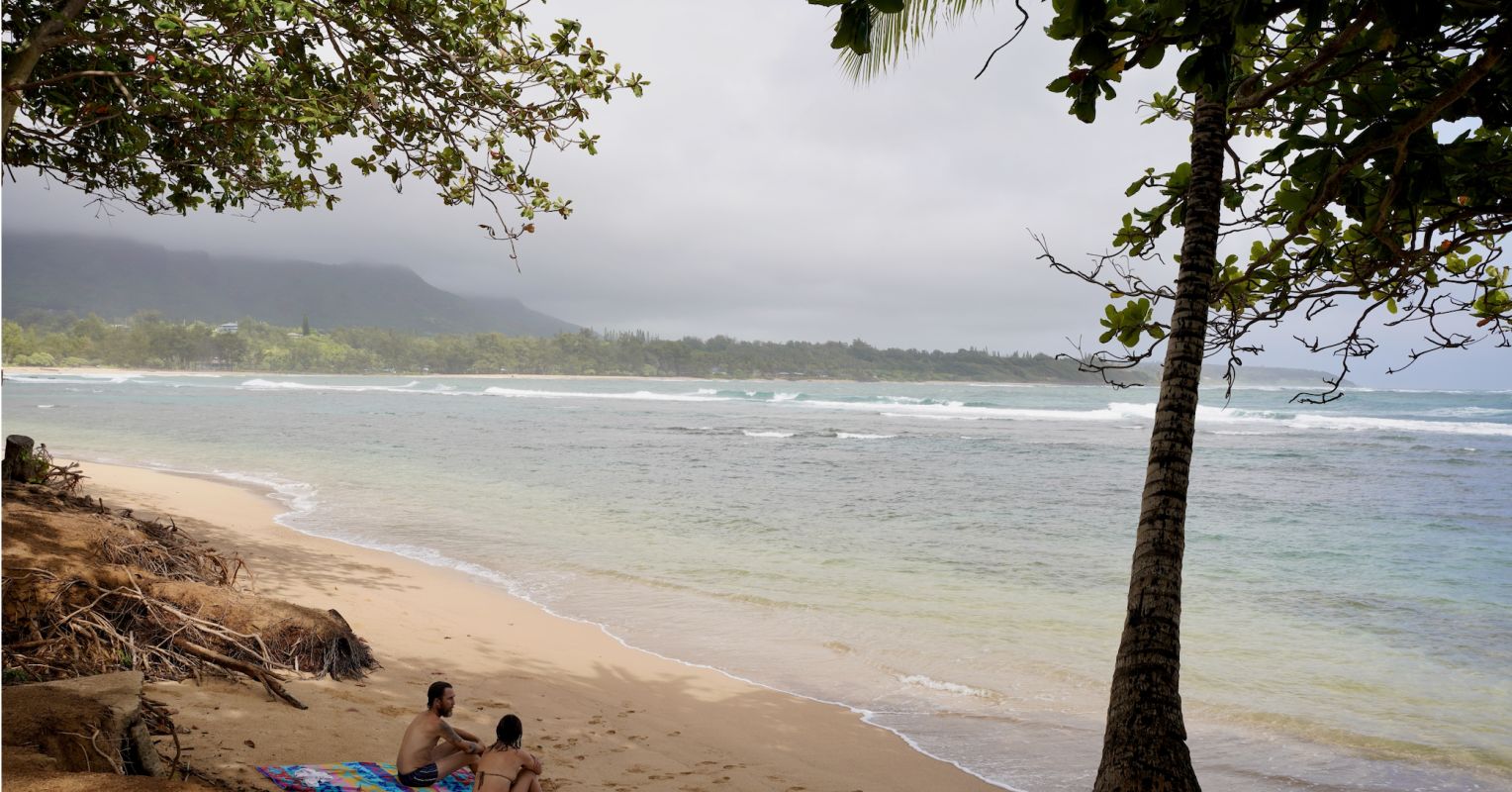
I recently had the opportunity to visit Kauai to meet my father-in-law’s side of the family. Except for him and his sister, everyone else stayed on the island after high school. He’s a third-generation Japanese American whose family’s lineage dates back to his grandparents’ immigration from Okinawa to Hawaii to work on the sugar plantations.
Kauai during his childhood was much different than it is today. There was limited tourism. The beaches were rugged. There were no lifeguards, so you swam at your own risk. People lived off the land and sea. His brother loved the ocean and was an avid fisherman, bringing home fish to feed the family. They even captured turtles for food, long before turtles became an endangered species.
They grew up poor in Kapa‘a, about 10 miles north of Lihue Airport. They walked everywhere barefoot, even to school. Life was hard, and the family knew little beyond the manual labor of working on the sugar plantations for low wages.
There was also a complicated racial and class hierarchy in Hawaii. “Haole,” a Hawaiian word for foreigner, was commonly used to describe white people or those of European descent. White people generally occupied the highest levels of the social and economic order, while Portuguese immigrants often occupied an intermediary position between white elites and the largely Asian and Native Hawaiian plantation workforce. This hierarchy was closely tied to the plantation economy and its reliance on immigrant labor.
But the hierarchy didn’t stop there. Within the Japanese community, Okinawans were often viewed as being of a lower social class than mainland Japanese in Hawaii since Okinawa was annexed by Japan in 1879. The prejudice toward Okinawans was palpable and followed them to Hawaii when they arrived as contract laborers.
Over the years, much of that animosity subsided as the various plantation communities developed a shared working-class identity that also included Native Hawaiians. Despite their differences, there was a sense of generational investment in the local communities. These families fought for labor rights, put down roots, and stayed to raise generations of families.
Today, some of that tension has shifted toward mass tourism, or what is increasingly called overtourism. The issue isn’t simply that people visit Hawaii. It’s what happens when a place becomes something to be consumed and exploited. Housing that once served local residents can become investment properties. As short-term rentals take hold, neighborhoods can become fragmented and housing less affordable for the people who actually live there.
Quite frankly, I’ve never had to think much about these issues while traveling. But seeing my father-in-law’s modest home, the same home he grew up in and where his two younger brothers still live, made it different. Visiting the local landmarks where he attended elementary and high school made the history feel tangible.
Kauai suddenly wasn’t just a beautiful vacation destination where I could frolic on the beach, get a tan, and drink a few mai tais. It was someone’s home. It was my father-in-law’s home. And that impacted the way I looked at the island. It also made me think about something much bigger than tourism.
Perhaps part of the problem is psychological. We live in a culture that teaches us to maximize profit. How to make more money, more investments, more “passive income.” When something has value, our capitalistic instinct is, “How can I make money from this?” rather than, “Should I?”
Having the money and means to profit from something doesn’t necessarily mean we should do it. Keep in mind, this isn’t an argument against making money or owning property. It’s a question about what happens when the pursuit of financial gain becomes so normalized that we stop considering the human cost.
Homes become investment income so much so that the land is viewed as a commercial commodity first and foremost, with limited thought to the impact on the surrounding community, where paradise becomes a product. We should question our consumeristic and capitalistic mindset that can turn places into something to be bought and sold. Just because something can be turned into a profit doesn’t mean it has to be. Just because we have the financial freedom to turn homes into short-term rentals doesn’t mean we have to.
Can our experiences be enough instead of making paradise a product for our own gain? Can we be content to go countercultural, even when it means passing up financial gain, so others can afford to live, maintain their communities, and have a place they call home?
Maybe that is part of what it means to travel with respect and humility to the local culture and environment. For us to remember that the place we are visiting existed before we arrived and will hopefully continue long after we leave. Paradise may be something we experience, but we also need to keep in mind it’s someone else’s home.