
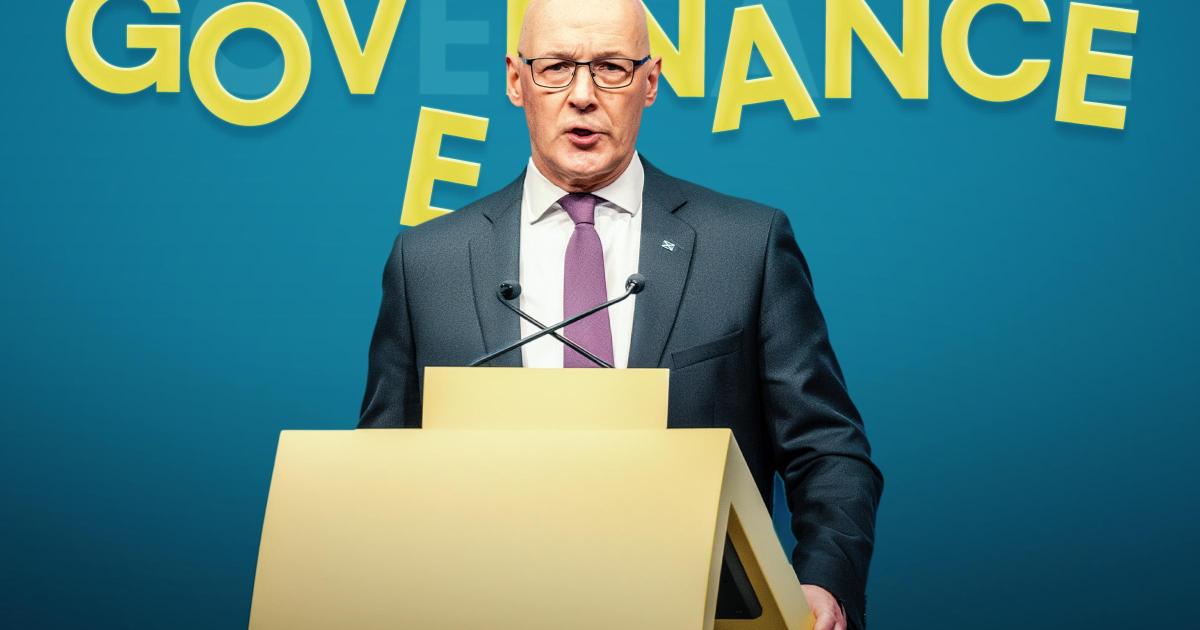
“You cannot put bad governance and the proper use of public money in the same box,” Sir Ewan told The Herald on Sunday. “They just do not exist together.”
Gvrnnc Disemvowelled: Why do Politicians and Public Officials Only Pay Lip Service to Good Governance?, the new book by the 88-year-old who has served on the boards of listed and private companies, universities and charities is, he admits, about “trying to get something off my chest”.
“But there is so much hard evidence here that I’m surprised others haven’t taken it up,” he adds.
Gvrnnc Disembowelled is a follow up to Sir Ewan Brown’s 2022 book Corporate Ego
The book is a follow-up to the business leader’s Corporate Ego, his 2022 study about the fall from grace of Scottish companies including HBOS, RBS, Johnston Press and Standard Life.
“I’d written this earlier book on the private sector, on companies that had failed,” Sir Ewan explains, “and it was really people coming back to me after that saying, if you think governance is bad in the private sector, have a look at the public sector.”
The new book catalogues failures across a wide range of Scottish institutions, including the Water Industry Commission for Scotland, Ferguson Marine, CalMac, Historic Environment Scotland and the University of Dundee.
Sir Ewan argues that despite different circumstances, many of the cases share common themes including weak scrutiny, lack of challenge, blurred accountability, poor financial oversight and cultures that discourage whistleblowing.
Governance, he says, is “a word that people just don’t want to discuss”. But failures in oversight ultimately have direct consequences for public services and public finances.
“It’s the fact that I sit there as a taxpayer saying, if we’re living with bad governance over all these areas, it almost inevitably leads to misuse of public money,” he says.
Good governance, he argues, saves money. Sir Ewan wrote directly to Ivan McKee when he was appointed Cabinet Secretary for Public Sector Reform, pointing out that a 5% saving across Scotland’s 22 health boards would free £1 billion to invest in social care. He never received a reply.
In the book, it is the governance of NHS Scotland that the former director of Noble Grossart and ex-chairman of Scottish Financial Enterprise focuses his sharpest criticism.
He argues that the country’s largest public institution is overseen by weak regional boards that are routinely micromanaged and second-guessed by ministers while shielded from genuine accountability.
At the heart of the book, and in many ways the catalyst for writing it, is the announcement in November 2022 by then health secretary Humza Yousaf that NHS Forth Valley was to be placed in special measures following failures of leadership, governance and culture.
“Here’s the person who’s the minister responsible for health, acknowledging that one of his health boards really should just have been wiped out. That was an appalling thing to have to stand up and say. But equally, there were no resignations.”
NHS Scotland has a chief exec and a logo (Image: PA)
What followed, he says, was a familiar pattern. The Scottish Government stepped in for a period, consultants were brought in, business plans were revised and, ultimately, nothing changed.
“I thought this cannot be right. And then I started to look at the other health boards, and I particularly looked at the composition of the boards themselves.”
What he found troubled him. In the book, he writes that “public bodies focus on getting what looks like the right board or structure optically” even if that means it ends up “being sub-optimal operationally”.
NHS Forth Valley’s board, as he noted in a sharp email exchange with a Scottish Government official reproduced in the book, included “an ex-journalist, a trade unionist, two local councillors, a whistleblower, an ex-police officer, and a local pharmacist”.
Yet on a body tasked with overseeing an annual budget of more than £600 million, there was no one with direct business experience, or a background in managing large-scale budgets, or professional financial and risk-management expertise.
“Rather than prioritising strong and effective boards and installing good governance across the public sector, the Scottish Government has tended to bow to moving chairs and non-executive directors from one quango to the next, flirting with patronage and addressing what it misguidedly believed was a democratic deficit,” he writes.
NHS Scotland itself, he points out, has had a chief executive since 1991, and yet the organisation “doesn’t actually exist other than as a logo”.
And still, the chief executive has a dual role, acting as director-general for health and social care, which, Sir Ewan argues, blurs civil service loyalty to ministers with independent operational leadership.
He says that this “dysfunctionality at the very top” filters down through NHS Scotland’s 14 regional boards, eight special boards and 31 health and social care partnerships.
His warnings echo comments made by outgoing BMA Scotland chair Dr Iain Kennedy, who told The Herald last week that health boards remain preoccupied with “keeping the Scottish Government sweet” and protecting their own reputations ahead of patient safety and clinician welfare.
Michael Matheson (Image: PA)
The book also reveals that following a meeting on August 2, 2023, then health secretary Michael Matheson invited Sir Ewan to help prepare a report on NHS governance.
However, the collaboration abruptly collapsed just two months later when Sir Ewan discovered that the chair of NHS Greater Glasgow and Clyde had been brought in to assist a Scottish Government review into governance arrangements at NHS Forth Valley.
Sir Ewan was deeply alarmed, having already strongly criticised the Glasgow chair’s role in fronting the government’s official Blueprint for Good Governance as a clear conflict of interest.
When a senior NHS executive confirmed the appointment on October 6, 2023, Sir Ewan immediately withdrew from the project, branding the appointment in a blunt parting email to both Mr Matheson and the Permanent Secretary as “simply bad governance”.
The book catalogues governance failures at NHS Forth Valley, NHS Ayrshire and Arran, NHS Grampian, NHS Tayside and NHS Greater Glasgow and Clyde where a corporate homicide probe is under way following infection-linked deaths at the Queen Elizabeth University Hospital.
Sir Ewan points out that in every case, no board chair or non-executive member resigned or was removed.
He draws a comparison with two of the most notorious private sector scandals of recent times, the Post Office Horizon scandal and the collapse of construction giant Carillion, arguing the NHS boards he examined displayed some of the same characteristics including passive non-executives, a lack of challenge to management, and a reluctance to look critically at internal assurances.
What compounds these boardroom failings in the public sector, Sir Ewan argues, is that because politicians focus mainly on winning the next election, they put politics ahead of good management generally.
So when problems arise, government bodies naturally try to cover them up and control the headlines instead of honestly looking into what went wrong.
That culture of secrecy and stifled internal challenge, he argues, reached its zenith inside the machinery of the governing party itself, with Peter Murrell‘s embezzlement of more than £400,000 from SNP funds during his time as chief executive.
“When control is so all-embracing that it can keep at bay potential whistleblowers, the doubts and concerns of colleagues and the searching enquiries of auditors, a devious manipulator with sole access to the books can and does render governance totally ineffective,” he writes.
Peter Murrell was sentenced to five years and three months in prison after pleading guilty to embezzling £400,310.65 (Image: Jane Barlow/PA Wire)
Sir Ewan makes a number of recommendations in the book, including establishing NHS Scotland as a standalone public body run by an independent chair and a chief executive recruited from outside the civil service.
He argues that Scotland’s 14 regional health boards should be consolidated into a maximum of four, with total board membership capped at 15.
Across the wider public sector, Sir Ewan calls for all political parties to openly admit that the prevailing standards of governance are unacceptable.
He recommends bringing in external facilitators every two years to review board performance directly for cabinet secretaries, empowering chairs to hire and fire chief executives, moving non-executive remuneration from daily attendance rates to fixed annual fees, and overhauling whistleblowing systems to give staff direct, anonymous access to audit committees without fear of retribution.
“This cannot be solved by one political party in one five-year government — I’m realistic there. It’s simply too complex and too large,” Sir Ewan said. “But if all the political parties could at least acknowledge that the system is broken, and that these examples of bad governance are unacceptable, that would be a starting point.”
Sir Ewan plans to post 150 copies of Gvrnnc Disemvowelled to politicians, officials and public figures on Monday in the hope of forcing a cross-party reckoning with what he calls a “serial affliction” at the heart of how public money is overseen in Scotland.
“There’s a lot at stake here,” he says. “If I could start a conversation, I’d be thrilled to bits.”