
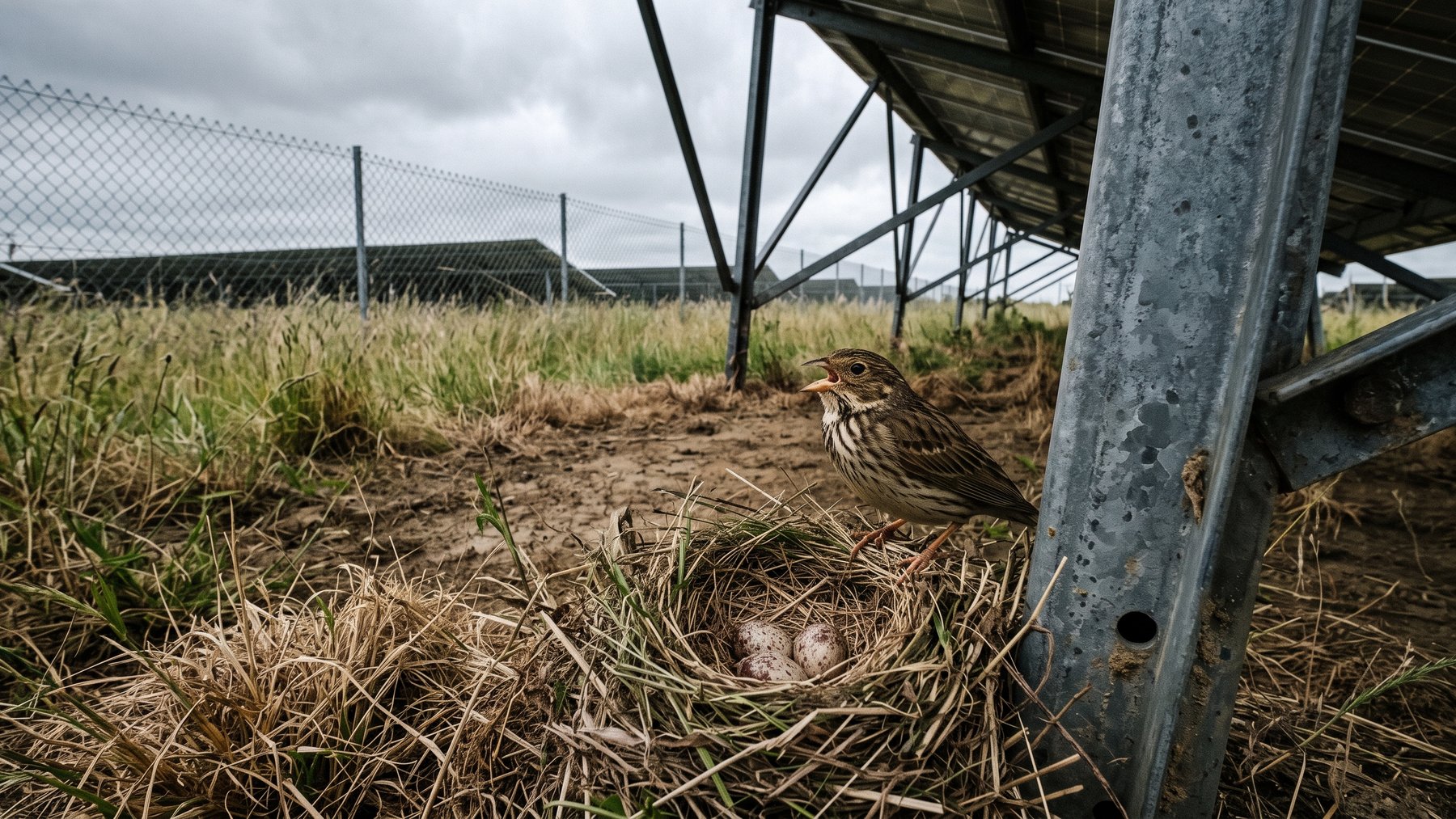
From the road, the array near Watchfield in Oxfordshire looks like any other, rows of dark panels on low frames with grass between.
Down in that grass, something was happening that no one had documented on a British solar site before.
A small, streaky brown bird was raising chicks under the panels.
And it was thriving there far better than its neighbors out in the open fields.
Every nest the researchers found inside the array raised its young. On the fields around it, a stubborn share came to nothing.
What is different on the other side of that fence?
What the fence and the panels are doing
A corn bunting builds its nest on the ground, tucked in a clump of grass and open to anything that walks or flies by. On ordinary farmland a fox, a stoat or a crow finds it quickly, the central problem for a bird once among England’s most familiar field sounds.
Inside the array the odds shift.
The security fence built to protect wiring also keeps out much of the ground predator traffic, the panels throw overhead cover, and the untidy grass holds insects and seed that intensive fields nearby have lost, so a ground nest gets a far better chance.
That much is inference, not proof. The researchers are careful to call it a reasonable read of what they saw rather than a mechanism anyone has tested directly, since no one has run the experiment that would isolate the cause.
Related
The bird that nearly left English farms
The corn bunting was common across Britain within living memory. It feeds on the ground, lives on seeds and insects, and needs rough, unmown grassland right through spring and summer to breed.
Modern farming took most of that away.
Tight mowing schedules and thinner insect populations stripped out the tall, messy cover the bird depends on, and it vanished from field after field onto the conservation red list. One of its last strongholds sits inside a community owned solar plant.
That is the surprise the study records. The work at Westmill is the first published evidence of any ground nesting farmland bird raising young on a UK solar park, which is why a handful of corn buntings in the grass drew scientific attention.
How a small power site became a refuge
Westmill was never meant to be a bird reserve. Its 5 megawatt array covers about 30 acres near Watchfield on the Wiltshire and Oxfordshire border and has run since 2011, one of the first community owned solar parks in Britain.
The management is what matters.
After construction the ground between the panels was seeded with a local meadow mix, and grazing is timed so that nesting birds are not disturbed in spring and the flowers that feed insects are not cropped before they bloom. The result is tall, mixed grass standing right through the breeding season.
Researchers from Lancaster University, with volunteers from a local farmland bird group, wrote the findings up in the journal British Birds. They recorded five nests inside the park between 2019 and 2023, every one successful, against 36 nests within about half a mile of the fence, where only 60 percent got young away.
Why this matters beyond one field
The honest caveat is the authors’ own.
Related
Westmill is the only solar park in the country where a study of ground nesting farmland birds has been published, and it differs from most sites in its seeded layout and light touch management, much as an unusual field edge changes what a fox does around a run of solar panels.
A tightly packed array mown to the dirt would not repeat it.
Still, the backdrop gives the result weight. UK farmland bird abundance has fallen about 62 percent since 1970, so any land use that could hold nesting habitat rather than erase it is worth a hard look, and solar sites elsewhere have begun turning up nesting birds under their panels, a pattern industry groups have begun to document as they draft new guidance for the sector.
What the corn bunting will need next
The lesson is management anyone could copy. Keep the grass long through spring, keep ground predators out and leave the panels over the nests, and a failing farmland bird suddenly has somewhere that works.
Most of that cuts against the usual playbook.
Standard practice on solar sites tends to favor short, tidy grass kept uniform year round, the opposite of the shaggy cover these birds need, so copying Westmill would mean letting a site look untended, much as some habitats thrive around an offshore wind array left alone, as coverage of the study has laid out.
The authors are careful about what five nests can prove.
The sample is small, the site unusual, and the cause still a suggestion rather than settled fact, drawn from four of the park’s five breeding seasons. Even so, under those panels a red listed bird is simply doing what it always did, and for once the power station is the safest field it has.
Read the whole thing?
Get the week’s signal, not the noise
Our sharpest reporting on energy, climate and nature — free, once a week.