
The timing was perfect. Dr Ewan Gibbs from Glasgow University is one of Scotland’s leading experts on energy. We met on the day the public consultation over new North Sea drilling closed.
Andy Burnham faces a big decision. Whatever call he makes will be politically divisive.
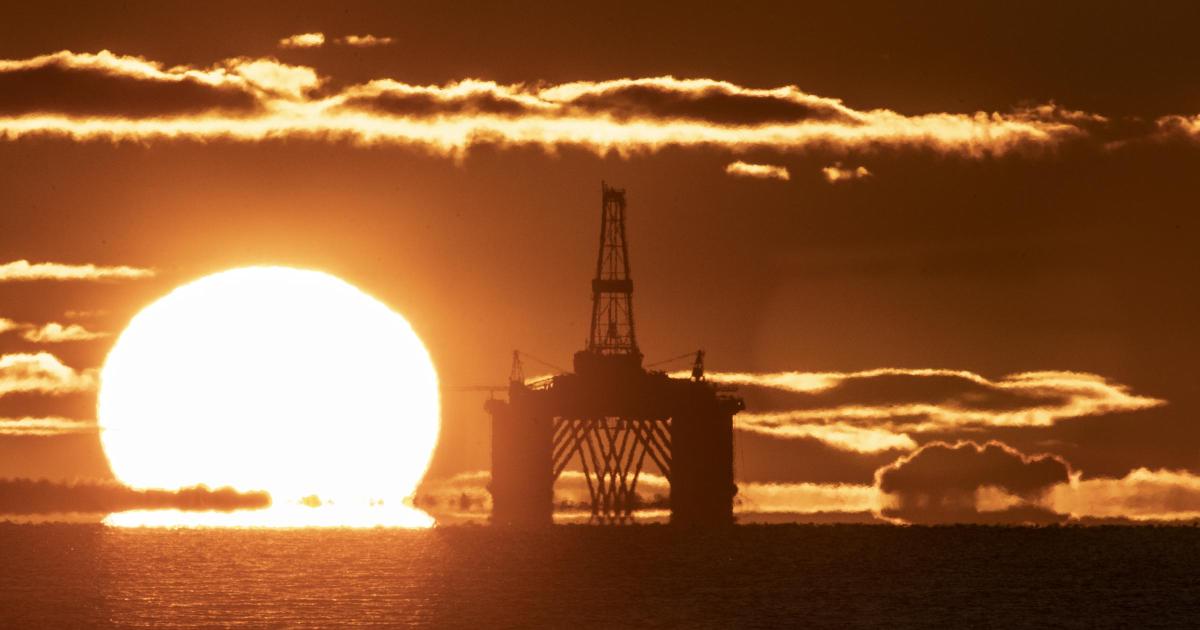
The issue centres on the Rosebank and Jackdaw oilfields.
So we get right to the point: will more drilling save people money on their bills?
“The simple answer is no,” says Gibbs. North Sea oil is “overwhelmingly exported, 80% is sold on the world market”.
Gas prices are set internationally. Gas, says Gibbs, is “the key swing fuel”. When it comes to electricity, gas “determines the overall cost”.
We’ve seen “volatility in gas prices” through events like Russia invading Ukraine. “Gas prices are subject to market forces.”
Dr Ewan Gibbs from Glasgow University (Image: Robert Perry)
Britain’s oil and gas industry is privatised. The state doesn’t “own the major gas burners in the power station sector”. Additionally, Britain “got rid of our gas storage facility about 10 years ago – which was a big mistake”.
Gibbs adds: “Oil and gas is part of a world market in hydrocarbons. The idea that we can expect energy security from the oil and gas sector as it’s currently set up isn’t a go-er. I’d go so far as saying our continued reliance on oil and gas is a clear cause of energy insecurity for Scots.”
He adds: “Higher prices are being fuelled by our continued dependence on oil and gas.”
Energy insecurity means both higher prices and “volatility around supply”. The Iran war “created potential shortage concerns about Britain’s access to jet fuel. So it’s not just about access to oil – it’s also access to products made through refining.
“This isn’t helped by the fact we have only four major refineries left. Grangemouth was allowed to close. Scotland doesn’t have any refineries.”
Britain has “an inbuilt dependency on gas”, especially as most homes use gas boilers.
So, if more drilling won’t reduce bills why is Burnham even thinking about it? Until early 2022, Gibbs explains, both the British and Scottish governments “wanted to be seen as leading advocates” of decarbonisation. There was cross-party support, including from Boris Johnson’s government.
However, the Ukraine war panicked politicians.
“The argument became: we have these fields domestically, we should be burning them.”
Lobbyists
THAT political pivot echoed the 1970s, a time of “war in the Middle East, inflation and worries about Britain’s economy”.
Gibbs adds: “North Sea oil and gas was seen then as a major part of the solution. Oil and gas were politically safe in a volatile world. In the 2020s, that perspective has been resurrected.”
However, today “the North Sea industry is much smaller in terms of production”.
Lobbyists, Gibbs says, have “successfully projected the sense that the regional economy of north-east Scotland continues to be heavily reliant on oil and gas employment”.
The political right, he adds,“has successfully demonised environmental legislation”, linking lower petrol prices to more drilling.
The North Sea has become “a form of culture war” with suburban motorists and Aberdeen oil workers pitted against “effete, smug, superior people” and “the green vote in Glasgow’s southside”.
Gibbs adds: “Reform, the Tories, and even parts of the SNP are clearly playing off that narrative.”
Equally, however, Scotland’s oil and gas workers are suffering “real pain”. The industry “has been in contraction” for most of this century. In the North Sea, “that’s primarily because the largest fields have been drilled”.
The contraction is down to decisions made by private industry. “The big players have been getting out of the North Sea for a very long time. BP recently announced it’s selling off the last of its North Sea assets.”
This contraction has been “seized on” by lobbyists to claim the government taxes oil and gas companies too hard. However, Gibbs says “BP sold their iconic Forties oilfield in 2003”. BP also sold Grangemouth to Ineos in 2005, and Shetland’s Sullom Voe Terminal in 2017.
Given the flight of big players from the North Sea, says Gibbs, “the idea this is some sudden decision provoked by tax policies is unlikely”.
“Employment and production” in the North Sea peaked many years ago, he adds.
There has also been “very visible longstanding job losses in carbon-intensive sectors of the economy in other parts of Scotland”, like Grangemouth.
The truth is that, from the perspective of big oil companies, the “benefits” of the North Sea “are declining” and internationally there are simply “richer provinces” to explore.
Gibbs says: “Regardless of what happens with licensing decisions for Jackdaw and Rosebank, the long-term trend of contracting production and employment isn’t going to change in the North Sea.”
That’s particularly the case due to the control of the North Sea by private companies and foreign governments, he adds.
The North Sea has become “a form of culture war” with suburban motorists and Aberdeen oil workers pitted against “effete, smug, superior people” and “the green vote in Glasgow’s south-side” (Image: WPA Pool)
Norway
THE national debate about the North Sea would be very different if oil and gas hadn’t been privatised under Margaret Thatcher, Gibbs says.
Norway, which has a similar history in the North Sea to Scotland, established a Sovereign Wealth Fund. It’s valued at $2.3 trillion and covers around one-quarter of Norway’s annual expenditure.
Norway saw oil as a windfall and finite resource and believed the proceeds should be put into a “fund for future generations”. In Britain, Gibbs adds, “obviously that decision wasn’t taken”.
For a time, the North Sea wasn’t all in private hands. The British National Oil Corporation (BNOC) was based in Glasgow, prior to privatisation. BNOC was partially privatised as BritOil in 1982. BP then bought it in 1988.
When there was some state involvement, the ethos was to make rigs and infrastructure, with much of the work in Scotland.
Then, however, Thatcher stated that the North Sea would be a “sea of private enterprise”.
Labour, during the 1979 general election, said the North Sea should be used to finance “manufacturing and research and development” to reconfigure the economy. Despite recent job losses caused by private companies, however, “the renewable sector isn’t picking up the slack”, Gibbs says.
Under the so-called “just transition to net zero”, oil and gas workers should move into secure jobs in the renewables industry, avoiding repetition of the agony caused by Thatcher shutting industries like coal.
The just transition could have been funded by a UK Sovereign Wealth Fund if the Conservative Party hadn’t opted for privatisation. “That seems a very socially responsible way to use oil profits,” Gibbs says.
Gibbs notes, however, that today Norway’s transition “isn’t as advanced as ours”. He suggests that the “flip side of having a very successful nationally owned oil industry is that the prospect of getting rid of it becomes much more difficult”.
The public are understandably worried about net zero as “energy consumers have had a terrible time in Britain, nor has it been a good time to be an energy worker or to be in a region reliant on hydrocarbons”.
Gibbs says: “I understand why, if you’re sitting in Aberdeenshire or Shetland, seeing politicians celebrating further job losses and closures isn’t very welcome”.
Consumers – already hit with punishing energy costs – are also “being asked to pay for the transition” through our bills.
This hit comes via what’s called the “Contract for Difference”. It’s complicated, but broadly it’s a subsidy towards developing the renewables sector. It provides financial certainty for companies developing the industry, in case electricity prices fluctuate.
Dr Ewan Gibbs from Glasgow University (Image: Robert Perry)
Consumers
THE cost of the scheme is passed to consumers in electricity bills. Gibbs says this isn’t unique to renewables as it’s also seen in the nuclear industry. It’s an incentive for the development of renewable industry as it requires substantive outlay.
So, while transitioning to net zero is absolutely necessary, “the current model” risks deindustrialisation in areas like Aberdeen, while consumers pay for the transition via their bills. A “publicly owned” energy sector wouldn’t operate like this, Gibbs says.
Britain hasn’t “historically followed this model” during other energy transitions, such as the period when we switched from primarily coal to electricity.
Electricity generation increased fivefold between 1950/70. Government investment was used to fund that change.
“We don’t have that mechanism available now. We’re asking private companies to lead the transition, then we have to provide mechanisms to finance that. Ultimately, it’s all of us paying for that – people with large families, poorer people, and pensioners. They’re paying more of their income proportionally to finance this. It’s a very regressive form of tax.”
In terms of employment in Scotland’s renewable sector, most jobs are “low pay and insecure. They’re not building wind farms. They’re self-employed doing installations like heat pumps or charging stations for electric cars. These aren’t particularly well-rewarded jobs”.
A “just transition” isn’t “just about job numbers, we should be talking about job quality and longevity as well”.
In terms of jobs losses in the oil and gas industry, Gibbs says the closures of both Grangemouth and the Mossmorran petrochemicals plant were entirely “foreseeable”. He adds: “The Scottish Government was committed to a just transition replacement plan for Mossmorran but hadn’t got round to it. That’s incredibly frustrating.”
Both sites could have been reorientated for manufacturing. Scotland still needs “the broad array of chemical products made at those sites”. Trade unions proposed making “sustainable aviation fuel at Grangemouth”.
Gibbs says: “It’s about using skills and facilities – like pipelines – that have their origins in fossil fuels but could be used for renewables. That sort of planning should have been done.”
Such reorientation will be needed for the offshore industry to prevent suffering among oil and gas-dependent communities. “You need to provide future options – not just for workers now, but for their children and everyone in these regions.”
There is “absolutely” a risk of repeating the mistakes of Thatcherism. However, Gibbs explains that, prior to Thatcher, the coal industry was shedding jobs without it leading to mass unemployment.
More Scottish miners lost their jobs in the 1960s than the 1980s. However, they “were directed by government policy” into safer, better-paid manufacturing jobs.
Many miners, for example, were found employment at Uddingston’s Caterpillar tractor factory. Energy transition doesn’t need to tell a “pessimistic story”.
Dr Ewan Gibbs from Glasgow University looks at the energy sector in Scotland and North Sea oil (Image: Robert Perry)
Unjust
IN terms of coal, there was a “just transition before the highly unjust transition” under Thatcher. Understandably, many oil and gas workers fear becoming “the coal miners of the 2020s”.
Memories of the assault on coal “reinforces arguments on the political right around retaining oil and gas”. Gibbs stresses that “we need to remember who is closing down the oil and gas industry. It’s not red bureaucrats or green activists, it’s oil and gas companies. Oddly, they’re very absent from the discussion”.
A publicly owned energy industry would give Britain control over “a rapid, fair and just move towards an electrified society”. Full electrification is the government objective, though transport – especially aviation – and home heating makes the task complex.
Big changes are possible, though. In the 1960s, Britain shifted from what was called “town gas” – dirty gas derived from coal – to natural gas. Remnants of town gas can still be seen in places like Glasgow’s Provan gasworks. The switch to natural gas is why most homes now have gas boilers.
Read more
This switch happened at a time of public ownership. “It was very rapid, effective and made people’s lives better.” The gas industry was privatised in 1986. “Many European countries have publicly owned energy systems. It’s not some wacky socialist suggestion,” says Gibbs.
Indeed, many foreign state-owned energy companies – including French, Irish and Norwegian – own parts of Scotland’s energy systems, including nuclear power stations and wind farms.
Gibbs suggests the Scotland Act be updated. “It effectively says the devolved administration isn’t allowed to own electricity generation.” The Act was written by the Blair government which was “keen to be seen at peace with the changes Thatcher’s government made to Britain’s economy”.
The Burnham government seems “far more likely to be sympathetic to the case for publicly owned electricity. It’s the UK Government which has the financial firepower to invest in offshore wind farms”. Local government should be given “stakes in electricity generation”.
The creation of GB Energy under the Starmer government “held out hope” of more state involvement, especially, says Gibbs, when then energy secretary Ed Miliband said he “wanted British people to own things and make things again”.
GB Energy failed to live up to expectations, though. Gibbs says the government doesn’t have to go for “outright nationalisation. It could begin with GB Energy taking more significant stakes in joint-venture projects”. More state control would allow government to prioritise reducing bills for homes and manufacturers. Energy costs, Gibbs warns, are causing “factory closures”.
Foreign
MOST wind turbines in Britain are imported. Lower energy cost would make homegrown manufacturing easier. So it’s “foreign governments and privately owned multinationals” making cash from UK citizens.
However, Gibbs notes that, given the North Sea has a “limited life”, there’s understandable “wariness” within government of “public intervention”. However, there is a case to be made that the government could handle North Sea decline better than corporations.
As renewables is a “new sector that will play a defining role in our economic future, there must be a case for much more public ownership”. If railways can be renationalised, says Gibbs, “then I don’t see why not for electricity generation”.
Public ownership goes to the heart of issues like “energy sovereignty, and the feeling of insecurity that key decisions aren’t in our hands when they clearly ought to be. We’re talking about our wind, our public spending, our budgets, our future”.
Currently, Scottish wind farms are on track to generate “several times the electricity demand. It’s not a story of us becoming energy poor, but energy abundant”. The problem centres on what to do with this abundance of electricity.
Some claim it should “power data centres” – a move that would be deeply unpopular with many voters, create few jobs, line the pockets of tech tycoons, and have negative environmental impact due to water consumption.
Using abundant renewable electricity for cheaper energy in manufacturing, especially in green industries which create jobs, would fit with the SNP’s claims of wanting “reindustrialisation”. However, says Gibbs, “that hasn’t happened”. Scotland still imports most wind-farm infrastructure from China, Denmark and Germany. Along with the cost of energy, “that’s a considerable problem in the transition story”.
Gibbs says the “huge levels of growth in the output of renewable electricity in the last 15 years” has meant Scotland could close the last coal-fired power station at Longannet and Hunterston nuclear power station. The way the electricity grid works means it’s difficult to manage “the build-up of electric renewable capacity that we’re seeing”. There are problems in how to “distribute” that power. Parts of Scotland where the energy is generated “benefit least and pay the most”.
When it comes to wind, “the benefits aren’t being reaped in Shetland, Orkney or the Highlands as they ought to be”. More infrastructure, like pylons, is needed.
Unless the infrastructure is fixed, “you end up with wind farms paid to not operate and surplus capacity not being used – which is perverse”.
Gibbs adds: “Britain in some ways led the way on offshore wind, and Scotland was at the apex of that. But we didn’t see the gains from that in terms of our economy … We didn’t create a system conducive to the interests of consumers and communities.”
Tidal energy is still a developing technology. Gibbs hopes the same mistakes aren’t replicated when it eventually matures.
Sturgeon
THE ScotWind deal under Nicola Sturgeon, which saw large swathes of the seabed auctioned off to foreign and private investors for a relatively low price was, says Gibbs, “one of the worst sets of policies adopted in the devolved era”.
First Minister Nicola Sturgeon at the opening of the European Offwhore Wind Deployment Centre in Aberdeen Bay in 2018 (Image: Jeff J Mitchell)
Economists have claimed billions more could have been raised on the deal. Gibbs says other benefits – such as Scottish companies making money from supply chains – haven’t been realised.
The penalties for failing to bring about these “value-added” benefits are far too insignificant, says Gibbs. Giant corporations can just absorb the relatively small fines. He is also concerned that “some of the developments simply aren’t going to go ahead ultimately”. The SNP just “gave the operators what they wanted” as they were keen for the deal to be seen as a success. “That was a real mistake.”
While the Scottish and UK governments claim they are still committed to net zero, Gibbs doesn’t see “the urgency required in rushing that transition forward”.
Both governments are essentially trying to “nudge consumers and private companies to do the right thing. Do we really feel we’re living in a society where petrol cars and gas boilers are on the way out in the next decade? If we want to achieve net zero that must be the case”.
The goal is for Scotland to reach net zero by 2045 and the UK by 2050. Gibbs doesn’t believe the targets will be met.
The Scottish Government has already “amended its own supposedly legally binding targets on the way to net zero as it wasn’t going to meet them.
“And now Scottish Government ministers talk about the case for new drilling – which is clearly outwith the objectives they set themselves”.
Gibbs finds it “staggering” that Conservative leader Kemi Badenoch wants to purge anyone who supports net zero from the party.
He’s also “astonished that politicians, not just on the right but even on the left, or nominally centre-left in the SNP”, have criticised windfall taxes on multinational oil companies “making huge amounts of money on escalating prices”.
He adds: “The oil and gas lobby has been pretty effective. But the public should be seeing benefits too. That money should be spent in Aberdeen supporting the transition.”
Donald Trump has also interfered in UK energy policy in ways never seen before, calling for more drilling. That has increasingly made the debate ideological.
Nuclear
GIBBS says that nuclear power remains “the dog that hasn’t barked” in the net-zero debate. There were hopes in the 1960s that nuclear would be the power of the future. However, “under privatisation it was very difficult for nuclear to prosper”. Both the Scottish Labour-LibDem coalition and then the SNP government opposed extending nuclear power in Scotland.
Gibbs says “a balance of technologies” is needed for net zero, but if nuclear is going to be used then “we need a very, very rapid rollout and that isn’t on the cards”.
We also need to work on “very large battery and storage construction” as currently electricity has to be consumed effectively as soon as it’s produced.
One of the most “foolish mistakes” made in terms of energy policy was mothballing Britain’s gas storage facilities. Gibbs called this a case of “knowing the price of everything and the value of nothing” when it came to
“long-term security”.
It leaves Britain vulnerable to “sudden movements in price”, and even “petrol rationing” in the worst case scenario. Closing Grangemouth was “incredibly damaging on an economic level. A significant oil-producing country closed its only oil refinery. It’s absurd”.
The facility that remains at Grangemouth now imports fuel from overseas. “That’s what we’ve done. It’s not about transition, it’s about a new form of dependency.”
Due to the Iran war, concerns arose about jet fuel shortages in Britain. “Grangemouth used to make jet fuel. There’s been a real loss of national capacity. It’s bad for national security, economic activity and employment. It’s a very visible failure of the just transition story.”
Meanwhile, wealthy landowners – called “Green lairds” – get richer renting land for wind farms. “Whoever owns the lands decides what happens on that land,” says Gibbs.
When it comes to Green lairds, he sees echoes of the dominance of private companies in the energy sector. It underscores the fact that it’s the wealthy benefiting from the current system, not ordinary people.
Governments should focus on what citizens want, he says, like warm homes and reasonably priced, dependable energy. “But that involves a level of public intervention and control which is either not available or considered desirable by those who control the political status quo in London and Edinburgh.”
Governments seem either too weak or indecisive to take the steps needed, like “a massive rollout of heat pumps that will make life better because it’s going to make energy cheaper”. Much of the communication from government on issues like heat pumps is ill thought-out and confusing. “That antagonises people,” Gibbs says.
The state should “take control of the development of wind farms”, and establish a “much stronger cap” on energy prices. “It’s effectively not a cap at all as it rises and falls with energy price.” However, it’s hard, Gibbs says, to imagine a fairer system “under private ownership”.
Closures
THERE will be more closures like Grangemouth and Mossmorran, he warns, so this time governments need to plan for that eventuality unless they want another “devastating story”.
There are concerns around Sullam Voe, Flotta, Hound Point and Kinneil terminals, he believes. A tipping point could come with North Sea contraction when a “domino effect” begins and privately owned sites are judged “no longer viable”.
Aberdeen has suffered “10 years of sustained contraction”, leaving a “prosperous region no longer prosperous”. There is negative equity and falling tax receipts. Cumulative UK-wide job losses in oil and gas are estimated at 200,000, with Scotland the epicentre.
Gibbs’s advice to Burnham, as he prepares to decide on whether to allow more drilling, is this: he must avoid “getting sucked into the false idea that if we licence these fields it will bring a new lease of life for Aberdeen and energy security to Britain. It’s not going to do that”.
He doesn’t buy the idea that taxation from more drilling will help fund the transition. Such claims must be approached with “significant caution or at least a sense of realism” as the North Sea is in such a state of dire contraction driven by private companies.
The notion of more drilling after a summer which caused wildfires at Arthur’s Seat in Edinburgh is “astonishing”, he adds.
Until recently all parties were “signed up to net zero and agreed climate change was the key problem. That’s clearly not true any more. The disconnect between the climate change discussion and these actual experiences of climate change in Britain are jarring”.
Is he optimistic for the future? Not on “the current trajectory”, Gibbs says. “As long as we accept that we’re going to devolve key decisions to profit-making private companies I don’t think there will be a very positive transition – there might not be much of a transition at all.”
Just look at the “slowdown in the reduction of carbon emissions”, he says. “It’s frightening if you’re concerned about society and the economy.”
Currently, however, Gibbs believes Burnham “probably” will back more drilling thanks to “intensive lobbying by the oil and gas industry”. He’s also concerned about the “repeal or watering down” of the windfall tax.
There are claims that while Burnham wants more drilling, he’s worried about “optics” given heatwaves and wildfires. “That really sums up the problem,” says Gibbs. “Even politicians of the centre-left in Scotland and Britain lack a commitment to a decisive strategy for either addressing climate change or devising a more just and secure energy system owned by, and run for, us.”
If Burnham does fall in line behind the oil and gas industry, then, says Gibbs, “you have to ask where that takes Britain”.
He worries that the Scottish Government “seems intent on pursuing data centres as a way to absorb the large electricity surpluses we may be on the verge of producing … and taking the hit when it comes to our valuable water supplies”.
Right now, he fears, “the transition, in so far as we have one, sees us replicating the worst features of the carbon economy: a model run for the benefit of large multinational corporations secured by government all too often leaving consumers, citizens and workers vulnerable and poorer”.