

The Coalition of the Willing will have a far tougher time governing Welsh rugby if the WRU board steps down
Rob Regan wants to help Welsh rugby
The pressure on the Welsh Rugby Union board is intensifying, and quite rightly its plans should be subjected to the most rigorous scrutiny.
But there is another uncomfortable truth that needs to be confronted: Welsh rugby is at an all-time low and tinkering around the edges is no longer an option. If the game is to recover, its structure requires radical change.
The most serious challenge to the current WRU regime comes from the self-styled Coalition of the Willing, which has spent months positioning itself as an alternative to the status quo.
JOIN OUR WALES RUGBY FACEBOOK PAGE Latest news, analysis and much more
There is something faintly Westminster about the whole affair. The Coalition of the Willing resembles a shadow government, waiting in the wings for its opportunity to take over.
Led by Hayley Parsons, the Go.Compare founder and one of the most formidable and highly-respected figures in Welsh business, the group also includes entrepreneur Glenn Melford-Colegate and former Principality chief operating officer Rob Regan.
They clearly mean business.
But political ambition is one thing; governing is another.
If the Coalition gets its chance, it will need to produce something more substantial than opposition to the WRU’s proposals: a fully costed, deliverable plan capable of putting Welsh rugby on a sustainable footing.
That is particularly important when it comes to the most contentious proposal of all reducing the number of professional Welsh regions from four to three.
The logic behind the reduction is straightforward. Four teams currently exist in a state of near-permanent financial survival, with limited resources and little realistic prospect of regularly competing for major silverware.

GoCompare founder Hayley Parsons(Image: Rob Browne/WalesOnline)
The theory is that three better-resourced teams would have a greater chance of reaching the business end of the United Rugby Championship and competing seriously in Europe.
The WRU’s proposals may not deliver that. There are legitimate questions over the detail and plenty of flaws to be addressed.
But the Coalition must avoid falling into the opposite trap; preserving four teams simply because abolishing one is politically difficult.
Melford-Colegate outlined elements of an alternative plan in an interview with WalesOnline last week.
It includes central player management, data, academy standards, specialist services and procurement; regional control of brands, team selection, local partnerships, venues and supporter relationships; a maximum illustrative WRU funding envelope of £110 million over five years; £25 million of secured owner support; leaner squads and central or joint contracts; explicit financial, governance and performance gates; and a 90-day independent validation process before any commitment is made.
He describes the proposal as “deliberately honest about its limitations” but insists that it represents a credible alternative; one he believes the WRU has yet to properly consider.
There are, however, obvious vulnerabilities.
A 90-day window could prove exceptionally tight for decision-making across organisations with competing interests.
The model also appears to depend to some degree on commercial partnerships and ticket sales holding up, or even improving, at a time when neither can be taken for granted.
Then there is the question of power.
Establishing the proposed “explicit financial, governance and performance gates” would inevitably create friction.
Central contracting is another potentially combustible issue in Welsh rugby and is something the benefactors have been strongly opposed to for decades.
And leaner squads bring their own danger in that if the playing resources are cut too deeply the Welsh clubs could become even less competitive.
Ultimately, though, this debate has to come back to one thing: money.
If the ambition is genuinely to compete for the United Rugby Championship and reach the knockout stages of the Investec Champions Cup with regularity, a playing budget of at least £8 million per region would appear to be the sort of investment required.
The pathway into the professional game also needs considerably more money.
Welsh rugby needs greater strength in depth, the financial muscle to bring leading Welsh players home from England and the ability to recruit high-quality overseas players.
Concentrating talent is unavoidable if the objective is to create sides capable of winning rather than merely surviving.
Three professional clubs would still provide sufficient opportunity for young Welsh players; provided those regions were properly resourced and their squads strong enough to put those players in teams capable of succeeding.
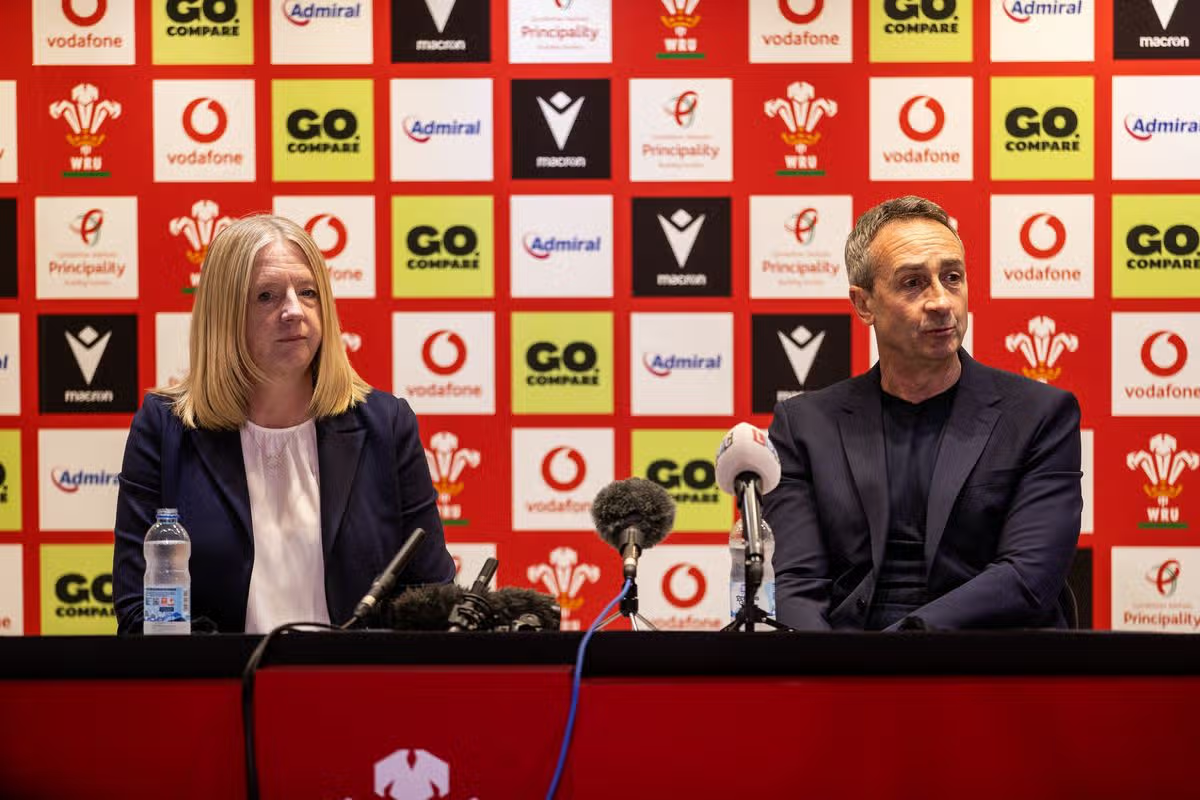
25.04.25 – Picture shows WRU Chief Executive Abi Tierney and newly appointment Dave Reddin Director of Rugby and Elite Performance speaking to the media at the Principality Stadium.
There is also nowhere near enough competition for places in Welsh rugby.
Imagine, then, that an extraordinary general meeting is called, a vote of no confidence succeeds and the WRU board is forced to resign.
Suppose members of the Coalition of the Willing then find themselves running the organisation, even temporarily.
They would have to hit the ground running.
What happens when they open the management accounts and discover that the financial position is as grim as some have suggested?
Would they be prepared to swallow their pride and conclude that four regions are simply unaffordable?
That is the test.
For now, the Coalition is riding a wave of popular discontent. But populism could be a wonderfully effective vehicle for getting through the doors of the Principality Stadium.
But it is considerably less useful once you are sitting behind them.
The Welsh public will not give a new regime years to fix the problems. They will expect results immediately.
And if the next Six Nations campaign is poor, the same knives that are now being sharpened for the existing board will inevitably be turned on its successors.
There are capable people on the current WRU board. Andrew Williams, for example, has been the longest-serving FTSE 100 chief executive in Britain, while Jennifer Mathias has substantial experience from her involvement with Rathbones.
Their credentials should not exempt them from scrutiny. Given the condition of Welsh rugby, it is entirely reasonable to question the board’s decisions, its strategy and whether it has the right people in the right positions.
But the same principle must apply to those seeking to replace it.
There are people sitting at the top of Welsh rugby who arguably do need to leave and there is a strong argument that fresh ideas are needed.
The Coalition of the Willing may genuinely want to improve Welsh rugby, and that is admirable. The harder question is whether it is prepared to make the decisions that improvement will require when the numbers, rather than the politics, dictate them.
Opposition is easy. Governing Welsh rugby will be something else entirely.
Follow all of our channels to ensure you stay up to date with the latest Welsh rugby news. Sign up to our free daily newsletter here and our WhatsApp channel here for all the breaking news.