
 Play Brightcove video
The boss of the Welsh Rugby Union has rejected calls to resign, but admits “some hard decisions” must be taken. ITV News Wales Reporter Rhys Williams has this exclusive interview.
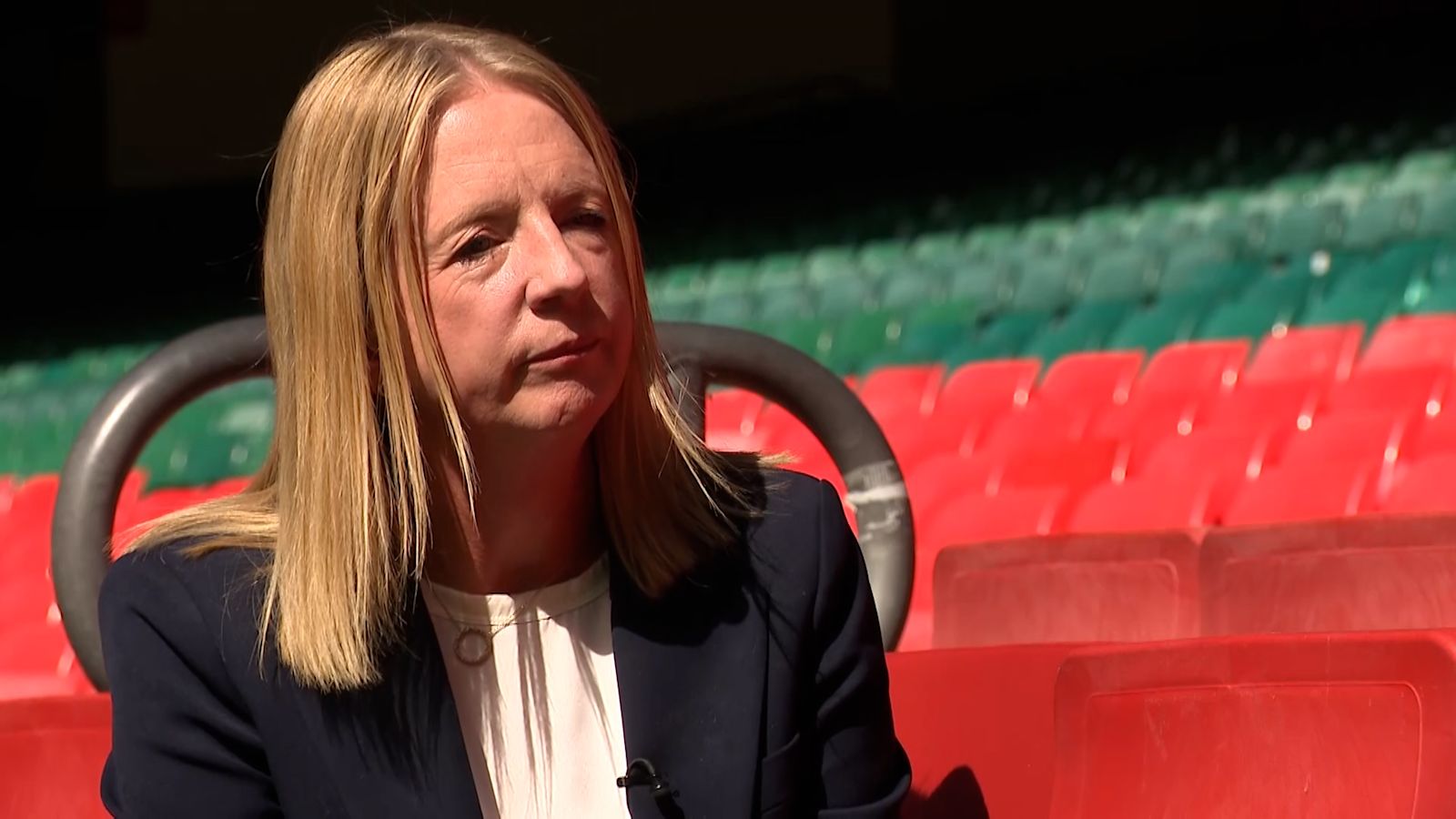
Welsh Rugby Union chief executive Abi Tierney has rejected growing calls for her and the board to resign, as she defended the controversial decision to cut Wales’ four professional rugby teams to three in a wide-ranging interview with ITV News.
It comes as former Wales centre Tom Shanklin has become the latest high-profile figure to call for change at the top of the WRU, telling ITV News he has “zero confidence” in the leadership and believes there needs to be “complete change”.
Welsh professional rugby has spent more than a year in turmoil. The WRU’s preferred structure has shifted from four teams, to two, and now three. This has left arguably two of Wales’ most successful clubs , the Swansea-based Ospreys and Llanelli-based Scarlets fighting for one place in west Wales.
Cardiff Rugby and Dragons (who play in Newport), are set to be offered the other two licences.
Pressure on the leadership of Welsh rugby has intensified significantly in recent weeks.
Former Wales captain Jonathan Davies has called for the WRU board to step down, while Go.Compare founder and former Cardiff Rugby board member Hayley Parsons has also called for wholesale change at the top.Ms Parsons said last week she has enough support from community clubs to force an Extraordinary General Meeting in an attempt to oust the board.
Former Wales and British and Irish Lions centre Tom Shanklin has now joined the calls, telling ITV News he has “zero confidence” in the way Welsh rugby is being run and that there needs to be “complete change” from the top.
“The goalposts keep moving time after time,” he said.
“There’s no transparency, there’s no trust.”
Asked whether the entire board should resign, Shanklin said: “I think it needs to. If we want to proceed and get a new vision for Welsh rugby, there has to be complete change. And that starts at the top.”
Credit: ITV News
Speaking to ITV News, Tierney rejected those calls and defended her position.
“I can understand that people are concerned,” she said.
“But I don’t think it’s the right thing for the board to resign.
“We’re facing significant structural challenges in Welsh rugby, and rugby internationally is facing challenges. We’re going to have to make some hard decisions.”
Why is Welsh rugby being cut from four teams to three?
The future of the professional game has been trapped in uncertainty for more than a year.
When Abi Tierney took over the Welsh Rugby Union, she initially set out to sustain four equally funded professional sides, before a bombshell announcement it wanted to cut to a two-team model last year.
It has now settled on three.
Under this plan there will be one professional licence in the capital, one in the east and one in the west.
Cardiff Rugby and the Newport-based Dragons are due to be offered the capital and eastern licences, leaving Ospreys, who play in Swansea, and Llanelli-based Scarlets fighting for the remaining place in west Wales.
Tierney said the WRU has around £30m available for redistribution in an average year.
Around £10m, she said, goes towards the national team, player pathways and the community game, leaving roughly £20m for the professional sides.
Her argument is that dividing that available money between four clubs would leave each with too little to compete consistently at the highest level.
“We can have four teams if you want to have four teams,” she said.
“What we can’t have is four competitive teams.”
Tierney insisted the rationale had “always been both” financial and performance driven.
Critics argue the WRU has repeatedly shifted the emphasis of its case during a process in which its preferred number of teams has itself changed.
Shanklin said that uncertainty was already having consequences.
“Players and clubs don’t know if they’re going to exist or not,” he said.
“Why are people getting excited about coming to rugby if all the news is bad news?”
Has the WRU maximised its own income?
ITV News also asked whether the WRU had exhausted every realistic opportunity to increase its own revenues before deciding Wales could not sustain four competitive teams.
Tierney initially said: “Yeah, we have done.”
Asked specifically whether she was satisfied the Principality Stadium naming-rights deal was achieving the full market potential of one of Welsh rugby’s biggest commercial assets, Tierney pointed to the difficult environment in which the WRU is trying to attract sponsors.
She said the “toxicity and the arguments” surrounding Welsh rugby were damaging the brand and making sponsorship harder to secure.
But she added: “Can we do more? Absolutely.”
Does the WRU owning Cardiff create a conflict of interest?
The WRU also owns Cardiff Rugby, after taking control following the club’s collapse into administration last year.
Cardiff has since effectively been protected in the restructuring, with the club set to be offered the capital licence.
ITV News asked Tierney how the WRU could credibly decide which professional clubs survive while simultaneously owning one of them.
She said safeguards had been put in place to prevent a conflict.
“I have nothing day-to-day to do with Cardiff,” Tierney said.
“I don’t sit on the Cardiff board. I don’t make any decisions regarding Cardiff.”
She said anyone involved in WRU board discussions who had connections to Cardiff would recuse themselves when relevant decisions were taken.
Asked whether, even from a perception standpoint, the WRU should have avoided embarking on such a controversial restructuring while it owned one of the clubs affected, Tierney said: “I don’t think so.”
She pointed to external analysis which she said had independently validated the WRU’s approach.
Welsh Rugby Union chief executive Abi Tierney, Wales head coach Steve Tandy, and Wales director of rugby Dave Reddin. Credit: PA
But questions also remain about when Cardiff first began to be treated internally as part of a future three-team structure.
Swansea Council’s lawyers say the WRU told them in April that no licence decisions had been made.
But WRU accounts signed the previous November forecast Cardiff operating within a future three-team model – forecasts used to justify keeping almost £10m of Cardiff’s value on the union’s balance sheet.
Tierney denied Cardiff had already been chosen, saying the accounts were based on scenarios.
The WRU later told ITV News those assessments rely on assumptions about outcomes considered “more likely than not”.
The legal threat
Questions over transparency are also at the heart of legal action being taken against the WRU by Swansea Council.
Capital Law, which is acting for the council, says the case centres on whether the restructuring has been conducted fairly, transparently and according to objective criteria.
Céline Jones, of Capital Law, told ITV News that stakeholders had been told there would be a fair and transparent process for allocating the three professional licences, with a plan due to be published in June 2026.
But by July, the WRU had announced that Cardiff and Dragons would be offered two of the licences, leaving Ospreys and Scarlets competing over one spot.
“The council is concerned about the lack of fairness, transparency and objective criteria that were promised but have not been delivered,” Jones said.
She said Swansea Council’s claim is that the WRU’s actions breach UK competition law.
The WRU disputes the legal challenge.
Jones said the council’s concern was not simply whether three professional teams was ultimately the right answer, but how such a significant decision had been reached.
“It’s about the regulator of Welsh rugby making decisions which will have a considerable impact not only in south Wales but in the whole of Wales without explaining the basis for that decision or publishing data that backs that decision,” she said.
The WRU insists its decision was evidence-led.
Where is the evidence?
The WRU Board decided last October that the future professional game should be built around three geographical areas – the capital, east and west.
Tierney said that decision was based on factors including player pathways, infrastructure, the number of clubs and schools, player numbers and performance.
She said the WRU had subsequently commissioned further independent analysis to test that decision.
“We realise how this is a generational decision,” said Tierney, “so we took our time and we got external, independent advice to validate that.”
That work, she said, had only recently been completed.
Tierney maintained that the Board already had sufficient evidence when it decided the geographical structure last October.
Asked why the evidence relied upon by the Board could not have been published at the time, Tierney initially said it had been.
When ITV News pressed specifically on whether the underlying evidence for placing only one professional licence in west Wales had been published, Tierney asked for the interview to be paused while the position was checked.
It was then clarified that the evidence had not been published “in full”, although headline arguments had been made public.
Tierney maintained that the Board had sufficient information to make the original decision.
She said the subsequent external work had validated the Board’s conclusion.
The more detailed analysis is now due to be published in September – almost a year after the geographical decision was taken.
Could losing a professional team damage grassroots rugby?
The WRU also faces questions about what removing a professional side could mean for rugby participation in the area.
Tierney said the union had considered the potential effect on participation.
But asked specifically what impact losing a professional club would have, she said the WRU did not believe participation would fall because greater investment in pathways and community rugby would mitigate the loss.
Asked whether, in a scenario where Llanelli-based Scarlets lost their professional licence, that would affect rugby participation in west Wales, Tierney said: ‘No.’“Because of how we’re building things such as the pathways and the other elements of the pathway and investing in the community game, that will mitigate that impact,” she said.
Tom Shanklin strongly disagrees.
He has previously argued that Welsh rugby could be stronger with fewer professional teams, but now says his concern is on removing opportunities for young players to progress.
“I don’t think amalgamating four teams into two or three is all of a sudden going to make us super competitive,” he said.
“What will make us competitive is if we’ve got the correct pathway and we’ve got four pathways for these youngsters.
“By cutting four to three or two, you’re limiting game time for the 16, 17, 18-year-olds.”
Subscribe for free to our weekly newsletter for exclusive and original coverage from ITV News. Direct to your inbox every Friday morning.
Is three really irreversible?
The WRU has repeatedly stressed that its Board and executive are committed to three professional teams.
But Tierney stopped short of saying the decision could never change.
Asked whether three teams was now completely irreversible, she said: “I’m not going to be asked to have a crystal ball on that.
“The board is committed to three teams and the executive are committed to three teams, and that decision has been taken.”
But when asked whether a turnaround in the commercial performance of Ospreys and Scarlets could make retaining four affordable, she replied: “Potentially.”
But added that stronger finances alone would not solve what the WRU regards as the performance problem.
“It doesn’t address the performance side of it, which is just as important as the financial side,” she said.
‘I think about it every day’
The controversy has increasingly turned towards Tierney’s own position.
Almost a year ago she told ITV News the uncertainty over the professional game needed to be resolved quickly.
Since then, the WRU’s preferred plan has changed, a deal to sell Cardiff Rugby collapsed, senior Wales players have left to play club rugby elsewhere due to the uncertainty, Swansea Council has launched legal proceedings and calls for change at the top have grown.
Asked whether she remained the right person to lead Welsh rugby, Tierney said yes.
“I think about it every day,” she said.
“I’m not doing this to be popular. I’m doing it because I believe absolutely, based on all the evidence, it’s the right thing to do for Welsh rugby.”
Tierney said no credible alternative had been produced and argued that anyone replacing her would rapidly face the same structural problems.
Asked whether the WRU had done anything wrong over the past 12 months, she acknowledged there were lessons to learn.
“When it’s hard and the message is hard, I think you have to over-communicate your reasons why,” she said.
Reporting History sees journalists join News At Ten anchor Tom Bradby to revisit their remarkable on-the-day reports of the defining events of the modern age. Listen to the episodes below…