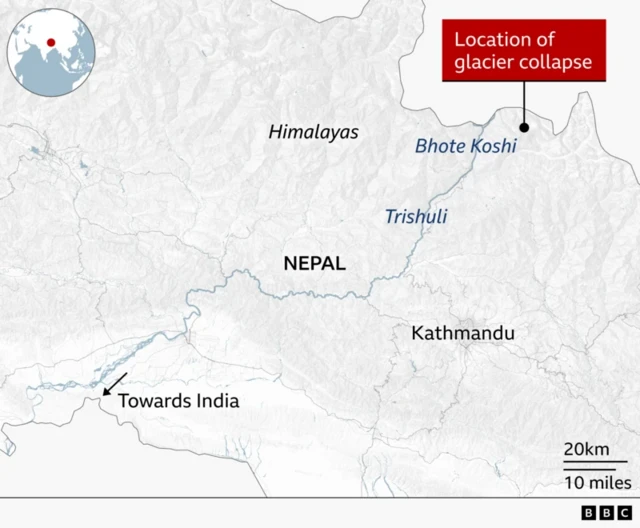
Cracks in two other glaciers nearby being monitored – officialspublished at 16:09 BST
16:09 BST
 Navin Singh Khadka
Environment correspondent, BBC World Service
Meteorology officials in Nepal have said they are now trying to monitor two other glaciers close to the one that collapsed causing the devastating floods on Wednesday.
They say the monitoring is crucial because some images they have received seem to show cracks on the glaciers.
They quickly add that the cracks may not mean a sign of imminent collapse and that they could be something the glaciers have had for some time now.
“But given what has happened with the nearby glacier, we are trying to monitor this as much as possible,” a senior official with Nepal’s department of hydrology and meteorology told the BBC.
The official said they were examining drone pictures shared by China, that were taken in and around the glacier collapse site on the northern flank of Mount Langtang Lirung, which is on the Nepal side of the border.
Experts with the International Centre for Integrated Mountain Development (ICIMOD), an international organisation that specialises on Himalayan hazards, said the two other glaciers feed into the same Lhende river that was flooded.
“Satellite imagery suggests one of the glaciers may contain hanging glacier ice masses that warrant observation and assessment,” said Qianggong Zhang, head of climate and environmental risks, with ICIMOD.
Scientists say hanging glaciers can be more hazardous because they cling to steep mountain slopes – just like a part of the collapsed glacier did.