
For decades, physicists working on nuclear fusion repeatedly hit a wall. Pack more than about 1.6 x 10^20 electrons into a cubic meter of plasma and the reaction…
For decades, physicists working on nuclear fusion repeatedly hit a wall. Pack more than about 1.6 x 10^20 electrons into a cubic meter of plasma and the reaction was supposed to fall apart.
A tokamak in eastern China has now held a plasma reaction well beyond those previous limitations, and it did so for several seconds.
A limit long thought fixed
Fusion runs permanently at the heart of stars, where hydrogen nuclei assemble into helium, and it may represent the next energy revolution on Earth.
It produces very little long-lived radioactive waste and behaves more stably than fission, which is why so much effort goes into making it work in a machine.
The pursuit of a durable reaction runs through one particular obstacle, the electron density limit of the plasma inside a fusion reactor, known as the Greenwald limit.
That parameter depends mainly on the electric current injected into the tokamak and on the machine’s size, and it was long considered impossible to cross.
Inside the artificial sun
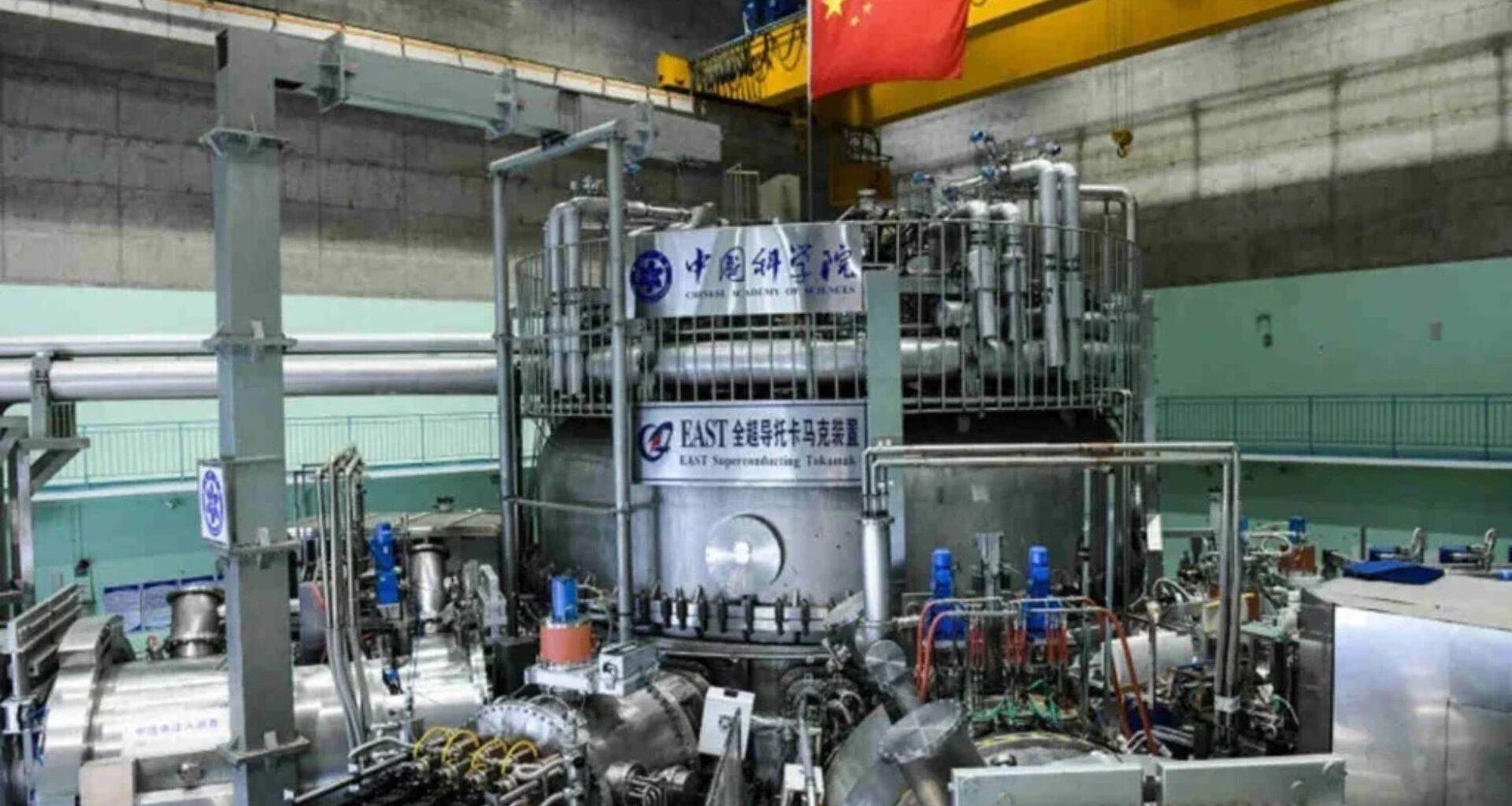
The reactor that crossed it is the Experimental Advanced Superconducting Tokamak, or EAST, nicknamed the artificial sun and located in Hefei, in eastern China.
Its confinement chamber is shaped like a torus, or a donut, and deuterium is injected into it before being heated to extreme temperatures.
The gas can reach 270 million degrees Fahrenheit (150 million degrees Celsius), at which point it becomes a plasma of electrons and ions.
A very powerful magnetic field is generated inside the tokamak so that the ionized gas stays confined rather than escaping toward the walls.
Ping Zhu, a physicist working jointly for Huazhong University of Science and Technology (HUST) in China and the University of Wisconsin-Madison, is a co-lead author of the study, which appeared in Science Advances.
“The plasma is nearly neutral electrically, since it contains almost as many electrons as ions. For fusion to start, that density has to be high enough, because it directly determines the power of the reactions,” he explained.
A theory waiting for proof
Other fusion reactors have gone past the Greenwald limit before, including T-10 in Moscow and DIII-D in San Diego, but only very briefly.
What sets the Chinese machine apart is that it experimentally confirmed a theory developed in 2021, known as plasma-wall self-organization, or PWSO, which ties the efficiency of fusion to the tightness of the reactor wall.
Dominique Escande, a physicist at Aix-Marseille University, is the researcher who formulated that idea, and he described what it predicts.
“This theory predicts the existence of two plasma density regimes caused by the radiation power loss from the sputtering of impurities on the reactor walls,” Escande explained.
“The first regime corresponds to the Greenwald density limit, while the second is the new regime discovered in the EAST experiments, where plasma density is higher than Greenwald’s.”
Those impurities are atoms such as tungsten or molybdenum, released by components in contact with the plasma when energetic particles from the plasma bombard them.
Only a quarter of the power
EAST managed to sustain its plasma for several seconds in a density regime above the Greenwald limit, which gives the PWSO theory its first confirmation of this kind.
The record value reached was 1.65 times the Greenwald threshold, and the team believes it can go further still.
“The PWSO theory does not predict an absolute upper limit in the free density regime,” Ping Zhu said.
He also pointed out that the experiment ran with only a fraction of the heating available, since microwaves tuned to the electrons are used to heat the plasma and limit interactions with the walls.
“In the EAST experiment, only a quarter of the power of the ECRH process is applied. This leaves a significant margin for progress beyond 1.65 times the Greenwald limit,” he added.
What the result does not show
Several seconds is not several minutes, and the experiment does not establish that these free density regimes can be held for long stretches.
The current record for sustaining a hot plasma stands at 22 minutes, achieved in the WEST reactor operated by France’s Commissariat à l’énergie atomique at Cadarache.
Whether high-density operation can be maintained over durations compatible with continuous energy production remains the central unanswered question.
Nothing here demonstrates a net energy gain either, which is a separate problem from density and one that no tokamak has solved.
A long road to ITER
WEST was built in part to prepare for ITER, the vast international project under construction in the same region of southern France.
Under the timetable ITER adopted in 2024, the start of research operations is set for 2034, with full magnetic energy in 2036 and deuterium-tritium operations in 2039.
Assembly is running ahead of that schedule in places, and the sixth of nine sector modules was lowered into the tokamak pit at the end of July 2026, roughly six months early.
“The results of our experiment suggest a practical and adaptable path for pushing back density limits in tokamaks, particularly those of the next generation,” the Chinese scientist concluded in a statement.
—–
Like what you read? Subscribe to our newsletter for engaging articles, exclusive content, and the latest updates.
Check us out on EarthSnap, a free app brought to you by Eric Ralls and Earth.com.
—–