
The researchers say the work opens up new opportunities to measure neutral hydrogen over cosmological distances and study how galaxies form and evolve over cosmic time.
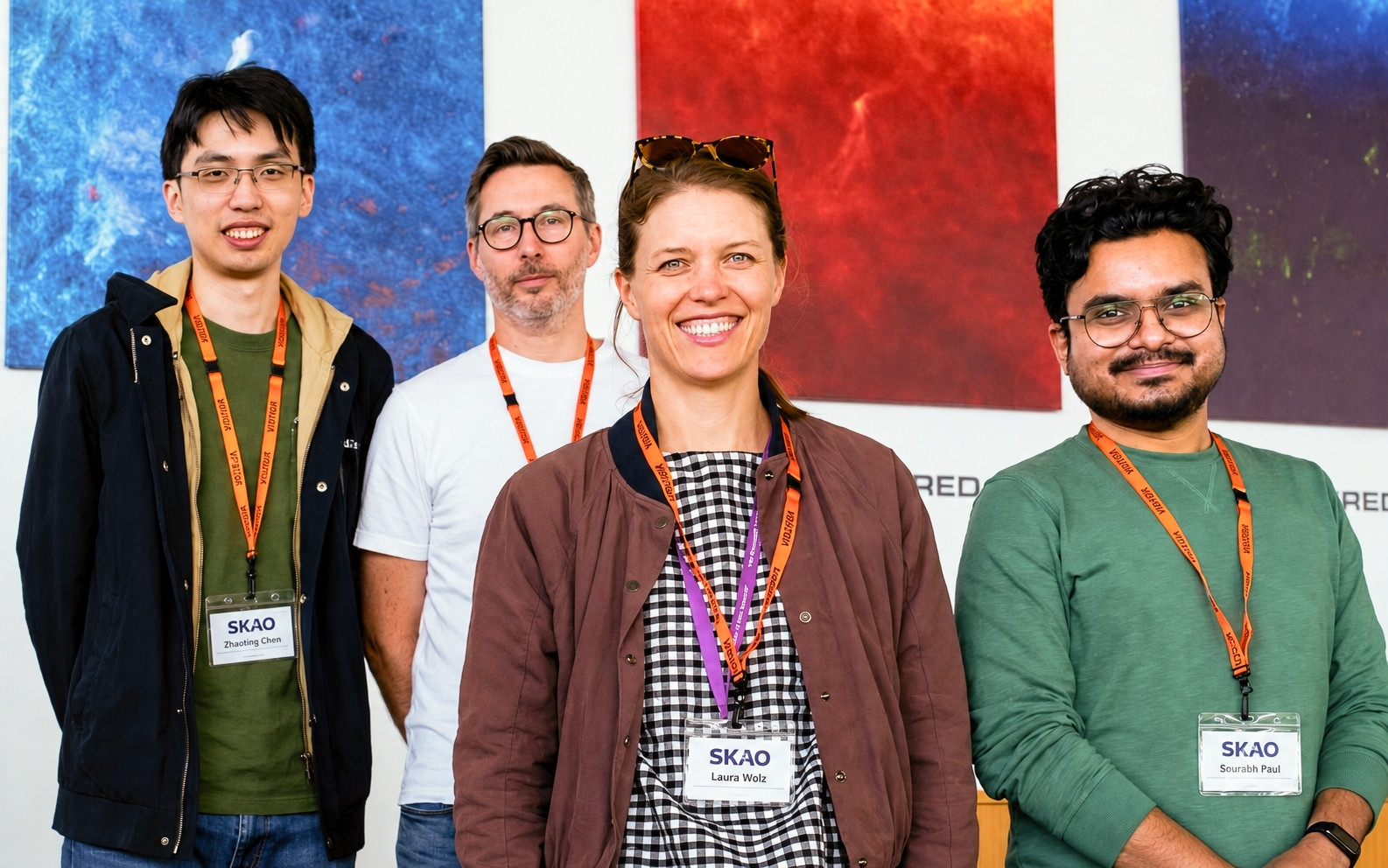
Dr Zhaoting Chen, co-author of the study, said: “Neutral hydrogen is one of the key ingredients for understanding how galaxies form and evolve.
“With intensity mapping, we do not need to detect every individual galaxy. Instead, we can measure the collective signal from hydrogen across large cosmic volumes, giving us a new way to study both galaxy evolution and the underlying matter distribution of the Universe.”
The detection also has important implications for future cosmological surveys. Hydrogen intensity mapping is expected to become a major science driver for the Square Kilometre Array Observatory, for which MeerKAT is a precursor telescope.
Professor Laura Wolz, co-author of the study from Jodrell Bank Centre for Astrophysics at The University of Manchester, added: “MeerKAT continues to open new windows for cosmology. The fact that this signal can be extracted from observations that were not originally designed for hydrogen intensity mapping is very encouraging. It shows the enormous scientific value of MeerKAT data and points the way to future observations with SKAO.”
The researchers say future observations covering larger areas of the sky and using longer observing times will enable astronomers to map hydrogen in even greater detail, helping reveal how galaxies formed, how dark matter shapes the cosmic web, and how the Universe has evolved over billions of years.
‘;