
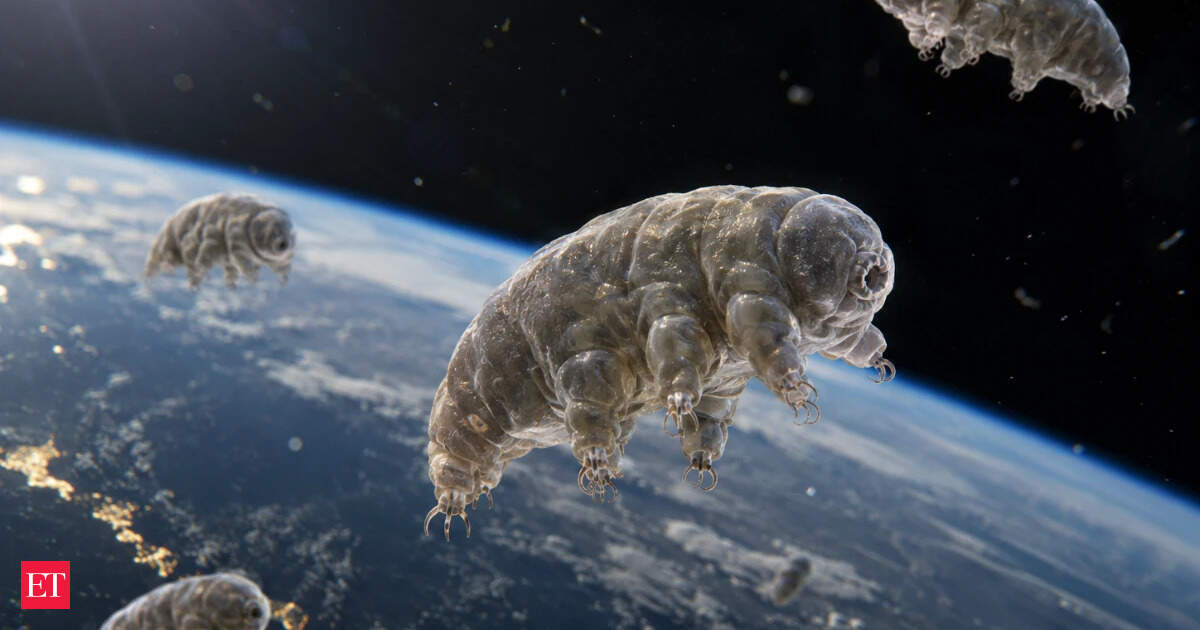
On September 14, 2007, a European Space Agency exposure platform bolted to the outside of a Russian Foton-M3 capsule opened its trays in low Earth orbit and left some 3,000 tiny animals unprotected there for the next 10 consecutive days, until the capsule landed back in Kazakhstan on September 26. No spacesuit. No pressurized cabin. Exposure to the cosmic radiation and virtually “zero” pressure that would kill a human in about 15 seconds. Upon the return of the tray, and with a few drops of water added on, a large share of those animals had revived and were moving again, within about half an hour.
That’s not a science fiction story. The animals were called “water bears” or “tardigrades,” and the mission was dubbed TARDIS. ESA describes it as the first time these creatures were directly exposed to the space environment, and the mission helped confirm that the eight-legged, half-a-millimeter-long invertebrates can survive that exposure, not the very first evidence of tardigrade hardiness in general, since their resilience to extreme drying and cold on Earth was already well documented.
What actually happened up there?
Tardigrades were carried by ESA’s Foton-M3 mission on board a research platform called Biopan-6, which remained in orbit between 258 and 281 km above the Earth. As per a 2008 peer-reviewed study titled “Tardigrades survive exposure to space in low Earth orbit,” published in Current Biology by K. Ingemar Jönsson and colleagues, the animals were divided into groups. One group was exposed to only the vacuum, with no sun, and those tardigrades lived at rates virtually the same as their cousins on Earth that were never exposed to space. Vacuum, on its own, barely fazed them.
Experiment BIOPAN-5, part of the Foton-M2 mission. Image credits: Wikimedia Commons
The real test was radiation. A second group was exposed to vacuum plus a slice of solar ultraviolet light (UV-A and UV-B); 68% of that group’s Milnesium tardigradum specimens revived within roughly half an hour of rehydration, a truly remarkable percentage for that treatment, though a significant number of those survivors subsequently died from cumulative damage in the days after. The third group, exposed to the entire spectrum of solar radiation, including the more damaging UV rays that are filtered by the Earth’s atmosphere, did not do so well, as just three animals survived. Live Events
The tardigrades had not been launched as active hydrated animals; they had been sent out in a dried-out, dormant state referred to as “the tun,” in which they replaced most of the body water with a sugar known as trehalose, just as they do when enduring drought conditions on Earth. Two species of tardigrades had been included in the Foton-M3 launch: Milnesium tardigradum and Richtersius coronifer. According to Ingemar Jönsson, who was the leading author of the study, the few survivors from the extremely harsh ultraviolet radiation group had received more than 7,000 kilojoules of radiation per square meter.
Why this isn’t just a fun Internet tidbitThe biggest unresolved issue for astronauts seeking to make the trip to Mars is radiation, worse than food, worse than psychology, worse than the rockets themselves. A 2016 study in Nature Communications, “Extremotolerant tardigrade genome and improved radiotolerance of human cultured cells by tardigrade-unique protein,” by Hashimoto and colleagues, identified a large clue to how tardigrades withstand radiation: a protein found uniquely in them, called Dsup, short for “damage suppressor.” Ordinary human cells in a dish of their laboratory suffered about 40% less DNA damage from X-rays when they were modified with the Dsup gene.
Tardigrade (water bear). Image credits: Wikimedia Commons
Researchers at MIT and Brigham and Women’s Hospital took a very practical approach, wondering if the same could be used to shield cancer patients during radiation therapy. According to Kirtane and colleagues’ 2025 paper titled “Radioprotection of healthy tissue via nanoparticle-delivered mRNA encoding for a damage-suppressor protein found in tardigrades,” published in Nature Biomedical Engineering, they took the same method (mRNA delivery) used in COVID-19 vaccines and injected it into healthy tissue to cause a temporary production of Dsup, protecting the tissue from the collateral damage of radiotherapy, but without altering anyone’s genome permanently.
The slightly humbling part
Tardigrades didn’t evolve to travel in space; they evolved to live in puddles that dry up in a person’s backyard gutter. More than anyone else, it was a bonus for space endurance. So the next time an “indestructible water bear” meme comes across your feed, it’s worth knowing that the underlying science holds up, and that it’s now being adapted in labs studying how to protect healthy tissue during cancer treatment.