
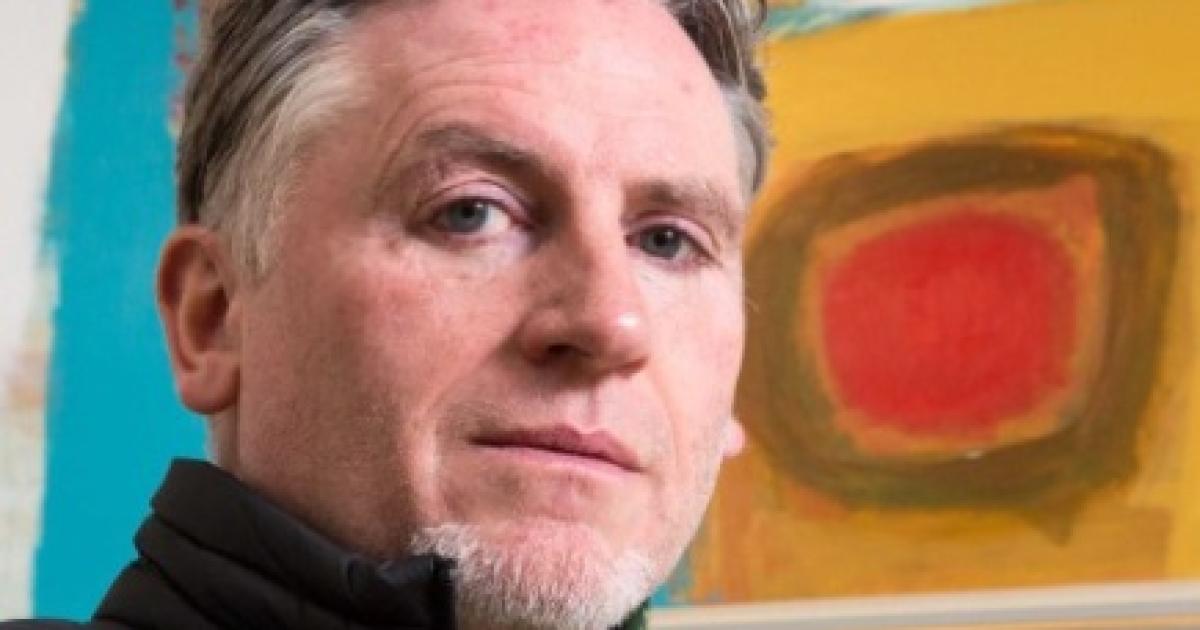
Their artistic paths have diverged since then – Scott’s work is figurative and representative, Laurie’s approach avowedly abstract – but they come together this weekend for a joint show at The Lemond Gallery in Glasgow.
Drysdale Scott (Image: Supplied)
Scott, who spent nearly 30 years as an art teacher before taking early retirement in 2019 to concentrate on painting, will exhibit a series of mostly new works showcasing his narratively-rich still lifes and, in particular, his studies of dancers. Tango is a big favourite of his, as shown in paintings such as Tango In Red And Green and Tango On The Spot.
“I’m a real fan of film noir imagery,” he says, addressing the look of the moodily-lit works and the sense of drama contained within them. “I’m also a huge fan of the work of Caravaggio and Velázquez, and the great English painter Joseph Wright of Derby.”
Caravaggio was one of the greatest exponents of the chiaroscuro technique, which emphasises the contrast between light and dark in a painting. Joseph Wright of Derby – his actual working name – was an 18th century painter and chief proponent of what’s known as tenebrism. Think chiaroscuro on steroids.
In fact to Scott’s mind you can draw a direct line joining the painters of the 16th and 17th centuries who mastered the use of light with the famous film noir cinematographers of the mid-20th century – John F Seitz, for example, who shot several Billy Wilder films, including the classic Double Indemnity.
Which theory neatly ties together his two main founts of inspiration. “That sense of drama and eeriness in a lot of these paintings is something I find quite electric,” he admits. “Combining that with the film noir imagery and taking my inspiration from those sorts of movies, is something I’ve always been really interested in.”
Winter Twigs on Blue by Simon Laurie (Image: Supplied)
But how do you pose a couple of tango dancers long enough to execute a work in oil, a notoriously difficult medium? Answer: you don’t. Instead Scott prefers to work from specially-commissioned photographic studio portraits of tango dancers in action: a freeze-frame image displaying poise and control but also tension and that all important drama.
“I don’t believe in capturing movement, or a blur,” he says. “That’s not what I’m about. I’m about sharpness, I’m about definition, about capturing a moment in time.
“The traditions I’m trying to follow are of the great masters, particularly the great Baroque masters. It’s not photo-realism, I’m not trying to do that … it’s pin-point. And in doing ballet or tango I’ve decided there aren’t going to be many wispy blurs, it’s going to be sharply focused. That’s something I pride myself on.”
Cut to Simon Laurie, Scott’s old studio colleague from art school days. He is known for paintings whose titles suggest landscapes but whose composition is formed largely from abstract shapes. “The titles are only a lead in,” he says. “They’re not important to me. They’re a lead in for the viewer, just to give them a clue.”
Read more
Exhibition celebrates 25 years of Glasgow School of Art’s Advanced Textiles centre
Glasgow School of Art rebuild ‘integral to nation’s self belief’, expert says
From the easel to the movie screen, Glasgow School of Art’s famous students
Glasgow School of Art in talks to open up Mack to tourists
For the upcoming show at The Lemond Gallery his work has taken a new direction, or at the very least it has seen the return of an old interest in new form: the still life. Laurie has painted still lifes before, but these were less abstracted and his palette back then tended towards the monochrome.
Not today. These new works, he says, “are much more abstracted than they were in the past. There’s lots more abstract shapes within them and lots more colour. I’ve been using yellow pre-dominantly, just to make them vibrant and bright. I’ve not really used it before. I wanted to introduce flowers back into my work – or flower shapes. Things which relate to flowers or to plant shapes.”
The intention, he adds, is to achieve “balance – a combination of some things which are quite recognisable and others which are completely abstract.”
Drysdale Scott (Image: Supplied)
One new work is titled Yellow Splash, as explicit a nod to that colour shift as you could want. But, albeit in more subtle form, it’s also there in the titles of other new works such as Autumn Gold, Summer Sonnet and Harvest Table.
One thing which hasn’t changed since his days at Glasgow School of Art is the quality all students are taught to cultivate – the sponge-like soaking up of influences from across the board.
“I still do that,” he says. “I still look at lots of people’s work, lots of painters. I’m trying to refresh all the time.”
Simon Laurie & Drysdale Scott opens at The Lemond Gallery, Glasgow on Saturday September 5 (until September 13)