
The council decided to put its own money into development projects when interest rates were historically low and more capital funding became available. With money from Homes England and the Greater Manchester Combined Authority (GMCA) – the mayoral body led by Mr Burnham until he returned to Westminster in June – it was the right time to make investments.
In 2017, the council carried out a piece of research on town centre living. Stockport is an affluent borough, but the centre hollowed out as there were fewer reasons for people in suburbs such as Marple or Cheadle Hulme to come in. A case in point is my granny, who has lived in the nearby village of Bramhall for 60 years: she used to drive into Stockport to shop in the covered market but eventually switched to out-of-town supermarkets.
By building homes in the town centre, the council reasoned, you could attract new residents to Stockport who would, in turn, make it a place for everyone to visit.
“I think we’re still the only place that’s asked for an MDC. We went to Andy [Burnham] and said, ‘We’d like to you to form an MDC in Stockport’”
Town centre living had another attraction, too: the council’s Liberal Democrat leadership saw it as a sustainable way to meet housing need and safeguard the borough’s green belt land. Stockport Council withdrew from Greater Manchester’s Places for Everyone spatial plan in 2020, citing the need to protect its green belt. (Mr Burnham has also consistently argued against green belt development.)
A decision was made: it was time for an MDC. This is a statutory body that has its own staff, focusing on development and regeneration; an independent chair; a board that spans political parties and the private sector; and a long-term vision – Stockport’s currently runs to 2039.
“I think we’re still the only place that’s asked for an MDC” in the whole country, says Paul Richards, deputy chief executive of Stockport Council. “We went to Andy [Burnham] and said, ‘We’d like to you to form an MDC in Stockport.’” (His suggestion is that other such bodies were imposed on areas from a mayoral or national level.)
Mr Burnham officially launched the corporation in 2019. It was the first such body in Greater Manchester and the fourth in the UK, after the London Legacy Development Corporation (the former Olympic Park in Stratford), Old Oak Common (the forthcoming HS2 terminus in north-west London) and South Tees in the North East of England.
Mr Burnham himself chaired Stockport’s MDC for six months before handing the reins to the late Lord Kerslake, who was succeeded by the late Eamonn Boylan. The current chair is Lord Barwell, a former Conservative housing minister – proving that the corporation draws leadership from across the political spectrum.
What housing has been built?
The Mailbox was the first new housing development in the town centre for 10 years. It’s a former Royal Mail sorting office that was converted by developer Rise Homes into 117 flats for private rent. It was funded by asset manager Gresham House with a £5.4m loan from the GMCA. (Rise Homes was asked for the development cost of the project.)
The building had sat empty for 15 years and “looked like an East German prison”, Mr Richards says. The developer punched a hole through the building, put in a mezzanine and extended the roof.
Its choice of build-to-rent was a pragmatic one: “That’s the main tenure you can get away in the current climate,” Mr Richards says. The scheme was completed in 2020 and fully let six months later. The council thought it would be occupied by 20 and 30-somethings commuting to Manchester, but there are 17 families living there too.
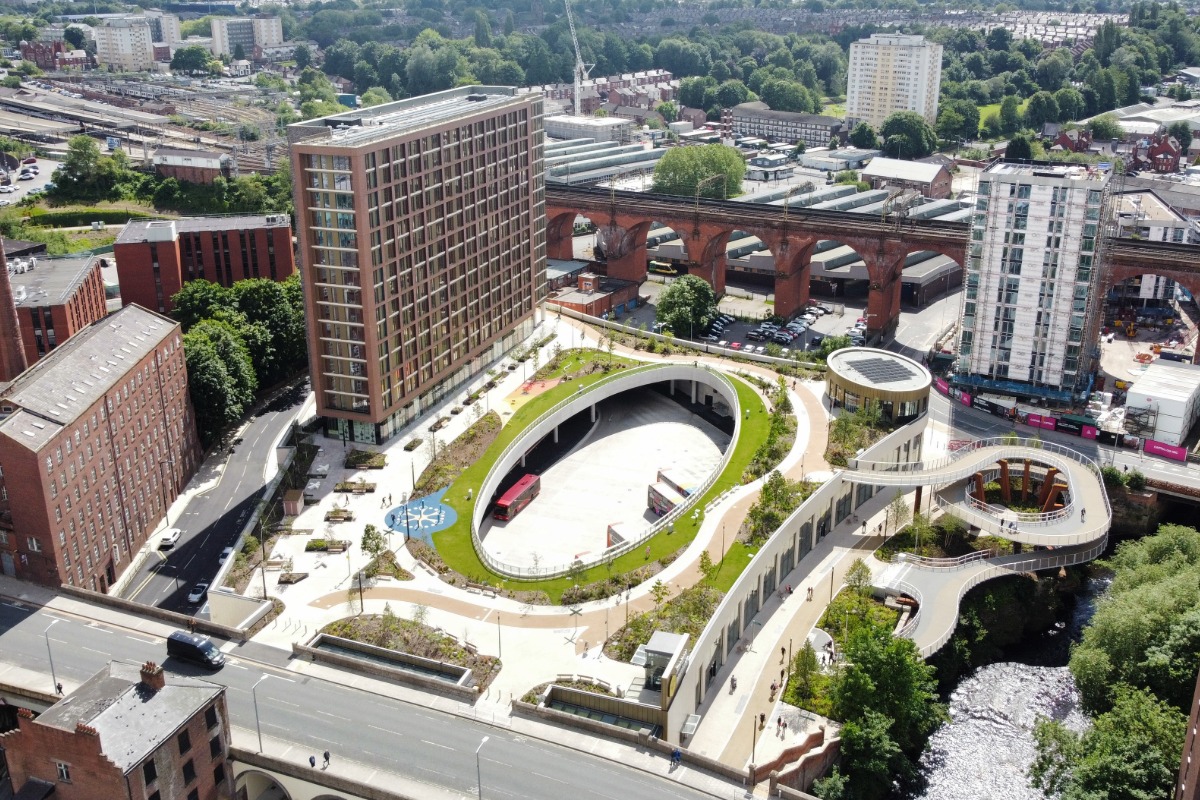
Down a sloping walkway stippled with foliage is the next housing block. It is part of Stockport Interchange – a redevelopment of a 1980s bus station by the council and Transport for Greater Manchester, which completed in 2024. The imposing oblong contains 196 build-to-rent homes. There is £55m of equity in the building: £30m from Gresham House and Cityheart, and £25m from the council and the combined authority.
The use of public money to de-risk sites and yield a long-term return resembles the combined authority’s new Good Growth Fund. “We’d say they’ve nicked the idea from Stockport,” Mr Richards says.
“[Build-to-rent] is the main tenure you can get away in the current climate”
The coolest new housing scheme is Weir Mill, which is set to complete later this year. Developer Capital & Centric has converted an 18th century mill under Stockport’s viaduct into 88 private rented flats, with funding from Homes England and brownfield grant from the combined authority. It has also built two red and black towers either side of the viaduct, adding another 165 rental homes.
There are nine commercial spaces on the ground floor, eight of which are pre-let. There will be an Italian restaurant, a book shop and a sports bar focused on women’s sports. Rents start from £1,100 a month for a one-bed flat.
Apart from a single affordable home in Mailbox, none of these developments include on-site affordable housing. It was negotiated out of Section 106 agreements due to the complexity and viability challenges of town centre brownfield development. (Rise Homes did pay for children’s play facilities elsewhere in the borough, while Capital & Centric is funding electric vehicle car clubs and a sustainable travel plan. Interchange delivered a rooftop park and a play area on site.)
However, affordable housing is being built close by. Hatters Yard, a development by housing association Great Places, is under construction next to Weir Mill. It will provide 148 homes, two-thirds for social rent and one-third Rent to Buy. The Guinness Partnership, another housing association, also has a project in the town centre.
Hovering in the background is the cautionary tale of Manchester city centre, where the combined authority was criticised for providing loans for high-end build-to-rent skyscrapers with no onsite affordable housing (although developers did fund other improvements, such as a primary school). Stockport doesn’t map exactly on to the comparison, though, because it already had a lot of social rent stock. According to its 2017 research, 56% of homes in the town centre were social rent.
The next project is Stockport 8: an eight-acre site currently occupied by industrial sheds, set to become 1,300 homes developed by the council with the English Cities Fund, a joint venture between Homes England, Legal & General (L&G) and Muse. The first phase will cost £350m and provide 435 homes, mostly build-to-rent. A total of 80 affordable homes have been forward-funded by L&G.
In February 2026, Stockport became the first place in the UK to secure an expansion of an MDC boundary, extending from the area around the train station to cover the whole town centre. The expanded MDC will build homes, offices, a secondary school, a healthcare hub, transport improvements and public spaces over the next 15 years.
Why an MDC?
What was it that made Stockport think it needed an MDC? For Mr Richards, it was the credibility and focus a single vehicle can bring that, “just being really honest, is more difficult for some of our partners in the private sector to accept if they’re just dealing with councils”.
He continues: “There’s something about the collaboration, whether it’s political collaboration or the public-private collaboration, that gives confidence to the development industry, to investors, to private money coming in, because they want to know that if they engage with this thing, it will deliver.”