
Your support helps us to tell the story
From reproductive rights to climate change to Big Tech, The Independent is on the ground when the story is developing. Whether it’s investigating the financials of Elon Musk’s pro-Trump PAC or producing our latest documentary, ‘The A Word’, which shines a light on the American women fighting for reproductive rights, we know how important it is to parse out the facts from the messaging.
At such a critical moment in US history, we need reporters on the ground. Your donation allows us to keep sending journalists to speak to both sides of the story.
The Independent is trusted by Americans across the entire political spectrum. And unlike many other quality news outlets, we choose not to lock Americans out of our reporting and analysis with paywalls. We believe quality journalism should be available to everyone, paid for by those who can afford it.
Your support makes all the difference.Read more
Your smartwatch may not be telling you the truth about the calories you burn in a workout – with possible consequences for your weight loss, a new study says.
A test of four fitness trackers against clinical lab equipment showed that the devices overcount how many calories people burned, Florida International University said Monday.
Unfortunately, the errors were the greatest for people with the highest body fat – who may be more likely to track calories, the researchers said.
“You can’t treat the calories burned number it gives you as an accurate number, because it’s not,” lead author Jason Kostrna, an associate professor of kinesiology and exercise science, explained in a statement.
“You could be off hundreds of calories each week and easily end up in a calorie surplus when you think you’re in a calorie deficit.”
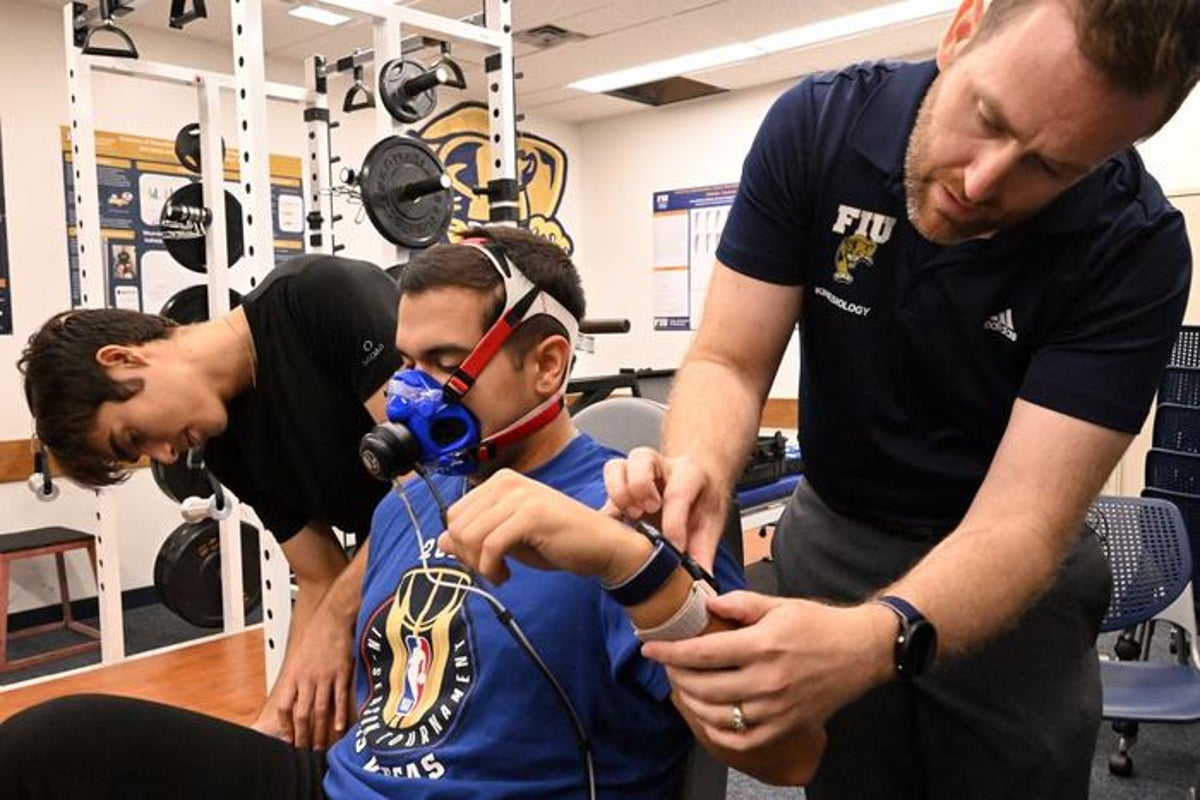
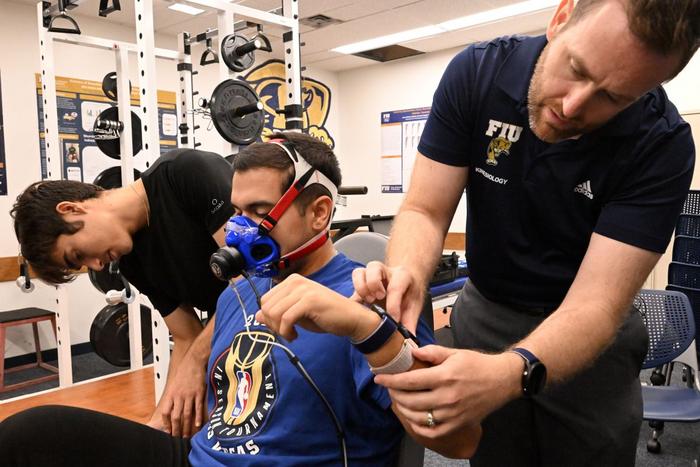 Florida International University Professor Jason Kostrna, right, reviews calorie data on four smartwatches worn by Ph.D. student Daimien Campos as he rides a stationary bike. Kostrna says a study shows smartwatches overcount calories burned during exercise (Photo by Taimy Alvarez/Florida International University)
The researchers tested the watches on the wrists of 58 Hispanic adults who rode stationary bikes in 10-minute workouts that fluctuated between moderate and vigorous intensity.
The watches included the Apple Watch Series 8, Fitbit Sense 2, Samsung Galaxy Watch 5 and Garmin Forerunner 955. They were all worn at the same time by a participant during each workout.
Participants also wore a COSMED K5 metabolic analyzer: a device strapped to their back with an attached face mask that measures their breath, oxygen consumption and how much energy they were expending.
The researchers tested the watch data against measurements from the COSMED K5 metabolic analyzer to determine which watch was the most accurate in tracking calories.
Apple was the most accurate, while Garmin and Samsung overestimated calories burned the most, the university said.
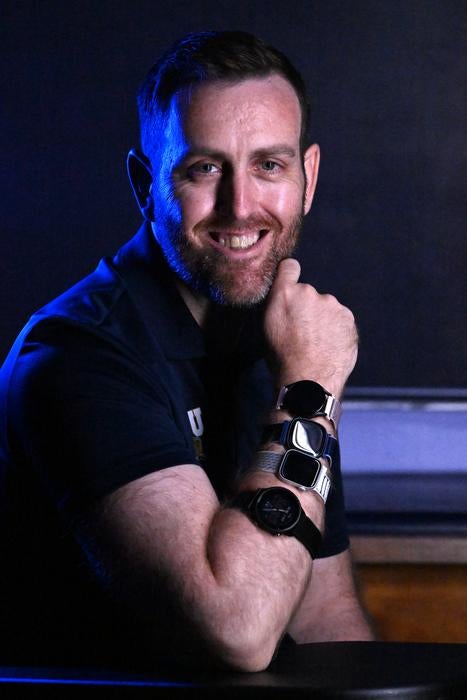 FIU researcher Jason Kostrna, wears the four smartwatches tested in his study. The watches include the Apple Watch Series 8, Fitbit Sense 2, Samsung Galaxy Watch 5 and Garmin Forerunner 955 (Taimy Alvarez/Florida International University)
Sometimes Google’s Fitbit failed to generate a reading at all or reported incredibly low and implausible counts.
The jury is still out on the watch’s accuracy because a lot of that data was excluded from the study.
The Independent has reached out to the watchmakers for comment on the findings.
It’s unclear why the researchers found the watches disproportionately struggled to record calories for people with higher body fat.
Kostrna theorized the algorithms the watches use to estimate calories burned may play a role.
“When the companies are developing those algorithms, we don’t know where the test data is coming from,” he said. “That’s why I think it’s beneficial for the companies to see this type of data, so they can refine their products over time.”
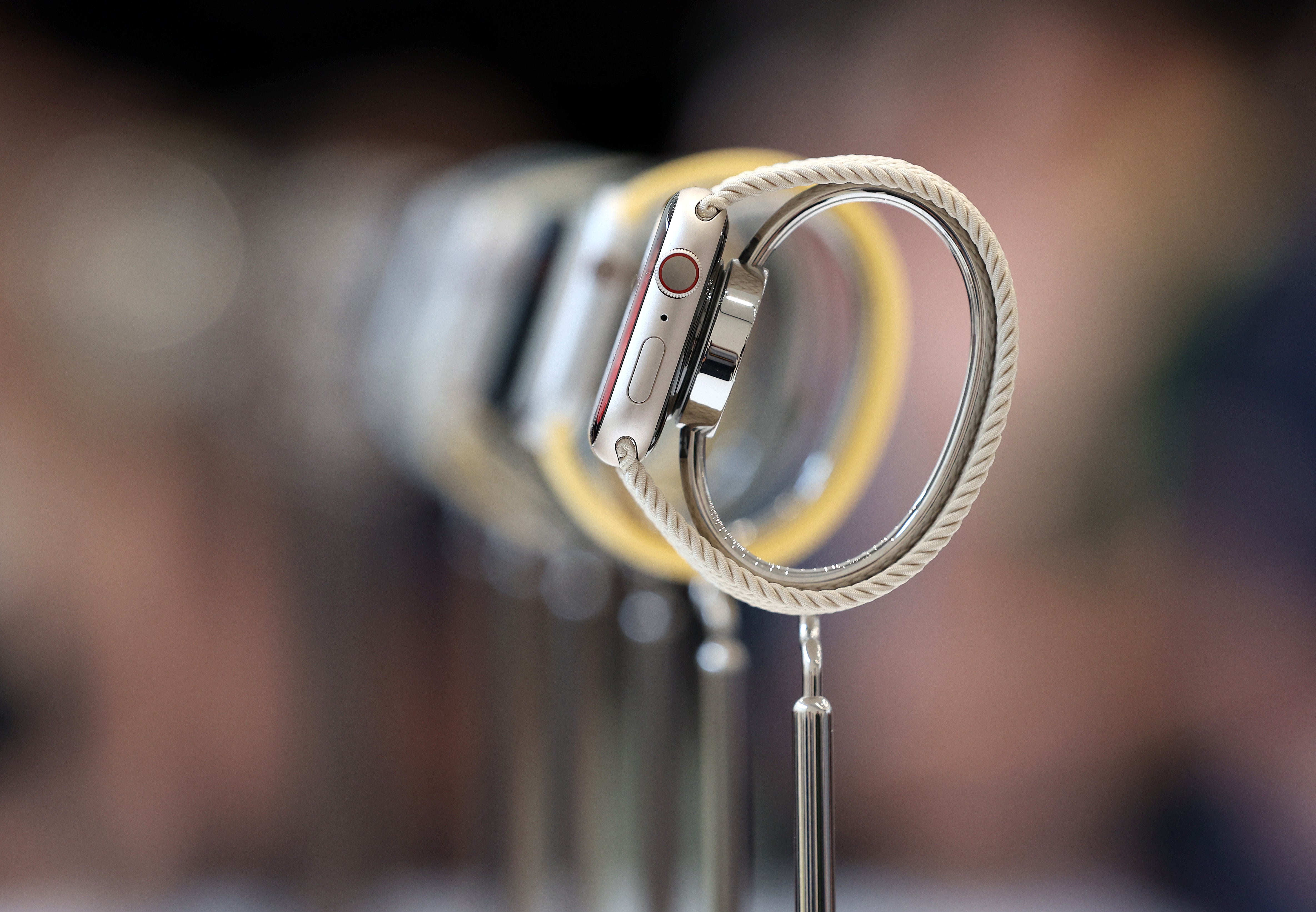 A new Apple Watch Series 8 is displayed during an Apple special event in Cupertino, California, in September 2022. The researchers say smartwatches can still be useful to wearers, even with limitations (Getty Images)
However, the researchers stressed that the watches can still be useful to wearers – even with limitations.
They may be imperfect, but the devices can “still have an important role to play” in tracking one’s health, Kostrna said.
The next phase of the university and Kostrna’s research will look at how the watches estimate calories during strength training workouts.
Short bursts of energy in strength workouts can be harder for smartwatches to monitor.