
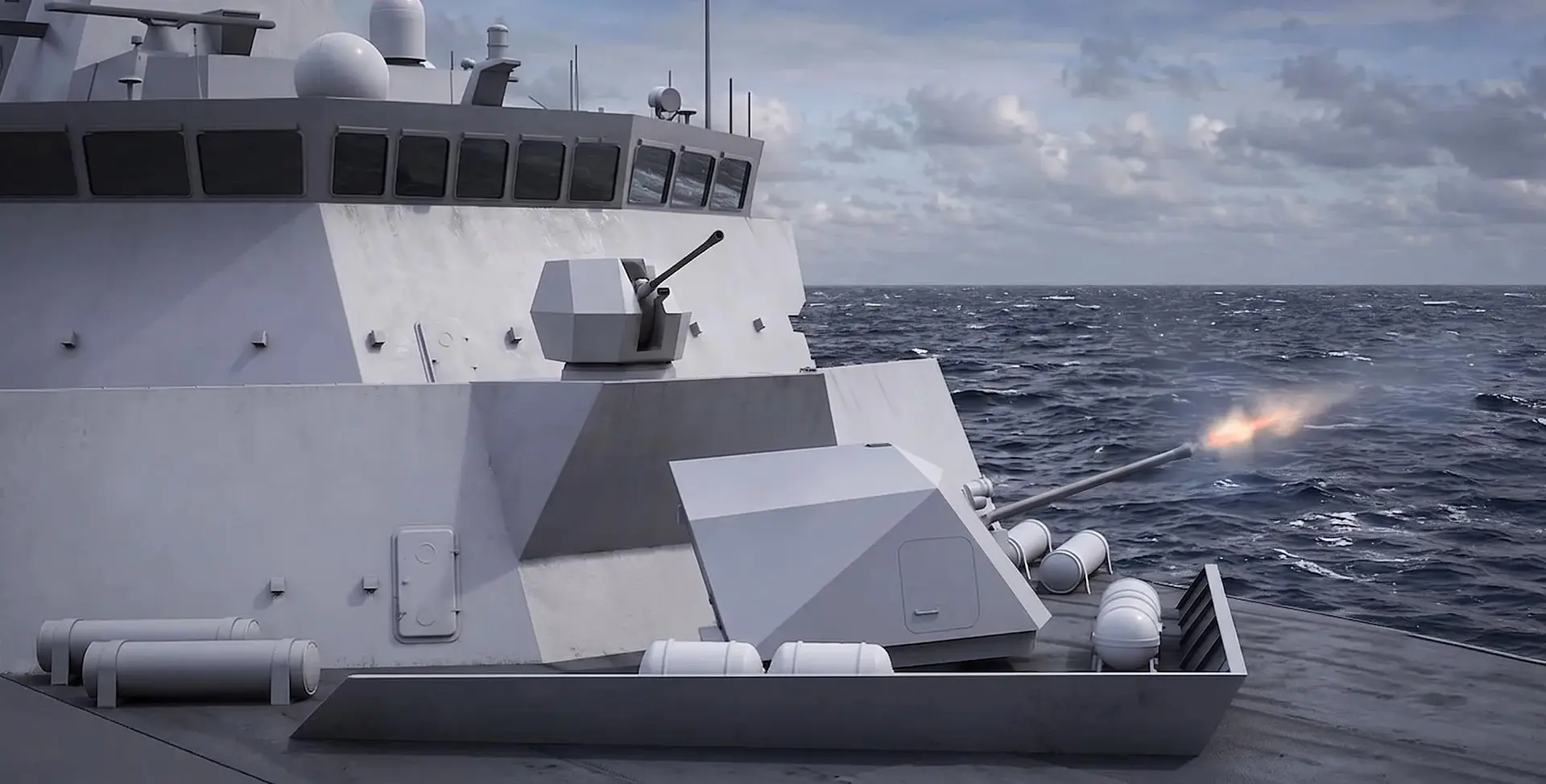
The Defence Investment Plan promised new munitions for the RN’s Type 31 frigates but says remarkably little about what will actually be bought. Behind that brief outline is a more complicated story involving ammunition already on contract, growing European demand and the possibility that guided 57mm rounds could eventually transform the effectiveness of the gun armament.
Beyond existing contracts
The DIP promises the Type 31 frigates will be equipped to fully exploit their new weapons against drones and surface threats, but gives little detail. The procurement is part of the £6.4Bn defence-wide munitions purchase, with no calibre, manufacturer, ammunition nature or value specified. The MoD says only that work is under way to provide ammunition for the Type 31 gun systems and that the precise scope, timing and value are commercially sensitive. The separate £1.6Bn Type 31 line covers Mk 41 VLS cells and Naval Strike Missile, while the Key Munitions section confirms NSM for both Type 26 and Type 31. The commitment is particularly opaque because operational and training rounds were already contracted several years ago.
BAE Systems Bofors was contracted through Babcock in October 2020 to supply five 57mm Mk 3 and ten 40mm Mk 4 guns for the five frigates, manufactured at Karlskoga in Sweden. Two ammunition contracts followed in November 2022. Nammo Raufoss received an £11M framework covering qualified 40mm and 57mm training ammunition. The single-source justification stated that Nammo owned the intellectual property for both target-practice rounds and was the supplier of the ammunition then being qualified for Type 31.
BAE Systems Bofors received a separate seven-year £65M contract covering technical support, simulators for the Type 31 Land Based Integration Facility and qualified 3P programmable ammunition for both guns. Bofors was again the only supplier considered able to guarantee that the ammunition undergoing qualification would be safe to use during ship acceptance.
In August 2023, the MoD issued a Request for Information (RFI) on future ammunition. It described the Bofors 57mm and 40mm 3P rounds and Nammo practice ammunition as providing the initial Type 31 gun capabilities, with an interim procurement already proceeding. The RFI examined alternative ammunition, supply-chain resilience and competition, noting that 3P’s sophistication could create a through-life cost issue. Analysis was due to run until May 2024, but no subsequent competitive award has been publicly announced but follow-on purchases are now within the contracts covered in the DIP.
Programmable punch
Both Type 31 gun calibres will initially have Pre-fragmented, Programmable, Proximity-fused (3P) rounds. Rather than carrying several specialised ammunition types, the gun can programme the same basic round immediately before firing according to the target.
Six fuze modes are available, including proximity detonation, time-controlled airburst and impact, allowing rapid engagement of aircraft, drones, missiles, fast boats and surface or shore targets without changing ammunition feeds. This is a substantial advance over conventional RN medium-calibre ammunition, but 3P remains unguided: programming determines how and when it explodes, not where it flies after leaving the barrel.
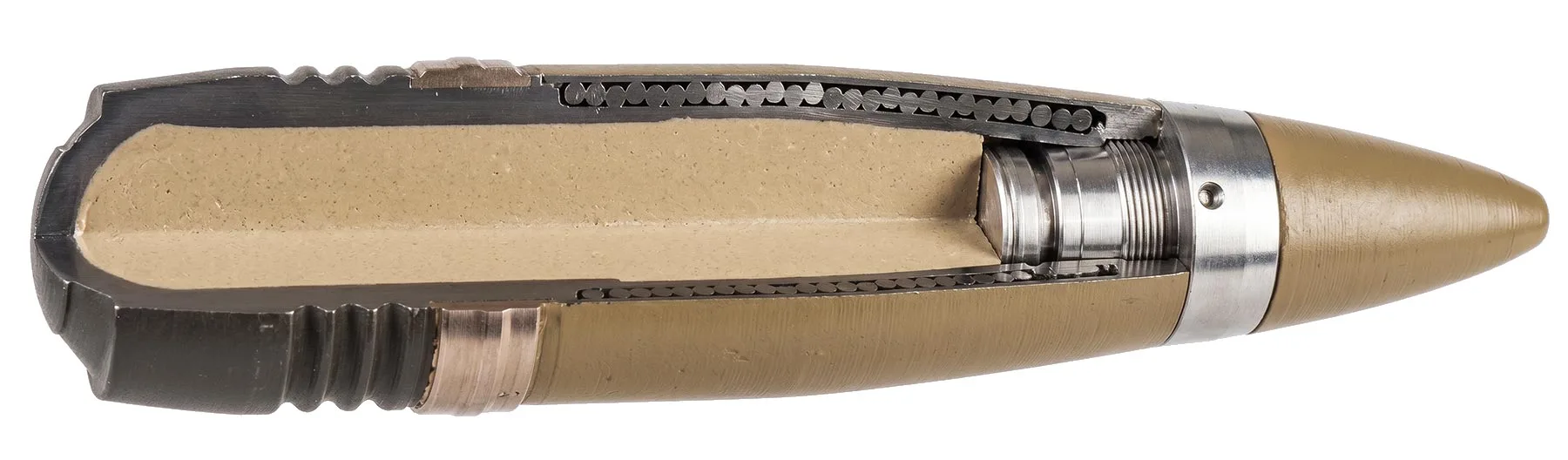 Cutaway of the 40mm 3P shell. The sophisticated fuse and sensors are in the nose. Note the 1,100 pre-fragmented tungsten pellets that surround the 120g PBX charge. When detonated, these are sprayed outward in a lethal cloud of metal that can destroy the delicate systems of missiles or aircraft or take out small boats and personnel. (Image: Navy Lookout).Close-range defence
Type 31 will carry two Bofors 40mm Mk 4 guns, one forward and another aft above the hangar. With a maximum rate of fire of around 300 rounds per minute, they provide the ship’s inner medium-calibre defensive layer. The 40mm 3P round contains tungsten pellets around a 120g polymer-bonded explosive charge, producing a quoted lethal area of about 140 square metres. Rather than requiring a direct hit against a small aerial target, correctly programmed ammunition can place a dense fragmentation pattern around it.
The Mk 4 has 100 rounds associated with the mounting, comprising a 30-round primary magazine and a 70-round intermediate magazine. Approximate barrel life is around 5,000 rounds. Programmable ammunition should reduce the rounds needed per engagement, but against sustained attack the ready-use capacity and speed of replenishment become limiting factors.
The Mk 4 can be configured as a deck-penetrating installation supplied from below or with its ammunition carried with the mounting and subsequently replenished manually. The precise replenishment arrangements aboard Type 31 have not been publicly detailed. The forward gun positions have space for magazines below decks, but the aft 40mm sits above the hangar where space is more restricted, making sustained replenishment of this mounting a particular point of interest.
The international supply picture for ammunition compatible with the 40mm L/70 family is narrower than it first appears. The standard cartridge is designated 40x365R, referring to its 40mm calibre and 365mm-long rimmed case. There is no obvious route to US Navy ammunition commonality because the service does not operate the Bofors 40mm L/70 family.
Nammo Sweden signed a seven-year Swedish framework in August 2026 for programmable 30mm and 40mm PABEX ammunition. The rounds are intended for land systems including Tridon Mk 2 and CV90, adding another significant customer for European 40mm ammunition. KNDS Group also offers ammunition in 40mm L/70, while Brazil’s Emgepron makes a variety of types including 3P ammunition. The existence of ammunition in the correct calibre does not, however, make it qualified for the Bofors Mk 4.
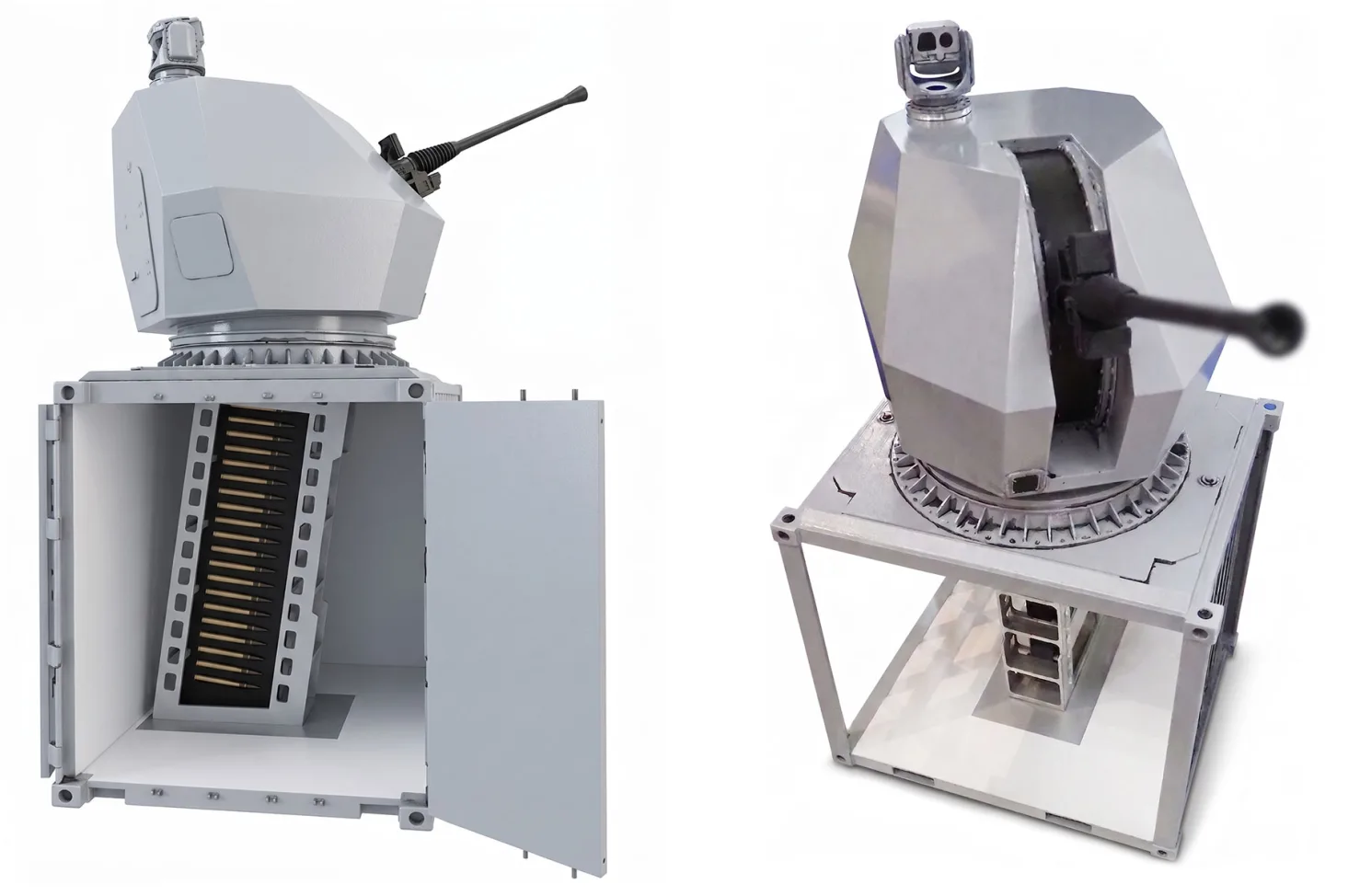 BAE Systems Model showing 40mm with optional deck-penetrating ammunition feed and on-mount optical director (Image: Navy Lookout).The heavier hitter
The Bofors 57mm Mk 3 forward is a considerably heavier weapon than the 40mm and will provide the principal gun armament of Type 31. Its Mk 295 Mod 0 3P complete round weighs about 6.1kg. The projectile itself weighs approximately 2.4kg and contains around 2,400 pre-fragmented pellets surrounding a 450g explosive charge, giving a quoted lethal area approaching 400 square metres. Published data for the 57mm 3P gives a muzzle velocity of around 1,030m/s. Maximum range varies according to ammunition and the definition used, with figures around 14.4km quoted for the Canadian 3P cartridge and greater ranges cited for other 57mm ammunition.
The Mk 3 carries 120 ready rounds and can fire at a maximum rate of approximately 220 rounds per minute. Its air-cooled barrel means this maximum cannot be sustained indefinitely and quoted barrel life is approximately 5,300 rounds. A small barrel-mounted radar measures the muzzle velocity of each departing projectile, compensating for variations including barrel wear and improving ballistic prediction and fuze timing.
Unlike the 40mm, the 57mm also has a substantial North American user base. General Dynamics Ordnance and Tactical Systems Canada manufactures 57mm 3P under BAE Systems licence as well as practice ammunition, while Nammo produces conventional 57mm L/70 HE and training rounds. US investment has also produced something the RN does not currently possess: guided naval gun ammunition.
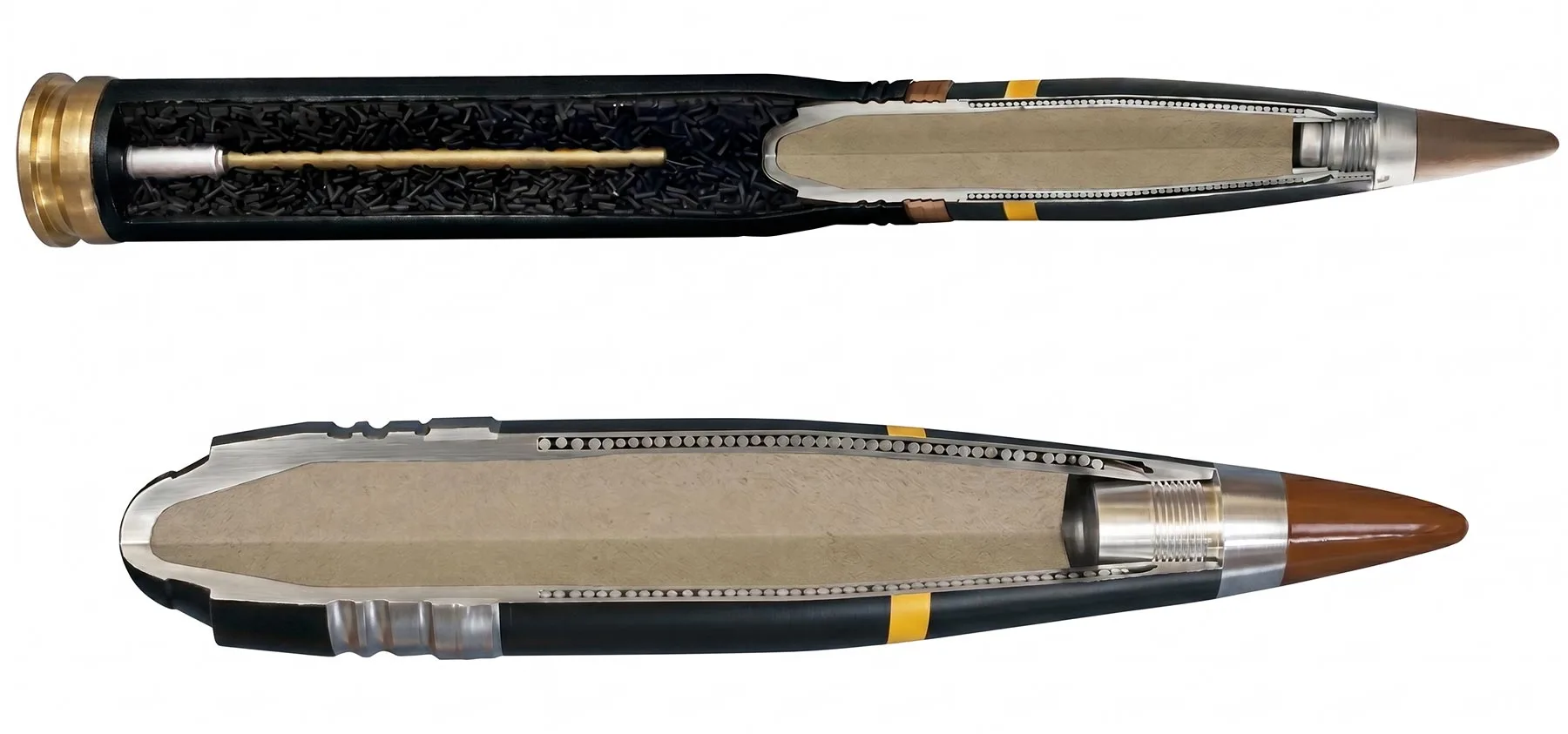 Cutaway of the Bofors 57mm cartridge and 3P shell (Navy Lookout image).Guidance required
Northrop Grumman is developing a guided 57mm high-explosive projectile for the US Navy’s Mk 110 57mm guns. The company received a development contract in October 2023 to mature and qualify the design and still describes the round as under development. The concept is particularly relevant to Type 31 because Northrop Grumman says it requires no modification to the gun itself.
The ship’s radar initially detects the target, establishes its position and provides the information required to slew and fire the gun. Once in flight, an onboard seeker activates, searches for the target, acquires it and tracks its movement. An ‘aft manoeuvre system’ provides continuous trajectory corrections in response to information from the seeker, allowing the projectile to follow a target that repeatedly changes course. Northrop Grumman has not publicly disclosed how the compact control system physically steers the projectile. The round also carries a multimode fuze capable of proximity and point detonation, selecting in flight which offers the best probability of defeating the target.
A fast target can invalidate a ballistic firing solution by manoeuvring during the projectile’s flight. A guided round can correct for that movement and potentially engage threats that might otherwise require a missile. Guided projectiles are far cheaper than missiles and exploit the much larger gun magazine.
Another US guided 57mm round has already reached production. The Mk 332 Mod 0 High Explosive 4-Bolt Guided projectile was developed by L3 under the Advanced Low-Cost Munitions Ordnance (ALaMO) programme and uses a radio-frequency seeker. A 2020 contract modification worth $14.85M (£11.1M) covered 808 rounds, equivalent to around $18,400 (£13,700) if the contract value is simply divided by quantity. Other US procurement data show ALaMO production lots at roughly $25,600-$32,700 per round, suggesting the true unit cost depends considerably on the contract and quantity involved.
BAE Systems’ earlier Ordnance for Rapid Kill of Attack Craft (ORKA), Mk 295 Mod 1, lost the US competition and does not appear to have entered production. The DARPA Multi-Azimuth Defence Fast Intercept Round Engagement System (MAD-FIRES), once mentioned in connection with Type 31, has similarly disappeared from public view following completion of its development phases. Neither presently looks relevant to RN procurement.
Finding the target
Type 31’s gun fire-control architecture is better suited to exploiting advanced ammunition than a simple count of directors might suggest. All three Bofors turrets are integrated through the Thales TACTICOS combat management system. Target information can be supplied by the ship’s Thales NS110 four-dimensional Active Electronically Scanned Array (AESA) radar and two Mirador Mk 2 electro-optical/infrared directors.
The NS110 provides multiple gunfire-control channels and has a separate channel supporting Sea Ceptor, while the Miradors also provide multiple channels. Four Thales Gatekeeper 360° staring EO/IR cameras provide additional situational awareness around the ship. Any turret can use the available fire-control channels, with TACTICOS dynamically allocating sensors and weapons across simultaneous engagements.
For conventional 3P, the accuracy and timeliness of the firing solution remain critical because the projectile cannot alter its course after leaving the barrel. A guided 57mm projectile would change that relationship. The ship still has to detect the threat, establish a sufficiently accurate initial track and point the gun, but after launch the projectile’s seeker and control system can correct its trajectory during the terminal engagement. That potentially gives the 57mm gun a useful additional layer between unguided ammunition and Sea Ceptor, particularly against small drones and manoeuvring surface craft where expending a missile may be disproportionate.
Type-31-Gunnery-controlFilling the magazines
Whatever ammunition is eventually selected, Type 31 is entering a market in which demand is rising quickly. BAE Systems secured orders worth approximately $171M (£128M) from Sweden and Finland in December 2025. Sweden is buying both 40mm and 57mm 3P ammunition while Finland is purchasing additional 57mm ammunition. BAE has been expanding output at Bofors as European governments rebuild stocks, with the same industrial base supplying naval users and a rapidly expanding land-based air-defence market. Demand for 40mm is particularly diverse, spanning Sweden’s CV90 fleet, Tridon Mk 2 and Nammo’s new PABEX programme.
The 57mm benefits from a wider naval customer base. Bofors is also strengthening the supply chain behind the weapons themselves. In May 2026, BAE completed its acquisition of Swedish precision-machining supplier Aston Harald, explicitly citing increased production capacity and supply security for products including the 40 Mk 4 and 57 Mk 3.
For the RN, procurement timing is important. HMS Venturer will be handed over to the RN sometime in the next two years, to be followed by acceptance, certification, trials and work-up. Buying large stocks early consumes money and ammunition shelf life before the ships are operational, but waiting risks joining production queues after other nations have secured capacity. The 2023 RFI suggests the MoD recognised these supply-chain and cost issues well before the DIP, explicitly examining market readiness, resilience, competition and alternatives offering better through-life value.
Although owned by a British company, the Type 31’s gun armament is of Swedish origin, its initial operational ammunition comes from Bofors and its training rounds from Norwegian-owned Nammo. The UK does not currently have a domestic production line for either calibre. This is not necessarily a serious weakness given close defence relationships with Norway and Sweden, but makes assured production access and sufficiently deep UK stocks important.
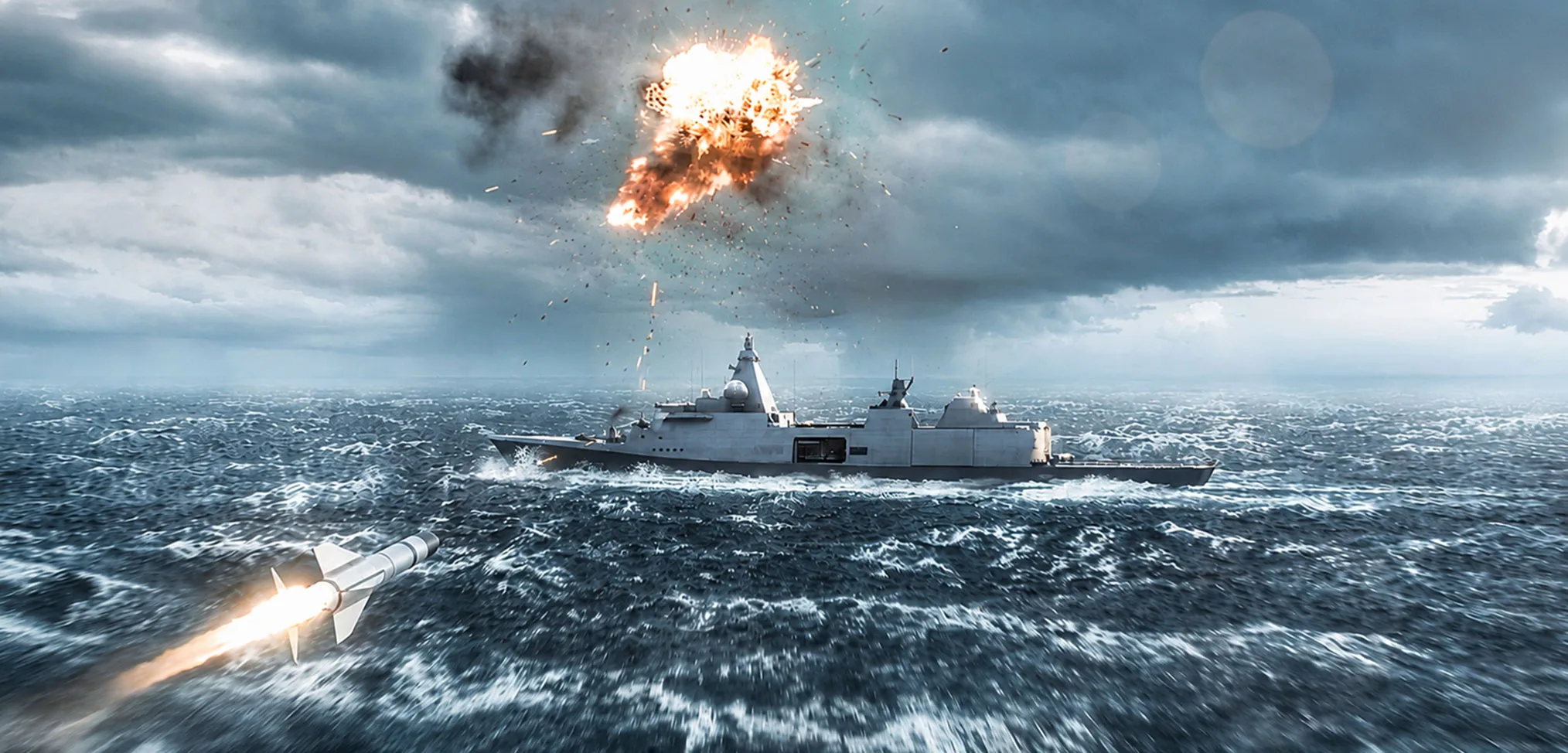 Visualisation of Type 31 guns in the defensive counter-missile role (Image BAE Systems).Multiplying ammunition families
Type 31 is only part of a wider change in RN naval gunnery. Type 23 frigates and Type 45 destroyers use the ageing Vickers 113mm Mk 8 gun, a unique calibre with no prospect of further ammunition development. Its replacement brings access to much more sophisticated rounds, but also leaves the RN supporting five naval gun ammunition families into the 2030s: legacy 113mm, 30mm ASCG, 40mm and 57mm for Type 31, and 127mm for Type 26. The price is greater logistics and training complexity, offset by access to ammunition markets where development and production continue.
Type 31 introduces programmable 3P ammunition which alone represents a substantial improvement in the RN’s medium-calibre ability to engage drones, missiles and small surface craft, particularly where proximity or controlled fragmentation offers a much greater probability of effect than conventional impact-fuzed ammunition. Guided ammunition would go further. A 57mm projectile able to acquire and manoeuvre towards a moving target begins to blur the boundary between gun and missile, promising greater effective range, better performance against evasive targets and cheaper engagements while conserving missiles. Type 26 could eventually provide the same qualitative shift at much greater range through advanced 127mm ammunition.
The DIP does not say the RN is buying guided 57mm ammunition. Northrop Grumman’s new projectile remains in development, and no advanced 127mm round has been ordered publicly for Type 26. The confirmed starting point for Type 31 remains Bofors 3P. For the first Type 31s putting to sea, at least initially, with minimal missile armament of 12 Sea Ceptors and no 30mm ASCG, it is especially important that each vessel has fully stocked magazines, certified gun systems and a trained crew to operate them.