
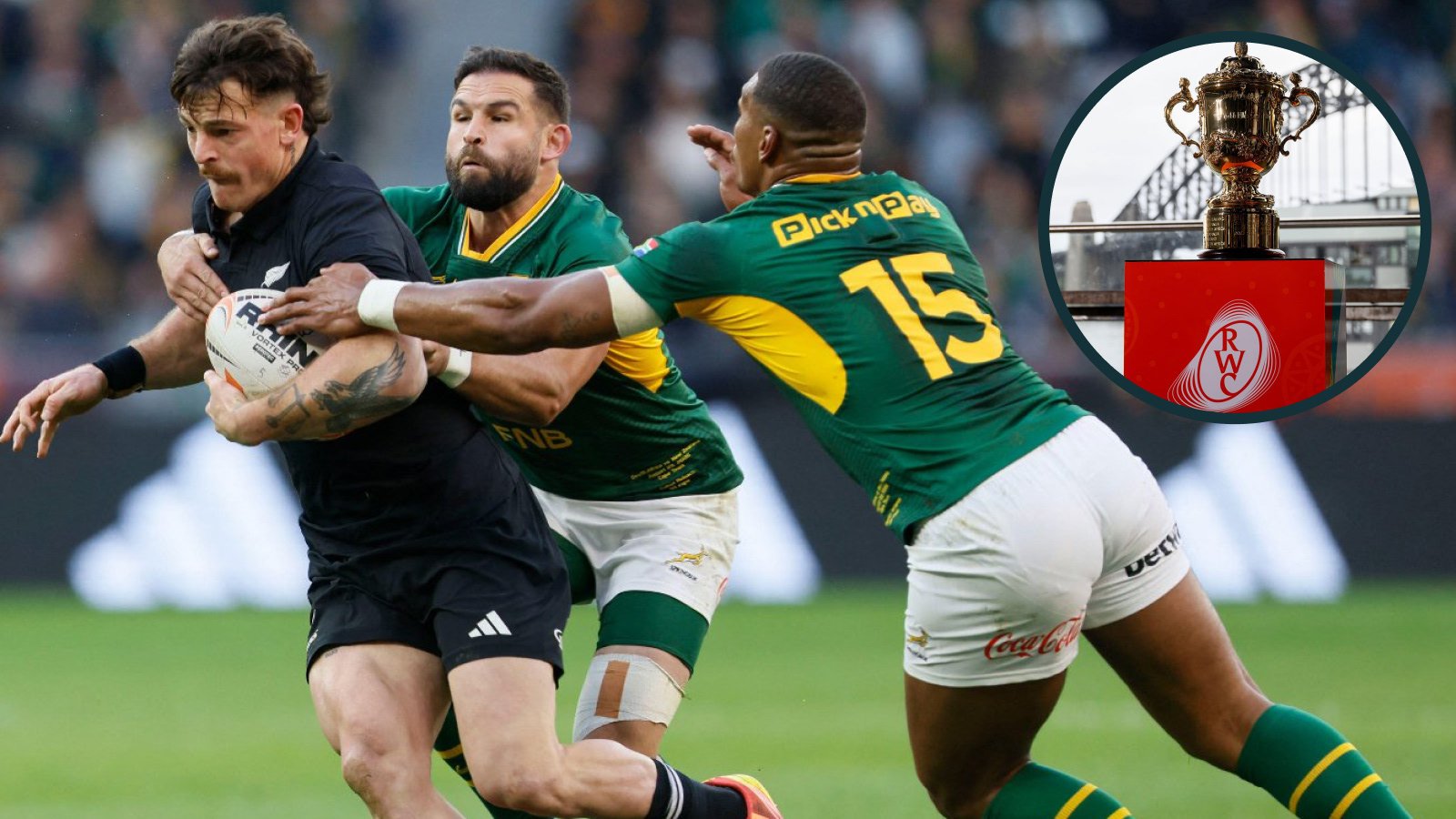
South Africa and New Zealand have spent five weeks proving they’re the two best sides on the planet. If the pools at Rugby World Cup 2027 in Australia run to seeding, their reward is a quarter-final showdown.
The top line
When the fourth Test of Rugby’s Greatest Rivalry kicks off in Baltimore on Saturday, with the Springboks 2-1 up after Ellis Park, Cape Town and Soweto, the two sides walking out will be ranked one and two in the world. They were one and two on 1 December 2025 as well, which happens to be the date World Rugby used to build the bands for the 2027 draw, and, for avoidance of doubt, the top spot has already changed hands twice inside this series alone.
So, the algorithm knew and it has known for two years. And the Rugby World Cup tournament format has taken that information, considered it carefully, and pointed the pair of them at each other in the last eight, for reasons completely inexplicable to the rugby public.
How the draw did it
The actual mechanics are worth understanding, because nothing improper happened here and that’s the damning bit. Twenty-four teams, six pools of four, top two from each plus the four best third-placed sides into a new round of 16. The rankings of 1 December 2025 split the field into four bands of six, band one held South Africa, New Zealand, Ireland, France, England and Argentina, and the draw in Sydney two days later put the Boks into Pool B and the All Blacks into Pool A. The balls came out as they came out, with Dan Carter and James Slipper doing the honours in front of a room that didn’t seem to grasp what it had just witnessed when SA and NZ were drawn.
The problem is underneath the balls, because the bracket pairs the Pool A winner with the Pool B winner at the quarter-final stage, and, unlike other sports, there’s nothing anywhere in the design that keeps the first and second seeds apart. South Africa get Italy, Georgia and Romania. New Zealand get Australia, Chile and Hong Kong China. Do the obvious thing in both pools and the two best teams in the world play each other with three rounds still to run.
World Rugby’s explainer had an answer ready for this, just in case, although the reasoning appears to be paper thin. Since the winners of Pools A to D face a third-placed side in the last 16, whilst the winners of Pools E and F face a runner-up, it therefore, in their words, “will all even out in the end”. Which would be a comfort if the complaint were about the round of 16. It’s a governing body answering a question about the architecture of its own tournament by pointing at a different room.
The incentive that really doesn’t matter
Then there’s the bit that should be keeping Rugby Australia awake. Finishing second in Pool A avoids the winner of Pool B in the quarters, which means the host nation has a coherent, spreadsheet-friendly argument for coming second in its own group, at home, against the All Blacks, in the biggest pool match this tournament has ever put on sale.
Nobody thinks Les Kiss is going to throw a Bledisloe fixture in front of 90,000 people. But Brett Robinson launched this format on the promise that “every match counts”, and he’s built one where the host’s marquee fixture counts against them, and one that potentially robs rugby of the final it demands.
Rugby has been here before
The 2023 draw is still the benchmark for incompetence. Held on 14 December 2020, almost three years out, seeded off January 2020 rankings because the pandemic had frozen the calendar, and by the time anyone actually played the thing the top four sides in the world, Ireland, New Zealand, France and South Africa, were sitting in the same half. Ireland went out to New Zealand in a quarter-final. France went out to South Africa in another. The best match of the tournament, and everyone in the Stade de France knew it at the time, was played a fortnight before the final.
Why All Blacks and France are built to stay with the Springboks, whilst England trail behind
Bill Beaumont’s defence of the timing was that the early draw gave “surety of the host cities and knowing where teams were going”, which is a sentence that really means nothing in playing terms. They could pin down the stadiums three years out. They just couldn’t manage the smaller question of which teams would be any good by the time they got there. Alan Gilpin later conceded the whole thing had been made too early and moved the 2027 draw inside two years, calling that a compromise, and he was right about the compromise part. Yet history appears to have repeated itself.
Further back it’s the same story with a mildly different cast. The 2015 pools were drawn in December 2012, when Wales were outside the world’s top eight and so came out as third seeds, which is how England ended up in a group with Wales and Australia and became the first hosts eliminated at the pool stage. In 2007, France lost their opener to Argentina, finished second and were routed straight into the Pool C winners, so New Zealand, the world’s number one side, lost a quarter-final in Cardiff and the final was South Africa against England.
Every one of those was signed off by people who’d read the rules very carefully and never once tested them against a fixture list that had any form of emotional resonance with the watching public.
What the rivalry actually gets out of this
Put the 2027 bracket next to the history of the fixture and it looks more careless rather than unlucky. South Africa and New Zealand have met 113 times since 1921, the All Blacks leading 64 to 45 with four drawn going into Saturday, and only six of those meetings have come at a World Cup.
Two were finals. Ellis Park in 1995, decided by three points, and the Stade de France in 2023, decided by one. The rest were a quarter-final in Melbourne in 2003, a semi-final at Twickenham in 2015, a third-place play-off in 1999, and a pool match in Yokohama in 2019 that the draw served up two weeks into the tournament, after which the two never met again. Ten World Cups; the fixture the sport sells harder than anything else has settled it twice.
Meanwhile this expanded format will play 36 pool matches in order to send eight teams home. The old one played 40 to send home twelve. Four extra teams have bought us a safer pool stage in which almost nobody goes out, and a knockout draw that eats its own headline act in the first week of proper rugby.
Want more from Planet Rugby? Add us as a preferred source on Google to your favourites list for world-class coverage you can trust.
The fix isn’t complicated
Re-seed after the pools. Rank the six pool winners on their records and put the top two in opposite halves before the round of 16 is set. Plenty of competitions manage it, on the radical principle that topping your group ought to be worth something.
The objection will be logistical, and it’s genuine, because Australia is vast, the venues run from Perth to Brisbane, and a fixed bracket sells tickets and books flights. Ticketing is a real constraint but surely it just shouldn’t outrank the question of when the two best teams in the world are allowed to play each other? This is fundamental to a World Cup.
World Rugby had one job after 2023, which was to stop the tournament eating its best match before the closing weekend. It moved the draw, expanded the field, added a knockout round, called it a landmark moment for the sport, and produced a structure in which the top two ranked teams are odds-on to meet before either reaches a semi-final. Saturday in Baltimore settles a series. If the pools go as seeded, the next one is a quarter-final, with each side three wins from the Webb Ellis Cup and the loser out with a fortnight of the tournament still to play.
READ MORE: Springboks v All Blacks: Seven talking points from Soweto as South Africa go 2-1 up