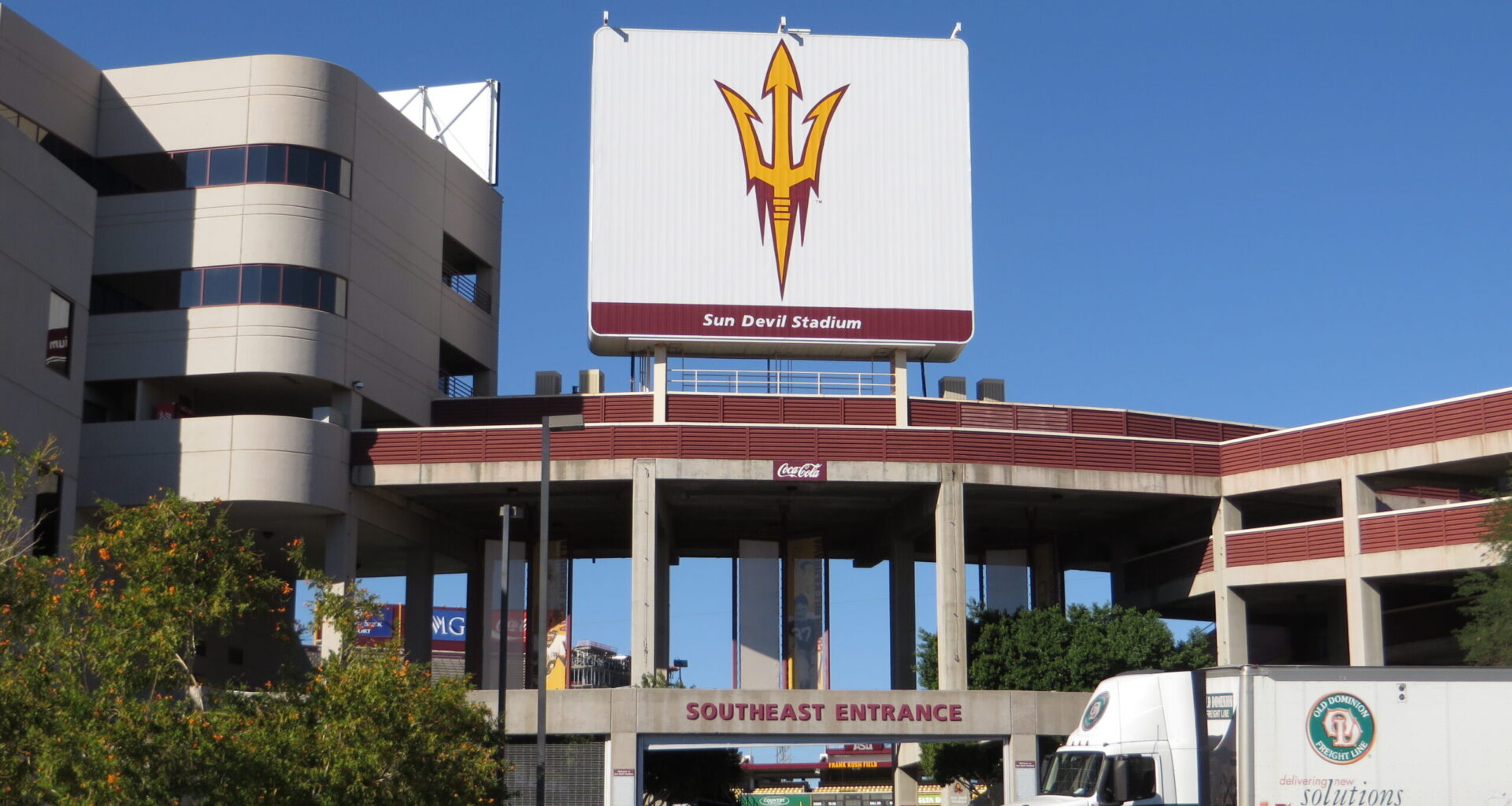
Walk into a Primark in the United Kingdom, and you will find the jumper aisles lined with American university names — Yale, Harvard, Princeton.
They are brands as much as institutions, worn by people who have never set foot on their campuses.
But two names will not have been there: Arizona State and Kansas.
Two universities that are virtually unknown to Britain — yet on 19th September, they will walk out at Wembley Stadium to play the first-ever NCAA college football game on UK soil.
American football has made extraordinary waves since first arriving in the UK in 2007, when the Miami Dolphins faced the New York Giants at Wembley. Now three NFL games take place here every year, split between Wembley and Tottenham Hotspur Stadium.
College football coming to the UK is not just a sign of how far American football has travelled; it is part of a continued, deliberate American invasion of global sport.
The Big Four — the NBA, NFL, NHL and MLB — have all sent games across the Atlantic.
Now it is college football’s turn.
They already play games in Ireland through the Aer Lingus College Football Classic, and this next step is a significant risk.
But one that could pay off enormously for the sport.
To get a better grasp of the game, Sports Gazette spoke to two ASU reporters.
For Hod Rabino, publisher of Devils Digest, the announcement immediately raised the question of brand globalisation.
“I was kinda surprised by the announcement. I know Arizona State does pride itself on a very big global reach. Their campuses here in Arizona, they have nearly 18,000 international students from 160 countries,” Hod went on to explain.
“I know that they also have a campus in China, and it’s absolutely a school that prides itself on an international outreach and also having a lot of international students on campus.”
The case for ASU as the standard-bearer of the Union Jack Classic is easy to make. Their international educational reach is already substantial — and this game offers a rare chance to extend it into sport.
That global identity runs through the squad itself.
Kirt Vakalahi, a defensive lineman, and punter Nick McLarty—both from Australia—prove that ASU’s recruiting already crosses oceans.
An international fixture could open that door even wider.
The game presents a unique opportunity to think bigger — to be genuinely ambitious about what American college football can become on the world stage.
Chris Karpman, a sports writer with SunDevilsSource, echoes that global ambition and traces it directly back to the university’s leadership.
“Michael Crow [ASU’s President] has envisioned a global brand, and my understanding is that he aims to expand Arizona State’s online programmes to the UK and other markets,” Karpman told Sports Gazette.
“Since they don’t currently offer students there the opportunity to earn degrees from ASU, I knew this expansion was inevitable.”
The drive to go beyond America is not ASU’s alone — it is shared by the conference they play in, The Big 12.
Commissioner Brett Yormark has earned a reputation as one of the most proactive strategic thinkers in college sport, and the Union Jack Classic reflects that.
This is an expansion play designed to bring in new money and new eyeballs for the Big 12.
“Brett Yormark is very aggressive about trying to figure out new strategies and approaches to increase the fan base,” Karpman explained
“To expand the audience. I think this [Union Jack Classic] was part of his thought process on how to go about doing that.”
In an effort to compete with the SEC and the Big Ten, the Big 12 is making a bold move to capture new audiences and revenue — and to make themselves a more formidable force in the college football landscape.
Hosting a regular-season game at one of the most iconic stadiums in the world is a powerful statement of intent. ASU President Dr Michael Crow is convinced that British exposure will translate into something lasting — new fans, new students, new reach.
“That sits in the back of the mind of Michael Crow, who again, already has established campuses overseas, and definitely would like to establish some more,” Rabino says.
“They fully realise that this is a game that can open some doors…when the Big 12 was presented with this opportunity, they knew that Arizona State, compared to other schools in the Big 12 conference, is a school that really prides itself on international outreach.”
Head Coach Kenny Dillingham—a university alumnus—has cemented his reputation as one of the game’s most dynamic leaders. After a breakthrough season that saw the team surpass expectations and reach the College Football Playoff quarterfinals, Dillingham’s decision to reject interest from Michigan and remain with the Sun Devils has only intensified the excitement surrounding the program.
Especially knowing now that the game will be played at a neutral site rather than at Kansas has only added to the anticipation among ASU fans.
While most fans will watch from afar, the beloved college football tailgate tradition is unlikely to survive the transatlantic journey for the few supporters who travel.
“I expect that people will figure out where they can pre-party in nearby bars or other places to gather, since the experience includes everything that leads up to the game and what you do afterwards.” Karpman explained.
With the UK’s drinking age set at 18—a notable shift from the US requirement of 21—many college students will likely take advantage of the local scene, turning pubs, restaurants, and town squares into social hubs for pre-game festivities.
The Union Jack Classic is a high-stakes match for ASU on every level.
On the field, it is a chance to set the tone for another College Football Playoff push.
Off the field, the university aims to seize a growing global audience to expand its international brand and online programmes.
For the Big 12, the hope is that this bold venture pays off in fans, revenue, and a stronger hand against the SEC and Big Ten.