

Some UK departing flights disrupted by technical issue
A technical problem with air traffic control is disrupting some flights across the UK.
Some departing flights at airports across Britain were disrupted on Tuesday after air traffic control provider NATS experienced a technical issue, Heathrow Airport said, adding that arriving flights were not currently affected.
Heathrow said it was working with NATS to resolve the problem as quickly as possible, Reuters reports.
Back in 2023, a technical problem at NATS led to widespread disruption across UK airports…
Updated at 10.24 EDT
Key events
Edinburgh Airport is hoping NATS can fix the technical problem fast!
They’ve posted on X:
double quotation markWe are aware of a technical issue affecting which may impact operations. We are working closely with air traffic control, airlines and other partners, and hope @NATS can resolve the issue as quickly as possible.
Manchester and Stansted airports are also affected by the UK’s air traffic control technical issue, Reuters report.
ShareITV: Heathrow, Gatwick, Southend, Isle of Man and Jersey Airports all affected
Heathrow, Gatwick, Southend, Isle of Man and Jersey Airports are all affected by today’s disruption, ITV News report.
A spokesperson for Jersey Airport said:
double quotation mark“UK air traffic control is currently experiencing issues which is impacting flights across the UK including services between Jersey and UK.
Passengers are advised to check the latest flight information directly with their airline.”
ShareNATS apologises for delays
Britain’s National Air Traffic Services have apologised for the problems affecting flight departures today.
Posting on X, NATS confirms there is a ‘technical issue’:
double quotation markℹ️ Technical issue We are investigating a technical issue which is causing some disruption to flight departures. Our engineers are on site and we will provide an update as soon as we can.
We apologise for the delay this will cause to journeys, passengers should check with their airline on the status of their flight. We will provide updates on https://nats.aero
ShareSome UK departing flights disrupted by technical issue
A technical problem with air traffic control is disrupting some flights across the UK.
Some departing flights at airports across Britain were disrupted on Tuesday after air traffic control provider NATS experienced a technical issue, Heathrow Airport said, adding that arriving flights were not currently affected.
Heathrow said it was working with NATS to resolve the problem as quickly as possible, Reuters reports.
Back in 2023, a technical problem at NATS led to widespread disruption across UK airports…
Updated at 10.24 EDT
Bailey: Food inflation has been lower than expected
Labour MP Julie Minns turns the Treasury committee’s attention to agriculture, and the impact of recent hot weather.
She explains that she recently visited the UK’s largest sheep auction, and saw that lambs are being sold earlier than usual – which means farms are receiving lower prices, but are forced to sell because the pasture hasn’t been there this year.
Andrew Bailey replies that the agricultural sector is important, and the Bank has noted that yields have been lower on cereal crops, such as winter wheat, spring barley and oats.
Internationally, El Ninos have historically affected the prices of rise, coffee, cocoa and palm oil.
Bailey says, though, that food prices haven’t risen as fast as expected yet:
double quotation markFood price inflation has come in under where we thought it would.
However, I think unfortunately this is another area where the risks are. On the upside, we have built into our forecast stronger, stronger food inflation by the end of the year.
ShareBailey: No secret plan to raise interest rates unconditionally
Bailey then insists that the Bank of England doesn’t have a “secret plan” to raise interest rates.
He says he sometimes get quite frustrated that some of his comments are interpreted as unconditional statements. They are conditional, he insists, because the world is uncertain.
Governor Andrew Bailey then tells MPs that mortgage rates in the UK have risen faster than in most, if not all, other major countries.
He says:
double quotation markUK mortgage rates now are typically at the moment about 75 basis points [three quarters of a percentage point] higher than they were at the point when the conflict broke out.
I think with the possible exception of Japan, although that’s a little hard to map, that’s the largest increase in mortgage rates in the G7.
ShareWatch the Bank of England hearing here
You can watch the Treasury committee hearing with some of the UK’s top central bankers here:
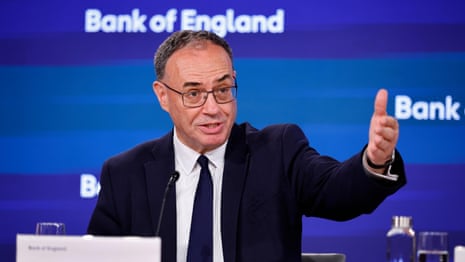 Bank of England governor Andrew Bailey faces parliament treasury committee – watch liveShare
Q: What would it take for Bank of England policymakers to change course on rates?
Bank of England policymaker Alan Taylor argues that has already course-corrected, even though “even though it may look like we’ve done nothing in terms of changing Bank rate”.
He points out that before the Iran war began, the markets was expecting two, maybe three cuts this year.
Instead, rates have been on hold all year – which Taylor dubs “an active decision to maintain restrictiveness.”
Deputy governor Dave Ramsden takes an alternative view, pointing out that wage growth has actually been below the Bank’s forecasts this year.
He argues that the global inflationary picture is much more of an upside inflation risk, rather than the ‘benign domestic picture’.
That’s why Ramsden was happy to vote to hold interest rates at the Bank’s last meeting, while Greene voted for a rise.
Bank of England policymaker Megan Greene then tells MPs that the the length of time the oil price has been high worries her, given the dangers of 2nd round effects (where high prices push up wages, which push up prices).
Greene argues it is better to act now on interest rates, and change course if the inflation shock is lower than she fears.
She explains:
double quotation markIf you think that you might be in a situation with higher energy costs and more second round effects and act accordingly and determine actually that’s not the case, then you can course correct, you’ll stay on top of inflation.
Updated at 09.41 EDT
Bailey: Oil price could be higher….
Treasury committee chair Dame Meg Hillier begins by asking the Bank of England about the economic consequences of the ongoing Iran war.
BoE governor Andrew Bailey responds, pointing out that the conflict is “obviously” a high level of high level of energy prices.
And he warns that oil price (which approached $100 a barrel today) could rise higher.
Bailey says:
double quotation markI think it’s fair to say that we’ve got higher energy prices. They could be higher still.
Bailey adds that pipelines are helping to move oil out of the region, but points out that the Houthis have attacked the Red sea area, which is where the Saudi pipeline goes to.
And he touches on crack spreads – the price difference between crude oil and its refined products.. That spread has widened, and it’s not all due to the Iran war.
Bailey explains that Russia has “quite a concentration” of refining capacity, which Ukraine has been successful at attacking.
double quotation markQuite a bit of the crack spread is actually not to do with, you know, the Strait of Hormuz.
Updated at 09.29 EDT
Bank of England hearing begins at parliament
Over in parliament, some of the Bank of England’s top policymakers are starting to be questioned by MPs on the Treasury Committee.
Happily, there’s a range of hawks and doves from the BoE, so we might hear about the disagreements at the central bank about interest rates.
Governor Andrew Bailey (who has recently been the ‘swing voter’ on the monetary policy committee is accompanied by deputy governor for Markets and Banking, Sir Dave Ramsden, as well as two external members – Megan Greene and Professor Alan Taylor.
In July, Greene voted to increase the Bank Rate by 0.25% while the other three witnesses were in the majority voting to hold rates. Taylor, though, is among the most dovish of the committee, and was voting for interest rate cuts earlier than many other colleagues last year.
Pleasingly, Taylor and Greene are at opposite ends of the table – reflecting their positions on the hawks-and-doves-ometer.
The committee says:
double quotation markThe session will focus on July’s Monetary Policy Report, and the MPC’s most recent decision to hold the Bank Rate at 3.75%.
MPs are likely to question witnesses on the potential inflationary impact of the ongoing war in Iran and how the MPC considers recent developments in AI.
Updated at 09.30 EDT
Before today’s UK bond sale took place, strategists at RBC had said some investors might be wary of buying into long-dated debt due to last week’s global drops in fixed income prices, “which continues to reinforce the risk of trying to catch a falling knife here“.
However, they said UK-specific factors were more positive and had contributed to a narrowing of 10-year gilts’ yield premium over German debt.
ShareAbout the UK’s ‘moron premium’….
The jump in UK borrowing costs has reignited talk that the UK is suffering from a ‘moron premium’ on its debt.
This term was coined by Dario Perkins of City research firm TS Lombard back in 2022 after Liz Truss’s mini-budget sparked a bond sell-off, and tends to be trotted out whenever UK bonds are under the cosh.
Yesterday, chancellor John Healey cited Liz Truss, austerity, and Brexit as causes of the UK’s borrowing challenges.
But, in a note titled “Diagnosing the cause of the UK’s moron premium”, Simon French of Panmure Liberum argues that the real cause of this excess yield premium is the UK’s inflation problem, due – he argues – to an inefficient supply side of the economy,,
French argues:
double quotation markIf something broke in the Gilt market in 2022, as Healey claims, then it was higher global inflation revealing the UK as a high beta economy for that theme.
Truss and Austerity did not make the UK economy high beta, and whilst Brexit did add inflationary frictions into the UK’s trading regime it has been less significant than the frictions created in domestic-orientated supply.
It would be easy to dismiss this as political framing from Healey, but for the fact that an honest diagnosis is necessary to unwind some of the luxury beliefs that gum up the supply side of the UK economy. “Control” – still an ill-defined concept by this government – will need to be a Trojan Horse for supply side reform if the UK government’s moron premium is to be reduced.
[‘high beta’ is a financial term for heightened volatility, such as a stock which moves up and down more rapidly than the wider market].
ShareAt least there were plenty of bids…..
Matthew Amis, investment director for rates management at Aberdeen Investments, is encouraged that there was strong demand for UK debt at today’s sale – even though buyers demanded a high interest rate.
Amis explains:
double quotation mark“With rising government bond yields, in particular long-end maturity bonds, today’s 30-year syndication was a key health check for the gilt market. UK long issuance has been much reduced in recent years, with the last 30-year syndication coming back in 2025.
“A poorly received gilt syndication would have put further pressure on gilt yields and in turn government finances. Despite this negative build-up, the re-opening of the 2056s gilt was well received by the market. UK primary issuance continues to be well-received and today’s syndication shows demand for gilts at these yields remains in good health.”
According to Reuters, the UK received more than £85bn of bids for the debt on sale, allowing it to choose the most attractive offers when selling £4.25bn of debt (however, even those offers can’t have been terribly eye-catching, as the UK agreed to pay such a high yield on this debt).
ShareUK pays highest borrowing rate since 1998 in 30-year bond sale
Newsflash: The UK has paid a record high borrowing cost to sell 30-year government debt this morning, as bond market turbulence puts pressure on the public finances.
The UK has sold £4.25bn of gilts maturing in 2056 at a yield, or interest rate, of 5.8168%, Reuters reports.
This appears to be the highest yield for any gilt sale since the UK’s Debt Management Office was created in 1998.
Significantly, it is above the 5.4047% yield which bonds of this type were sold for in May 2025.
It’s not a massive surprise, as last week’s bond market sell-off pushed up the yield on 30-year UK bonds to the highest since 1998. But such high borrowing costs will eat into the UK’s headroom to keep within its fiscal rules, adding to the challenge facing chancellor John Healey.
The bond sell-off has been caused by several factors, including fears that higher inflation will force central banks to lift interest rates, concerns that some countries are not controlling their spending, and competition from AI companies issuing debt to fund data centre rollouts.
Updated at 07.15 EDT