
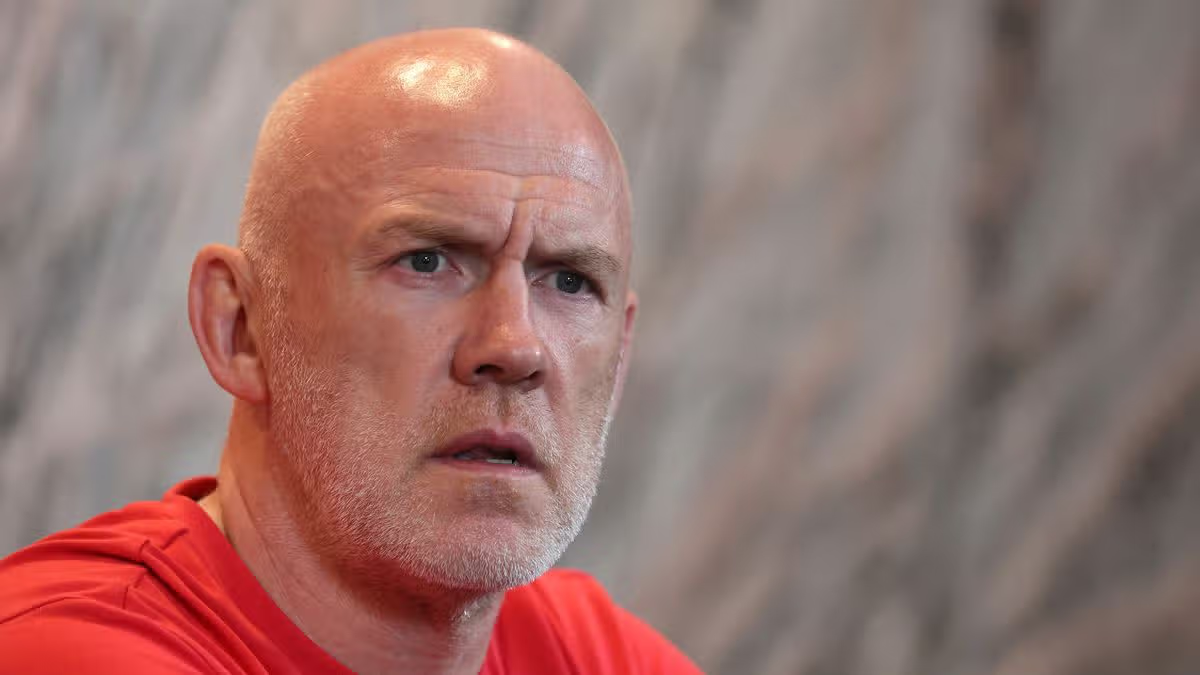
With the 2026-27 season upon us, Wales have just 12 Tests remaining before they begin their Rugby World Cup campaign against Zimbabwe in Adelaide next year.
Steve Tandy, therefore, has little time to waste. If Wales are to arrive in Australia capable of making a serious impression, the head coach has a substantial amount of work to do.
There were signs of improvement in performance during the Six Nations, but results remain a concern. Since taking charge, Tandy has won only three of 12 Test matches.
The challenge is clear. Wales have significant shortcomings to address across the team, and with the World Cup now firmly on the horizon, the margin for error is narrowing. Here are the areas that desperately need fixing.
JOIN OUR WALES RUGBY FACEBOOK PAGE Latest news, analysis and much more
Settle on a number 10 and attacking style
Wales’ attack has come under sustained scrutiny from a number of former players who have since established themselves as prominent pundits.
Matt Sherratt, the attack coach, has remained steadfast in his approach, continuing to select a second playmaker at inside centre, whether that has been Ben Thomas or Joe Hawkins.
The thinking is clear enough. Sherratt wants to bring greater variety to Wales’ attack, creating a shape that offers multiple options and, ideally, gives his backs a chance to exploit space.
The problem is that there is an increasingly persuasive argument that Wales lack both penetration and direction in midfield.
Eddie James, the powerful Scarlets centre, has predominantly been used at outside centre, yet several pundits believe his skill set would be better suited to No 12, where his size and physicality could be used to punch holes in the opposition defence and consistently win the gainline battle.
Bryn Bradley, the uncapped Harlequins centre, is another option who could potentially provide the power and directness Wales appear to lack.
There is, however, a more fundamental issue. If Wales’ pack is being driven backwards and losing collisions, it becomes considerably harder to execute the type of expansive game Sherratt wants to play. Attack coaches can devise as many intricate shapes as they like, but they still require a platform from which to operate.
Continuity and cohesion, both in selection and playing style, are important. But so too is the willingness to recognise when an idea is not producing the desired results and change course.
Wales may now be approaching the point where that decision has to be made.
Dan Edwards has started 10 of Wales’ 12 Tests since Tandy took charge, although Sam Costelow’s involvement has been limited by injury. Even so, there remains a sense that Tandy has yet to settle on his first-choice No 10 with the Rugby World Cup now approaching.
Edwards and Costelow offer different qualities, and there are merits to both options. But Tandy cannot afford to enter a World Cup campaign still searching for his answer at fly-half. By the time Wales kick off in Australia, he needs to know who his man is.
Wales have not settled on a first choice fullback
During the Six Nations, Tandy decided to give Louis Rees-Zammit a run of games at full-back.
The Bristol Bears flyer did not do a bad job, but his strengths are better suited to the wing, where he can use his pace in space to burn defenders and score tries.
Wales abandoned the experiment during the Nations Cup over the summer, with Blair Murray returning to full-back.
The Scarlets man is an exciting attacking player, particularly effective in transition and capable of creating opportunities when there appears to be nothing on.
But in international rugby, the aerial game is crucial, particularly since World Rugby decided to ban escort runners.
Murray is brave both defensively and under the high ball, but at 173cm he is not the tallest full-back in world rugby. There should be a place for the 24-year-old in Wales’ team, but many would argue that place should be on the wing.
His Scarlets team-mate Ellis Mee is strong under the high ball and is expected to get a run of games at full-back in the URC this season.
Tandy could also do worse than consider Cardiff’s Jacob Beetham. The 25-year-old stands at more than 6ft, is strong under the high ball and is an intelligent footballer.
Tom Rogers has also left the Scarlets for the Ospreys in order to play full-back, so it will be interesting to see how he develops in the position.
The real bolter, however, could be Wales Under-20s full-back Lewis Edwards. At 6ft 4in, he has the size required for the modern game and is imperious under the high ball.
Edwards has already been compared with England star Freddie Steward because of his aerial ability and stature, although he is arguably a more dangerous attacking threat.
The prospect of the 20-year-old making Wales’ senior World Cup squad may sound far-fetched at present. But if he can break into the Ospreys side and establish himself at senior level, he could yet emerge as the bolter.
Tighthead remains an issue
Tighthead prop remains one of the most important positions on a rugby field.
Wales will be hoping the experienced Tomas Francis can continue to anchor their scrum for a little while longer, but he will be 35 by the time the World Cup comes around.
Francis needs to be wrapped in cotton wool because of how important he remains to Wales, but equally, they cannot continue to rely on him indefinitely.
The problem is that there is a dearth of destructive scrummaging tightheads coming through Welsh rugby.
Archie Griffin is very good around the park, but his scrummaging remains suspect, while the same can be said of Dillon Lewis.
Keiron Assiratti has done a decent job when given an opportunity, while Ben Warren has the right physical profile for the position.
But this is an area where Wales have very few options of genuine international quality, and that should be a major concern with a World Cup approaching.
There remains a lack of ball carriers in the pack
The best teams in the world have a number of explosive ball carriers throughout their sides, players capable of breaking tackles and making significant post-contact metres.
Wales simply do not have enough of them.
Rhys Carre is one who can provide that sort of carrying threat, while Dewi Lake and Aaron Wainwright are also capable of consistently getting over the gainline.
But Wales need more players of this ilk. Against the very best sides, there is only so much that can be achieved without forwards and backs who can win collisions, break the defensive line and make valuable metres after contact.
Back-row balance
Aaron Wainwright and Jac Morgan are nailed-on starters when fit, but who plays blindside flanker alongside them remains open to debate.
The balance of the back row is crucial and, even towards the end of the Warren Gatland era, Wales were searching for a big, physical blindside in the mould of South Africa’s Pieter-Steph du Toit.
Tandy could opt for a dual-openside combination, with James Botham or Tommy Reffell playing alongside Morgan, but the more successful sides in world rugby tend to favour size at No 6.
Alex Mann is another player who has performed well for Wales, although he is not the biggest when compared with what other nations have available.
Wales could turn to Taine Plumtree, a talented player with plenty of X-factor, provided he can cut out the ill-discipline that has occasionally let him down.
Another option would be to move either Freddie Thomas or Teddy Williams from lock to blindside flanker, while Wales U20s captain Deian Gwynne and Dragons back-rower Ryan Woodman are also likely to be in the mix.
But this is another position where Tandy needs to find his answer. The right balance in the back row will be crucial to Wales’ chances of competing with the best sides in the world.
Follow all of our channels to ensure you stay up to date with the latest Welsh rugby news. Sign up to our free daily newsletter here and our WhatsApp channel here for all the breaking news.