
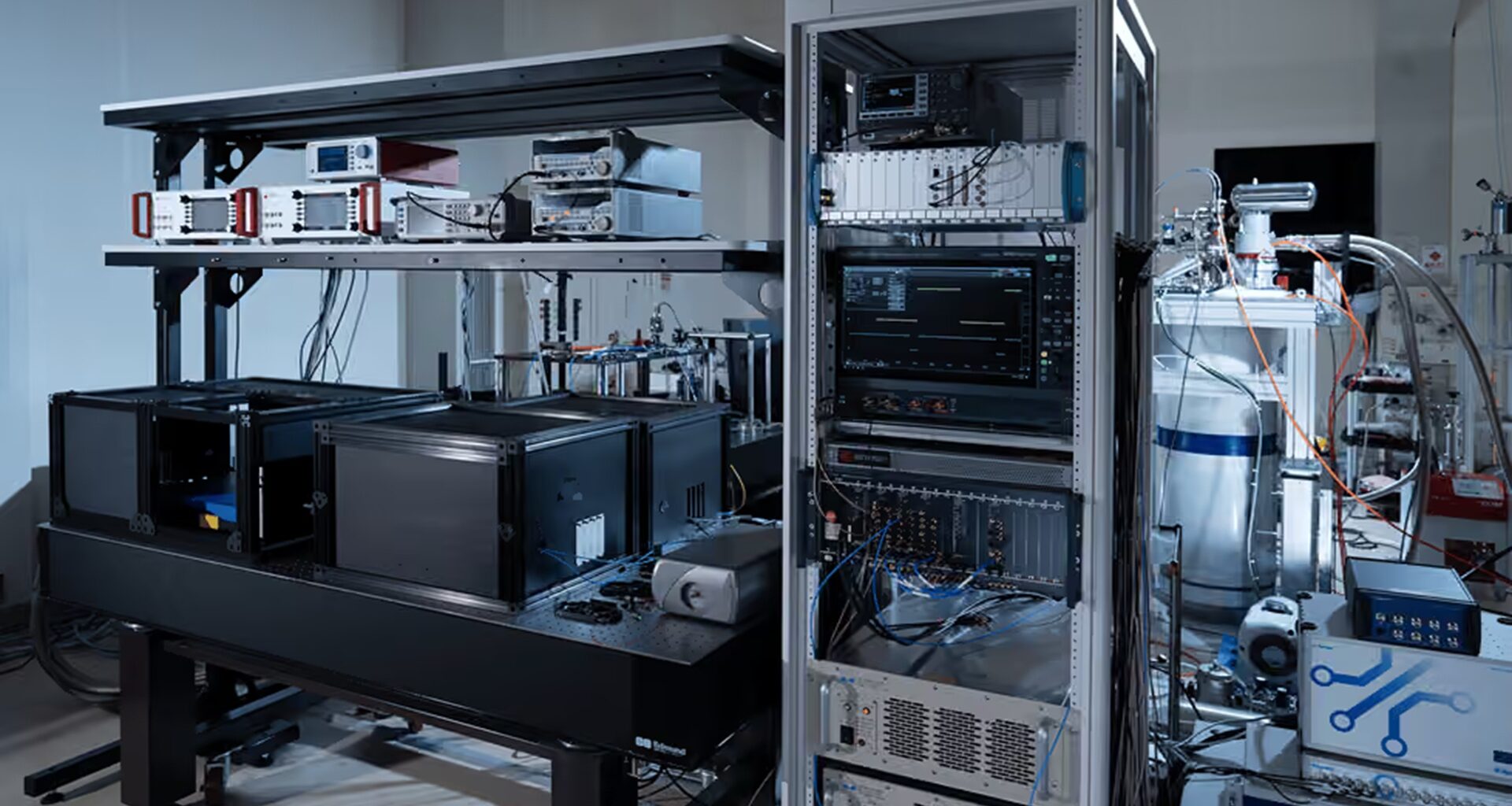
Japanese tech giant Fujitsu has developed the world’s first working diamond-spin quantum computer prototype that incorporates tin-vacancy (SnV) centers into photonic integrated circuits.
The new prototype can run at -456.9 degrees Fahrenheit (-271.6 degrees Celsius). This is roughly 2.8 degrees Fahrenheit warmer than the -459.6 degrees Fahrenheit (-273.13 degrees Celsius) required by superconducting quantum computers.
Fujitsu said that the technology could lead to more powerful quantum computers by using light to connect individual computing modules. The firm plans to create a multi-module diamond-spin prototype by 2027. It also aims to make quantum computing practical by 2030.
Under its quantum roadmap, Fujitsu aims to develop a 250-logical-qubit system by fiscal 2030 and a 1,000-logical-qubit system by fiscal 2035. “We are delighted to announce this prototype diamond spin quantum computer as a result of the collaborative research conducted since 2020 between Fujitsu, Delft University of Technology, and QuTech,” Kees Eijkel, PhD, QuTech general director, pointed out.
Turning diamond defects into qubits
The prototype relies on lattice defects in diamond crystals, better known as color centers, to create qubits. Diamond-spin systems have typically relied on nitrogen-vacancy (NV) centers, which are formed when a nitrogen atom replaces a carbon atom next to an empty position in the diamond lattice.
However, for the new system, the engineers turned to tin-vacancy (SnV) centers. These defects have a tin atom positioned between two vacancies in the diamond structure.
Fujitsu said that their symmetrical structure makes SnV centers less susceptible to external noise than conventional NV centers. Additionally, SnV centers emit light at roughly 10 times the brightness of NV centers. This could potentially improve the optical connections between quantum modules.
The approach could also lead to more efficient error correction. Its properties can keep quantum states stable, and allow logical qubits (groups of physical qubits that run quantum computations using specifications of a quantum algorithm) to be formed with fewer physical qubits than competing methods.
Quantum links using light
For the system, Fujitsu first created a process to bond high-quality, tin-implanted diamond substrates to alumina and silicon dioxide substrates. The diamond was thinned from several hundred micrometers to just several hundred nanometers for integration into quantum chips.
It also made photonic integrated circuits that combine nanometer-sized diamond crystals containing SnV centers with alumina optical waveguides. Finally, it created a mechanism to control the diamond-spin qubits with light, microwaves, as well as radio-frequency waves.
“The diamond-spin approach we have applied in this prototype not only offers exceptional scalability in its own right, but also has the potential to be integrated with superconducting quantum computers to further extend their capabilities, enabling more complex and large-scale computations,” Vivek Mahajan, Fujitsu’s CTO, said.
The device has already been operated in a test environment through the Fujitsu Hybrid Quantum Computing Platform. Users do not need additional specialist knowledge to control the new hardware, according to the company.
“Under our roadmap to achieve a 250 logical qubit system by fiscal 2030 and a 1,000 logical qubit system by fiscal 2035, Fujitsu will continue advancing practical quantum computing across a broad range of areas, from software to hardware, while leveraging the key advantages of the diamond-spin approach, including high fidelity and optical connectivity,” Mahajan concluded in a statement.