
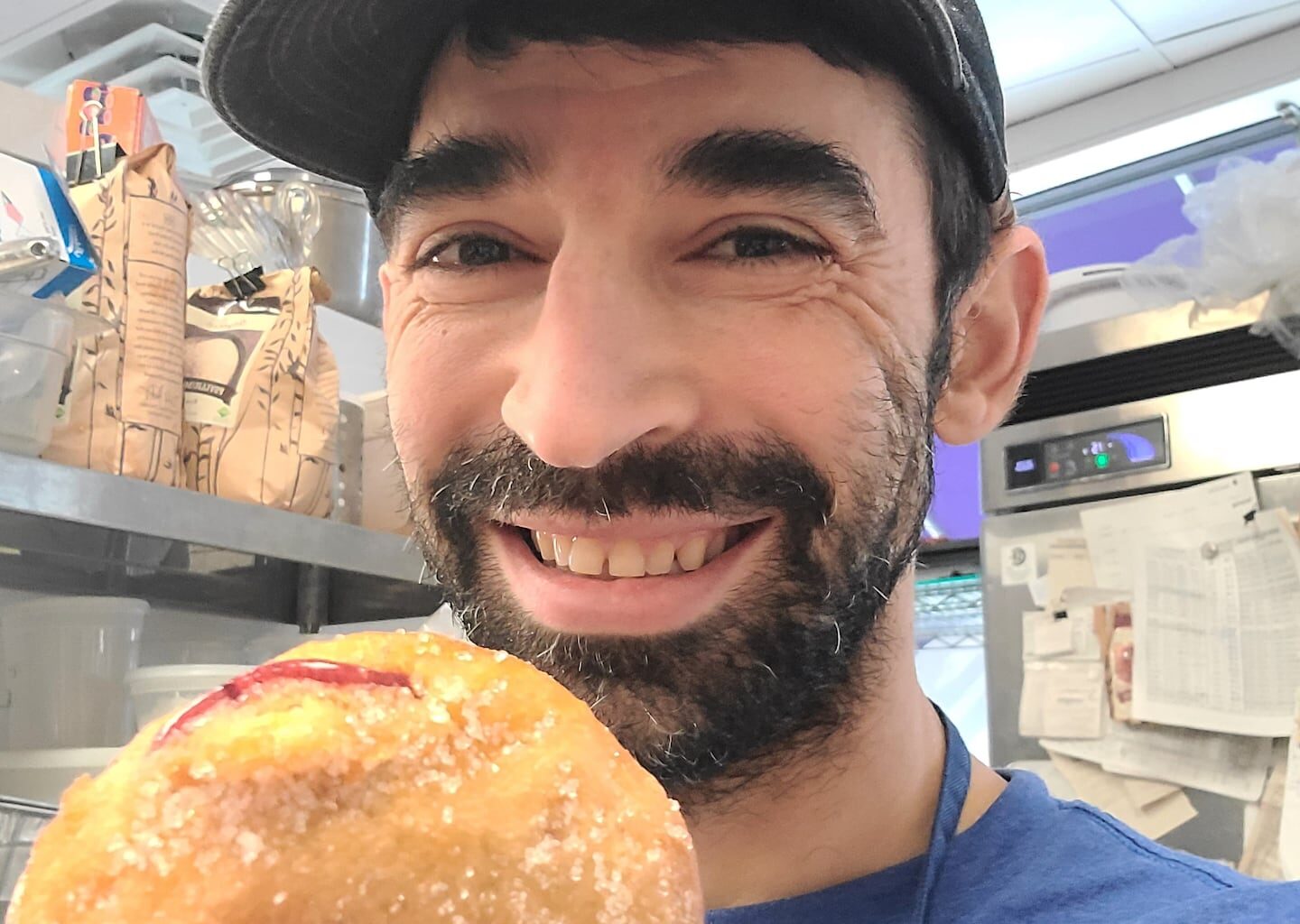
Since then, Khitrik has built a devoted following for homemade kosher foods that are also gluten-, dairy-, and nut-free. His mom still contributes recipe ideas, along with her gefilte fish, while working at Women’s Lunch Place in Boston, where she prepares nourishing meals for vulnerable women.
Today, Khitrik runs the business and wakes up early to bake the bread, including gluten-free challah made with organic oats.
“It’s hard to stop when we have so many people who tell us: Where else will they get [this] food? That makes it worthwhile. That’s what fills my cup,” he says.
We discussed his favorite challah, his most-missed Watertown restaurant, and his first overnight gig at a well-known bagelry.
What do you do?
Our niche is allergy-friendly, prepared, and baked foods. But I’m passionate about baking bread, so I’m trying to do more of that — artisanal sourdough is what I enjoy. Our business is very much focused toward helping families and friends share meals together, regardless of allergies. It’s home cooking.
I gravitate toward making artisanal bread and sourdough. At the store, we’re gluten-free. Trying to reach those standards of what I want from bread and getting rid of off flavors eventually led me to get my own grain mill. I mill my own flour. I totally geek out with people who like baking and the chemistry of it, because it’s very different when it’s gluten-free.
How did you come to take over Inna’s?
We opened in 2011. Inna — my mom — and I were in between jobs. We’ve both always been interested in having our own food business. We’ve always cooked together, baked together, and we thought: “This is our opportunity.”
I always thought I’d do something in tech, be successful, get a bunch of money, and then do what I really wanted to do, which is open up a gathering place, a food business, and create really good food — and to be in community with the growers of the food and the ingredients. That’s what I imagined as a dream sort of place, and I realized: Maybe here’s a chance, instead of waiting.
The [concept was] inspired by “Diners, Drive-Ins, and Dives.” We were actually looking at places that were for sale, breakfast and lunch places, cafes, and then [my mom] called me and said, “I have a great idea. Let’s open a deli,” after watching a show about delis and how there aren’t so many of them anymore.
It would be our own type, which combines our traditions. We have family in Israel, Russia, Belarus, the Soviet Union. Obviously, there’s a very strong history of deli traditions here in the United States. ”Jewish cuisine from around the world” was the tagline. We would serve matzo balls, and we’d serve shakshuka, and we’d cure our own meat for corned beef and pastrami. We’d have falafel. It was a very big menu, covering a wide variety.
How did Inna’s evolve?
It goes back to challah, in many ways. I was always interested in cooking and baking from a very young age. Challah wasn’t on our radar except for Shabbat. But I did Birthright, where I was first introduced to baking challah, especially in a traditional way, as a community. We braided the bread; learned the history.
Actually, Rosenfeld’s Bagels was my first introduction to baking. I worked there briefly as a teenager, for one summer, overnights. I’d go in at 10 or 11 p.m. I’d be done at 3 or 4. I eventually started braiding the bread, which was very fun. And, I mean, I loved eating it warm out of the oven.
After [Birthright], I was looking to continue. How can I find a Jewish community here? In trying to continue my connection in the community, I was referred to Kavod House, a Jewish social justice organization for young Jews in their 20s.
It was my people. It made me feel very welcome. And I loved baking bread, and I started baking challah, and suddenly I learned about gluten-free through that community. Down that rabbit hole I went, and I got pretty good at it and taught workshops.
When we were opening up our shop, full circle, I was already very familiar with gluten-free preparation, and I convinced Inna. I’m used to calling my mom Inna.
Do you call her that all the time, or just for the purposes of work?
Usually work-related. It just starts to feel pretty odd saying “my mom” this; “my mom” that.
I was able to convince her to keep the kitchen by default gluten-free, actually even dairy-free, and nut-free. We had a small corner where we kept separate sets of sugar, salt, and various ingredients, where we would prepare the few glutinous things. We just defaulted to keeping things allergy-friendly, and it allowed us to serve more people.
People who have allergies sort of get singled out. People would tell us: “Thank you. We were all able to share the same meal.”
It became clear that we served a need. People learned to trust that we were extremely careful, so we developed a following. Feeding people is very fulfilling to us, for both my mom and me. I sort of joke that I’m a Jewish mom, a Jewish grandma. That’s my personality profile, I guess.
Are you nut-free and gluten-free?
I love nuts. I love gluten.
How’s your mom still involved?
The primary way that Inna’s involved is gefilte fish. She’s still helping around the holidays, and I’m not sure if I would continue making gefilte fish if she didn’t come and help.
What’s your opinion of the Greater Boston food scene?
I don’t get out that much, but I hear about awesome places I would like to go to. The one that most comes to mind is The Mushroom Shop, a store that’s just focused on mushrooms, and it’s awesome. I’m a huge fan. I’m going to be making a pot pie for Sukkot, actually, using their mushrooms, which I’m really excited about.
Another business that’s very unusual but awesome that I still have not been to — that I really need to — is Lehrhaus.
It’s kind of a dream sort of library, Jewish space, restaurant, cafe. It’s a nonprofit, which I learned recently, which is awesome. They’re also doing a lot of stuff with local farms. There are definitely really interesting and mature businesses. I think of Joanne Chang from Flour. I saw their operation and how they get fresh food to all their cafes around town, their various routes. If you haven’t been to their central facility it’s worth checking out how they ensure quality and freshness at a bunch of different locations.
What’s the climate for Jewish businesses right now?
Complicated, I think. Part of me wants to not avoid politics. But, for the business, I don’t want it to be a political space.
When the war with Gaza started, it was very difficult, because we are very forward in that we are a Jewish business. We’re a kosher business. In some ways, when you’re challenged, it makes you stronger. I hope things come out better, and I hope there’s opportunity for growth from those challenges. My wife’s a cantor. My kid goes to a Jewish school. So the amount that we see across the spectrum of the stresses on the Jewish community — I hope that there can be room for more conversation, because silence is really stressful, too.
On a less political note, describe what goes on in the life of a baker. Do you wake up at crazy hours?
Around the holidays. Thank goodness for Shabbat. Thank goodness for the Sabbath because that sort of forces a break.
Today I was in at 5. For the holidays here, it’s 12-hour days. But, normally, it’s not so bad. I see Blacker’s Bakeshop next to us. They’re often here before me when they’re baking the night before, but it’s a much larger operation. I bake a fair amount of bread, but not huge volumes.
Bread takes up a lot of space. It takes up the ovens. It’s something that needs to get done when nothing else is being done, in a sense. Last night was good, because I went to sleep at 9. It wasn’t so bad.
What makes good challah? What’s the secret? You can get opinionated.
I’m very much into eggy, chewy, stretchy, like Rosenfeld’s does, and Blacker’s. I’m not a fan of — I won’t name names — but the cakey variety.
More recently, I started making oat challah, specifically for people to say Hamotzi, and that one is pretty awesome. It has that chewiness of oats, and it has more of that mouthfeel that I like in my challah and bread. What makes good challah? I mean, it’s not the shape. It’s balance: not too sweet, not dry.
What’s your best-selling food?
Latkes.
How come?
They’re a pain in the butt to make at home in small quantities. We don’t use seed oils. We use local potatoes. They’re really convenient. They’re versatile: breakfast, lunch, or dinner.
Assuming you have free time, do you have any favorite restaurants?
La Bodega is our go-to in Watertown. It used to be Strip-T’s. It’s fresh in my mind because for whatever reason we were talking about parsnips the other day, and my wife said, “Oh, I still think back to the parsnip cake that we had,” possibly on our last meal there. La Bodega is our go-to nice restaurant, with amazing owners.
Is there any food or drink that you absolutely cannot stand?
Canned tuna. And we make tuna salad here, too.
How do you do that?
I guess I can stand it.
What’s the best and hardest part about working with your mom?
Decision-making, trying to have a cohesive plan, and not getting distracted.
I love her. We’re good team players, right? It’s like when I play soccer with my brother: We grew up playing together, so it’s like we can sort of read each other’s minds. She’s an amazing cook. She has great ideas.
Interview was condensed and edited for clarity.
Kara Baskin can be reached at kara.baskin@globe.com. Follow her @kcbaskin.