
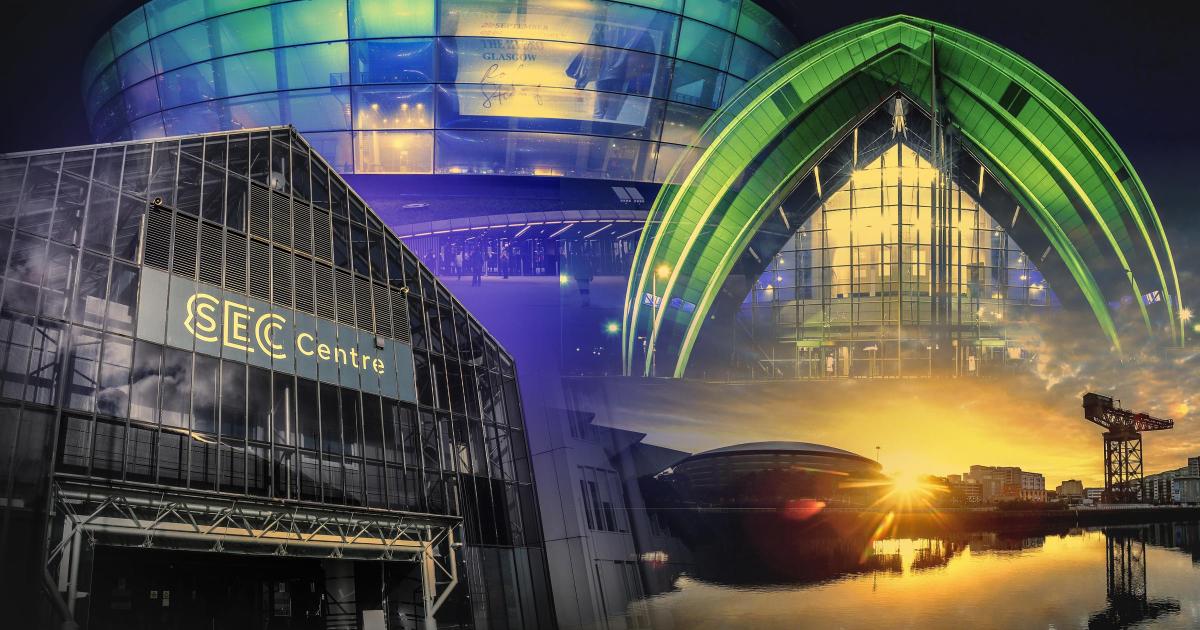
A new masterplan which envisages the campus becoming a new riverside “destination” and “city quarter” is aimed at boosting its annual economic impact to more than £1 billion.
Read more:
In an exclusive interview with The Herald, SEC chief executive Dominic McKay, who took over the role in May 2025, said the project to “reimagine” the site was aimed at ensuring Glasgow can keep pace with the likes of Melbourne, Lisbon, Bilbao, New York and London.
He highlighted how the three existing buildings on the site – the original SEC Centre, the Hydro and the Armadillo – are now “creaking at the seams”, with a record 2.5 million visitors coming through their doors last year.
Scottish Event Campus chief executive Dominic McKay is overseeing expansion plans for the home of the Hydro and Armadillo venues in Glasgow. (Image: Colin Mearns)
The new masterplan being drawn up for the 64-acre site is aimed at “unlocking” around 60 per cent of the campus site – which has been largely used for car parking – and attracting at least another 500,000 visitors to the campus each year.
It is hoped that private investment can be secured to provide the bulk of the funding for the project, which is planned to be carried out in phases and is expected to take more than a decade to complete.
A new outdoor arena and viewing platform will be created opposite the Hydro arena under expansion plans for the Scottish Event Campus in Glasgow. (Image: Scottish Event Campus)
Key elements of the new “Destination SEC” vision include:
Creating a new outdoor venue opposite the Hydro capable of housing crowds of up to 10,000 for open-air concerts, festivals and fan zones for sporting events.
Creating a new indoor events venue with a capacity of up to 5,000, which would be suitable for the latest “immersive” shows and exhibitions.
Boosting the capacity of the SEC’s conference and exhibition facilities by more than a third by either refurbishing or replacing the existing complex.
Developing the west side of the campus by building its first on-site residential accommodation, a new high-quality hotel and office space to encourage arts organisations and production companies to move to the area.
Hosting more major sporting events to build on the staging of six Commonwealth Games sports across the campus, the live broadcasts of Scotland’s World Cup matches in the Hydro and forthcoming ice hockey showcases in the same venue.
Building a new walkway over the Clydeside Expressway to replace the existing “Smartie Tube” bridge, which dates back to the mid-1980s, when the original exhibition and conference centre opened.
Undeveloped land currently used for car parking will be transformed into expansion plans for the Scottish Event Campus in Glasgow. (Image: Scottish Event Campus)
The new vision has been drawn up after previous proposals for an £80 million expansion of the original SEC Centre, which were heavily reliant on public funding, were shelved.
Mr McKay told The Herald he and his team had been encouraged by the SEC board to take a “clean slate” approach to the whole site “to reimagine what it could be like and where it needs to be for the future”.
A fan zone was created outside the Armadillo and the Hydro when the Scottish Event Campus hosted the Commonwealth Games this summer. (Image: Colin Mearns/frame/Herald Picture Agency)
He said: “We had 2.5 million people come through the campus last year, which was a record number for us. They contributed more than £600m to the Scottish economy.
“That is a significant return for Glasgow and Scotland. It is something we are proud of but we are really keen to build on it.
An overhead view of what the Scottish Event Campus in Glasgow currently looks like. (Image: Scottish Event Campus)
“We are currently creaking at the seams with our existing buildings. We had 150 events in the Hydro last year, 100 events in the Armadillo, and 100 conferences and exhibitions.
“We have been enormously successful over the last 40 years, but we need to think about what the future may hold.
The ‘Smartie Tube’ bridge over the Clydeside Expressway is set to be replaced with a new walkway under plans to transform the Scottish Event Campus in Glasgow. (Image: Colin Mearns)
“We have quite a lot of space around our three wonderful buildings. Around 60 per cent of our campus has not been developed. We are having a good think about how to reimagine our whole campus and what that space could look like in future.”
Mr McKay said the intense competition Glasgow faced for events was a key driver of the new masterplan.
Scottish Event Campus chief executive Dominic McKay is leading plans for its long-term transformation. (Image: Colin Mearns)
He told The Herald: “Glasgow was ahead of the curve when the SEC was built 40 years ago. We want to make sure we remain really competitive in the global market we operate in.
“While we are based in Glasgow and are very proud to be Glaswegian and Scottish, our days are spent thinking about other countries around the world. Our competition is Melbourne, Paris, London, New York, Lisbon and Bilbao.
“We think of ourselves, and we act, on the international stage. We have got to keep investing to make sure we remain competitive.
“There is a lot of interest in campuses like ours being developed and modernised for the future. It is happening all around the world right now. They are expanding, developing and creating true destinations.
“We need to make sure we have the same offering, or an even better offering, as our competitors. That is why we are so motivated.”
Mr McKay pointed to the success of the retail and leisure facilities around The O2 in London and suggested the SEC aimed to make much more of its riverside location.
He added: “We want to expand our horizons to make sure we attract audiences who may not necessarily be going to a show, exhibition or conference.
“If you look at other cities which have rivers running through them, those rivers are often destinations in themselves.
“We see our riverside being opened up more, to welcome people to a safe, secure, fun, exciting and vibrant place by having bars and restaurants along the Clyde.
“We definitely see the river coming to life more.
“To complement that, we also see the need to have places for people to live and work.
“We sit directly opposite STV and the BBC. In many respects, this is already a culture, events and entertainment corridor.
“We want to work with the creative industries, the cultural sector and TV production companies to see whether we can have some of those facilities down here.
“At the far end of our site there is an incredible location with a view straight down the Clyde. It would lend itself really nicely to residential accommodation.”
Mr McKay, who was unveiled as the SEC’s new chief executive in January 2025, previously worked for Scottish Rugby for 13 years, including a six-year spell as chief operating officer.
He told The Herald that the extensive use of the SEC’s site for the Commonwealth Games had demonstrated the future potential of the site opposite the Hydro, which is normally used for car parking, but was temporarily transformed into a fan zone.
He added: “That space alone is about the same size as George Square. We could get 10,000 people in there for a concert, festival or sports event.
“It is a great space. We are trying to be creative about what the future might hold. It is important to make sure we will be inspiring future generations to come here for years to come.
“Part of our thinking has come from conversations with event organisers and promoters. They have been saying that they would love more flexible space for outdoor venues and opportunities.
“Glasgow was only able to deliver the Commonwealth Games at the drop of a hat because people had the foresight to invest in all the infrastructure on our campus.
“As a consequence of the Commonwealth Games, we have already had enquiries from other sports events that are interested in coming to Glasgow. Conversations are taking place with organisations that have never been interested in the Hydro or the SEC before.”
Mr McKay said the plans for the new indoor venue being proposed for the campus were influenced by the huge growth in audiences for “immersive” shows and events.
He added: “We had a Tutankhamun immersive exhibition here last year.
“We were not sure how it would go, but it was an enormous success. We had 140,000 people through the doors. We are seeing that market beginning to grow significantly.
“As part of our reimagining of the campus, we want to make sure we have got a modern space that allows us to have the flexibility to host more of those experiences.
“We need to future proof any new building to make sure it is as flexible as it can be.
“The Hydro has been an enormous success. Its versatility is a huge asset. That is why it now attracts 150 events a year.”