
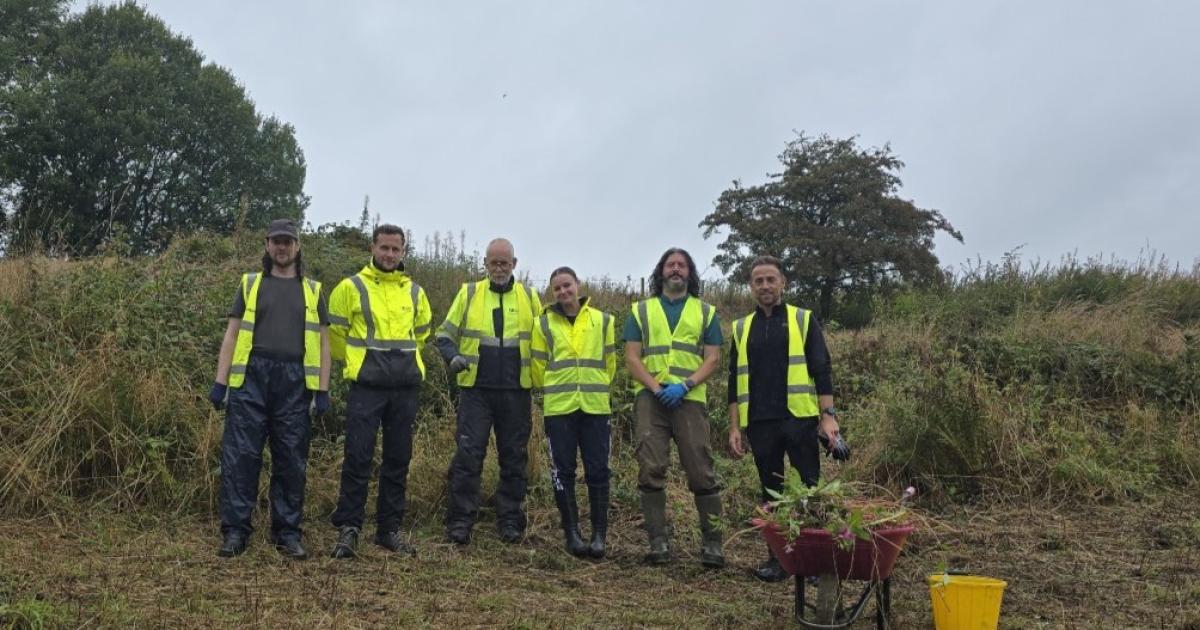
The effort took place near Jack House Reservoir in Oswaldtwistle, where United Utilities volunteers teamed up with the Hyndburn Prospect Foundation to remove Himalayan balsam, a fast-spreading non-native species.
Mike Shiels, delivery manager at United Utilities, said: “Our team works to deliver water projects across Lancashire and Cumbria, so it was great to take a break from our day jobs to support this environmental charity with some hands-on activity that will have a positive impact on Jack House Reservoir.”
Himalayan balsam is a highly invasive, non-native annual weed introduced to the UK in 1839 as an ornamental garden plant.
It thrives primarily in damp areas like riverbanks, canals, and wet woodlands, where it grows rapidly up to two to three metres tall, making it the tallest annual plant in the UK.
It is easily recognised by its reddish, hollow stems, serrated spear-shaped leaves, and distinct pink-purple orchid-like flowers.
Mr Shiels said: “Himalayan balsam spreads very quickly near watercourses and has a negative impact on water quality by contributing to riverbank erosion and disrupting the natural ecosystem along riverbanks.
“Unfortunately, the weather was challenging, but it was worth it to see the difference we had made working alongside volunteers from the charity.”
Himalayan balsam outcompetes native species by growing at an astonishing rate; its broad leaves and high density block out sunlight, completely suffocating native UK ground flora.
This leads to a severe loss of local biodiversity.
Because it is an annual plant, it dies back completely in the winter, leaving riverbanks entirely bare.
Lacking the deep, binding root systems of native perennial plants, the exposed banks are easily eroded by winter rain, causing soil to wash into rivers.
This degrades fish spawning grounds and increases local flood risks.