
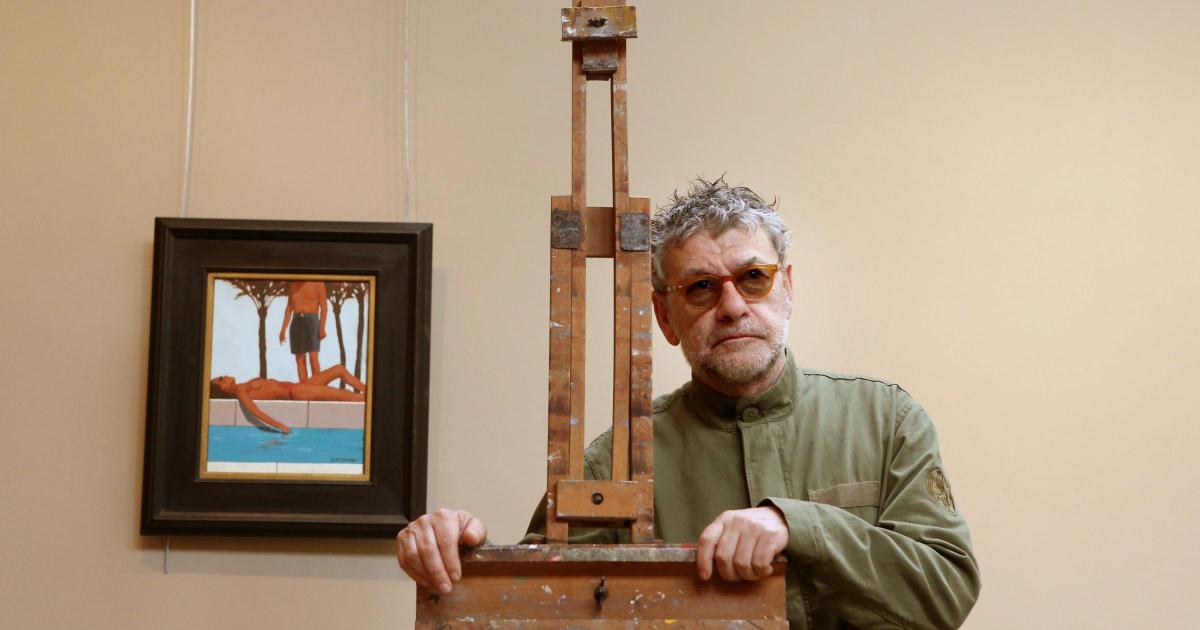
I’ll tell you what he was doing: getting rich. His most famous painting, and the best selling art print in Britain, The Singing Butler, sold at auction for £744,800. At one point, he was making half a million squids a year from prints and other merchandise. He had homes in London, Nice and, er, Kirkcaldy.
No wonder critics hated him. Well, that and his style, seen at best by the cognoscenti as poor man’s Hopper, tolerable perhaps as pulp illustration more than painting, and at worst as “badly conceived soft porn” and “brainless erotica”.
Disgraceful if true. As was his private life, evidently featuring a superfluity of stimulants and concupiscence. The Guardian called him a “lothario with a paintbrush”.
Read more
RAB MCNEIL’S SCOTTISH ICONS: John Knox – the fiery preacher whose pal got burnt at the stake
Rab McNeil: For whom the bridge tolled: the saga of travelling over the sea to Skye
Rab McNeil: It’s time to cut the Fringe – Edinburgh’s annual bourgeois fete
Rab McNeil: The truth is oot there as aliens frolic about in fancy UFOs
Now, I’ve no dog in this cock fight. All I can say is that, while the most popular, outdoor, beach depictions do little for me, the indoor ones at least intrigue. Arguably atmospheric, ken?
Still, even if your instinct is to take his side against snooty art critics, it’s difficult to ignore the fact that figures in his most famous work were, as revealed in 2005, straight copies from an illustrators’ manual.
Artistic licence for licentious art? Art, my bottom, said the critics, decrying him as the Jeffrey Archer of painters.
Sunday Times scribe Waldemar Januszczak described Vettriano’s work as “meretricious rubbish”, continuing: “It may have a role to play on the walls of a cocktail bar with pretensions, but its intrinsic shallowness, its magazine slickness, the unsightly coyness of its eroticism, the absurd melodrama of its moods, the banality of its imaginative flourishes, the creepiness of its world-view, the facelessness of its finish, all these shortcomings disqualify it from serious consideration by a national collection.”
Still not finished, he added that it belonged with the then popular poster of a female tennis player scratching her naked bum.
Art attack
CRITICS in his native Scotia also volleyed balls of fury Jack’s way. Sandy Moffat, then head of drawing and painting at Glasgow School of Art, said: “He can’t paint, he just colours in.”
Richard Calvocoressi, then director of the Scottish National Gallery of Modern Art, sniffed: “[W]e think him an indifferent painter.”
Jack Hoggan (as was) could not have predicted such ire when he was born on 17 November 1951 in the aforementioned Methil.
Life in the small miner’s cottage was hard and, from the age of 10, Jack was delivering papers and milk, cleaning windows and picking potatoes, with Pater taking half his earnings.
Jack’s Italian grandfather would bring home bookie’s pencils and betting slips, on which the boy doodled: “goalmouth incidents, birds’ nests. I had a thing about birds’ nests.”
He left school at 15, having learned only that “there are snobs in this life and then there is you”. For a while, he had a summer job as a bingo caller at Beachcomber Amusements on Leven Promenade, fleecing holidaymakers with fake numbers.
He worked in a colliery filling sandbags before securing an engineering apprenticeship. “I carried the journeyman’s toolbag,” he recalled, “and learned to say something interesting when all I was thinking about was women. The rest of the time it was smoking and skiving.”
His heroes hung around street corners. “They were hard men. I just wanted to leave school, buy clothes, maybe get a car, go dancing, pick up women …”
Knew his onions
THIS he ungallantly essayed at the Raith and Burma ballrooms, trying to snog gals afterwards with burger and onion juice dripping down his chin. Did I mention this was in Fife?
His life changed when a girlfriend bought him a box of watercolours for his 21st birthday. Thus began an obsession and the only training available to him: copying. He spent so much time at Kirkcaldy Art Gallery, studying artists like Peploe and McTaggart, that he feared staff suspected a planned heist.
One day, he took a train to London, visiting galleries every weekend. Unfortunately his trainee chef gig didn’t work out.
Neither did his digs, with a landlady repeatedly shouting: “Where’s my teeth?”
Back in Scotland, a series of jobs followed: shoe shop manager, bar manager, engineer. In 1987, aged 36, he moved to Edinburgh where he adopted his mother’s maiden name Vettrino, adding an “a” for an affectation that he felt suited both his dark painting style and his unshaven, vaguely dangerous self-image.
An application to study Fine Art at Edinburgh University was rejected. Meanwhile, he kept copying artists he admired, like Caravaggio, Van Gogh, Degas and Monet. Then he thought: ‘Why don’t I paint the things that are closest to me? Women.’
Accordingly, his breakthrough came in 1988 when he submitted two canvases – Model (then wife Gail) in a White Slip and Saturday Night (couple in a dancehall) – to the Royal Scottish Academy’s annual show. Both sold on the first day. Suddenly, the galleries showed interest.
That interest went stratospheric with 1992’s Singing Butler. Or, as Vanity Fair put it, The Singing Butler did it. In nostalgic, 1940s cinematic style the SB, as nobody calls it, depicts an elegant couple in evening dress dancing on a breezy beach accompanied by a butler and maid holding umbrellas.
Voted the UK’s third favourite work of art, Vettriano said it was a fantasy offering hope: “If you’re living in Grimsby on a wet Tuesday afternoon, you might be carried away with it.”
International exhibitions followed. In New York City, more than 40 collectors from the UK flew forth and queued round the block on a one-in one-out ticketing system to get first option on his work. Twenty paintings were sold on opening night.
‘Shabby’ sex
BEYOND SB, Vettriano’s other works are often seedier, featuring more pants, suspenders and stilettos (of which he owned a collection). “Sex is often seen as shabby,” he explained, “but what my work satisfies in people is voyeurism.” I see.
In 2013, Vettriano was the subject of a retrospective at Glasgow’s Kelvingrove Gallery and, in 2017, was one of three artists commissioned to paint portraits of Billy Connolly, shown at the People’s Palace, to celebrate the comedian’s 75th birthday.
On 1 March 2025, Jack Vettriano was found dead at his Nice apartment. He was 73.
He once said: “At least I tried. At least I am prepared to put it up on the wall. And you can have a go at it if you like.”