
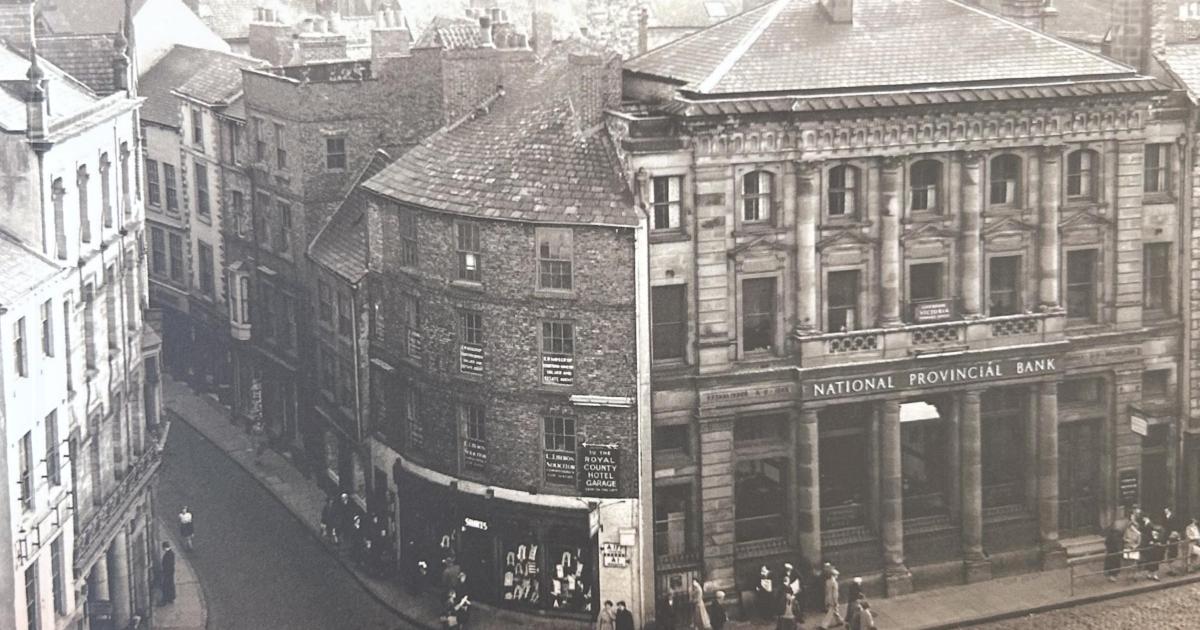
But there aren’t many pictures of the cathedral, castle or Prebends Bridge in the new photographic book of Durham compiled by Michael Richardson from his amazing collection in the Gilesgate Archive.
Street Memories of Durham by Michael Richardson (Amberley, £15.99) (Image: Michael Richardson, Gilesgate Archive, Amberley)
Instead, there are views of the streets of the city, of the changing vistas of people’s ways of life.
There are pictures of lost landmarks, be they the famous police box or Elgey’s timber merchants or the Leazes footbridge which, after 50 years, disappeared only two years ago.
It only took history 50 years to come full circle. This is the Leazes footbridge over the A690 on Gilesgate Bank being built in 1974. In October 2024, the bridge was demolished having apparently become too expensive to repair (Image: Michael Richardson, Gilesgate Archive, Amberley)
And in Michael’s pictures, we also meet the people of Durham who have populated those streets over the last couple of centuries, from the postman with his cat poking out of his uniform – just like Postman Pat, the cat is black and white because the photo comes from the days before colour – to footballer David Armstrong who played for Middlesbrough for 10 seasons after growing up in Gilesgate.
Postman Ephraim Meade with his cat in black and white in the 1890s, when he lived at Moatside Cottage in Saddler Street. Ephraim later became a lamplighter for the Durham Gas Company but tragically, on October 7, 1930, was run over and killed by a motor omnibus in Hallgarth Street when he was 73 (Image: Michael Richardson, Gilesgate Archive, Amberley)
Memories is privileged to be allowed to reproduce a small selection from the new book which is officially published on September 15. It is already listed on the websites of its publisher, amberley-books.com, and of Amazon and Waterstones, and should be in stores presently.
Street Memories of Durham (Amberley, £15.99)
Right into the 1950s, a train would bring the circus into Elvet station and the animals and performers would process down New Elvet to the showground, most likely The Sands or the Racecourse. Not only was this an obvious way of getting the animals from the station, but it was also a brilliant promotional way of advertising their arrival. This picture is from about 1899 and shows Lord George Sanger’s circus elephants ahead of some camels. In the 1890s, Sanger’s circus was one of the largest in the country and had 160 horses, 11 elephants, a dozen camels and about 330 people (Image: Michael Richardson, Gilesgate Archive, Amberley)
A great study by photographer T Kipling of four Salvation Army soldiers counting money in their street collecting tins in the 1890s (Image: Michael Richardson, Gilesgate Archive, Amberley)
A fabulous image from the top of St Nicholas’ Church in the 1950s looking down on the Market Place, with the first, circular police box controlling the traffic. (Image: Michael Richardson, Gilesgate Archive, Amberley)
Removing cars from the narrow streets leading to and from the Market Place has eased decades of congestion. It is amazing to think that until the 1960s construction of Milburngate Bridge, Silver Street was the main vehicular route through the city centre. As this 1930s picture of it shows, as it dropped down to Framwellgate Bridge, there were often too many lorries, people and boys pushing handcarts for it to cope (Image: Michael Richardson, Gilesgate Archive, Amberley)
During the Second World War, all towns took part in Wings for Victory campaigns when they were encouraged to raise more money per head for armaments than their neighbours. Captured enemy planes or tanks were often sent by the government to act as a focal point for the fundraising. Here in War Weapons Week held from November 16 to 23, 1940, a Messerschmitt fighter is on display outside St Nicholas’ Church. It arrived in the city in three parts on low loaders (Image: Michael Richardson, Gilesgate Archive, Amberley)
A delightful picture from 1892 of the children of the Reverend Samuel Guest Williams, who was then the second master of Durham Grammar School. Standing is the eldest, Mary, aged seven, with sitting on the haycart Warren, six, Algin, five (with a sticking plaster on his knee) and Wynne, four. From 1895 to 1920, their father was the vicar of St Lawrence’s, Pittington (Image: Michael Richardson, Gilesgate Archive, Amberley)
Many of the pictures in the book chime with the running subjects in Memories. This is the Durham District Services bus garage in Gilesgate Moor in 1951. “Many will remember the premises being used as a warehouse by James Crawford & Son, fruit and vegetable merchant,” says Michael Richardson in his caption. “The property was destroyed in a fire in the 1980s and social housing apartments occupy the site today.” (Image: Michael Richardson, Gilesgate Archive, Amberley)
Just where do all the old buses that Memories has been featuring this summer go to when their days on the road are over? Well, they were converted into mobile chemical toilets to be used on Gala Day in the 1980s. “Their engines were removed and they were towed to various destinations in the city,” says Michael. Judging by the amount of beer that was consumed on Gala Day, they were probably better used as toilets than they had been as buses (Image: Michael Richardson, Gilesgate Archive, Amberley)