
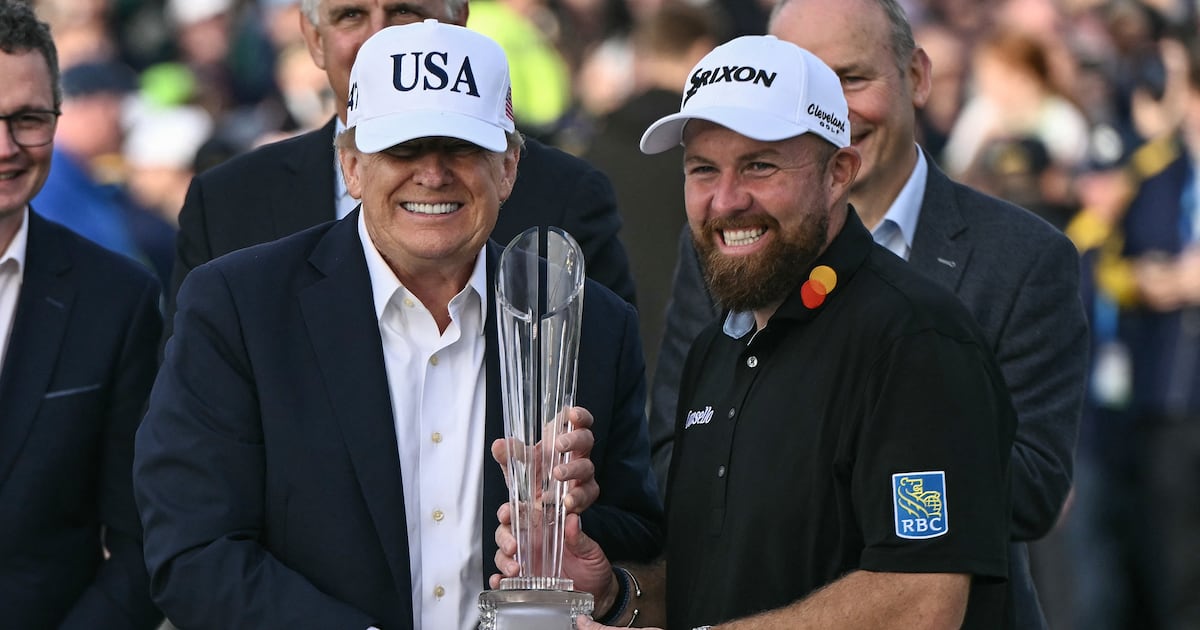
True to form, even on a weekend when his golf course was hosting a record-breaking native winner, Donald Trump still managed to dominate the headlines.
His unerring instinct for self-promotion survived even the fraught moment when he had to present Shane Lowry with the crystal trophy for winning the Irish Open.
Before doing which, he first raised a glass of a different kind, or at least the subject of it.
Somehow upstaging the man who had just won the event by an unprecedented 11 strokes, Trump announced that in response to intense lobbying the night before, he had decided to lift his tariffs “on Irish whiskey”.
But then Shane Lowry was only a golf champion. Whereas the US president had reinvented himself – if only for the weekend – as a champion of all things Irish and repeatedly voiced support for a United Ireland.
As he and Lowry strode separately to the first tee on Sunday afternoon, some in the international media teed Trump up to modify or retract his suggestion in Dublin on Saturday that a unified state was inevitable and would be “a great thing”.
Was he aware of the “backlash” his comments had caused in the UK, an ITV reporter asked. “I love my comments,” said the president, smashing the issue up the middle of the fairway, just as Lowry would shortly do the ball.
Minutes later, Lowry was mastering the green. Trump, meanwhile, was wrapping himself in it.
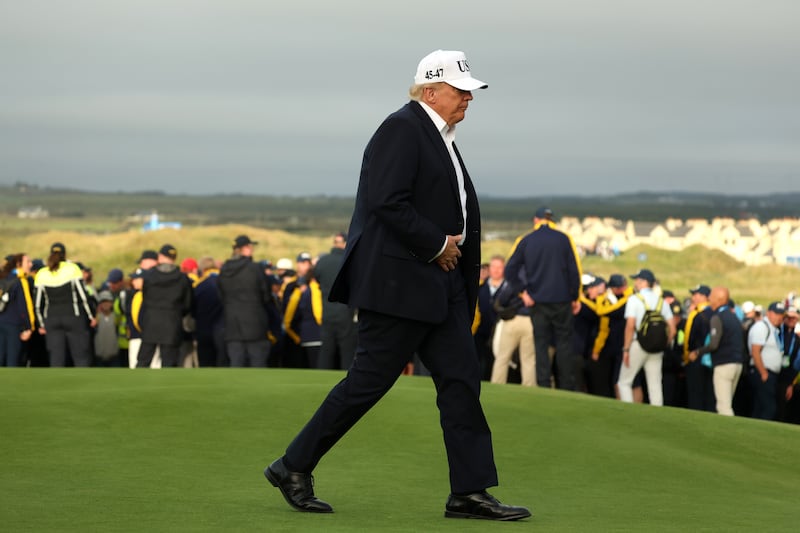 Donald Trump on the course in Doonbeg. Photograph: Anna Moneymaker/Getty Images
In an impromptu press conference, he expanded on his Hibernophilic feelings (despite an aside in Dublin when he had also noted that some of us were “vicious bastards”).
“I’ve always loved the people of Ireland and it just seems to me that you have Northern Ireland and you have Ireland and it would seem to me one of the naturals of all time is [to] put them together.”
The president stopped short of leading a chant: “What do we want? A United Ireland. When do we want it? Now.” Later again, asked if he had a “timetable” for unity, he refused specifics.
But in keeping with the traditions of the Banner County, he was determined to fly this one, timetable or no. Trebling down on the main theme, he repeated: “I think it should happen.”
As Micheál Martin, who joined him in Doonbeg on Sunday, will know, this part of Ireland has form in setting the political agenda, most famously when Éamon de Valera won a by-election here in 1917.
Whether the latest New York-born Irish patriot will have the same staying power remains to be seen. In the meantime, as he faces his own midterms, Trump’s West Clare pre-election pitch certainly made a stir.
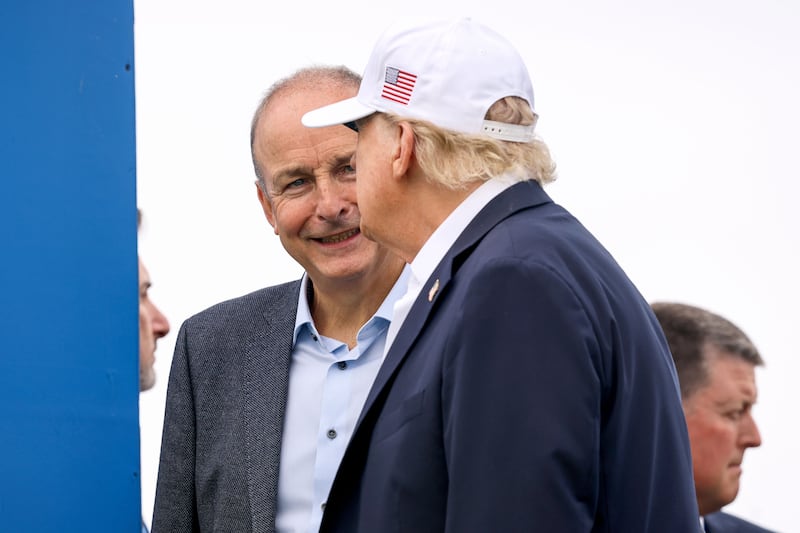 Micheál Martin stands on the first tee box with Donald Trump. Photograph: Ben Brady/Inpho
His secret service detail, at least, will be glad to see the back of Doonbeg. Links courses in general must be a presidential minder’s nightmare, composed as they are of a series of grassy knolls.
The one opposite the Doonbeg resort’s VIP suite, overlooking the 18th green, added greatly to their concerns on Sunday, as it became a gathering point for media and a curious public alike.
Framed by “Golf Force 1” (the President’s reinforced golf buggy) on one side and a scaffold-tower for snipers on the other, the resort’s side entrance was the subject of intense scrutiny all morning and afternoon.
At the behest of the secret service, gardaí evicted the public from the hill at one point and made a half-hearted attempt to evict reporters too.
In the event, the media held firm and were rewarded when Trump finally emerged to dismiss the buggy and walk past us to and from the first tee, answering questions all the way, and even signing golf hats, to the concern of paranoid minders.
They needn’t have worried. The biggest danger on the course was Lowry, whose putter was so hot it was a fire risk. Leading by four shots overnight and with a course record 62 already on his card this week, he razed the course again with a 63 to beat the previous record-winning margin: Bernhard Langer’s in 1987.
Many of his supporters were wearing Offaly GAA jerseys. But on a weekend when Trump narrowed the gap between the American and Irish brands of republicanism, he could have been forgiven for thinking all the green, white and orange colours were for him.