
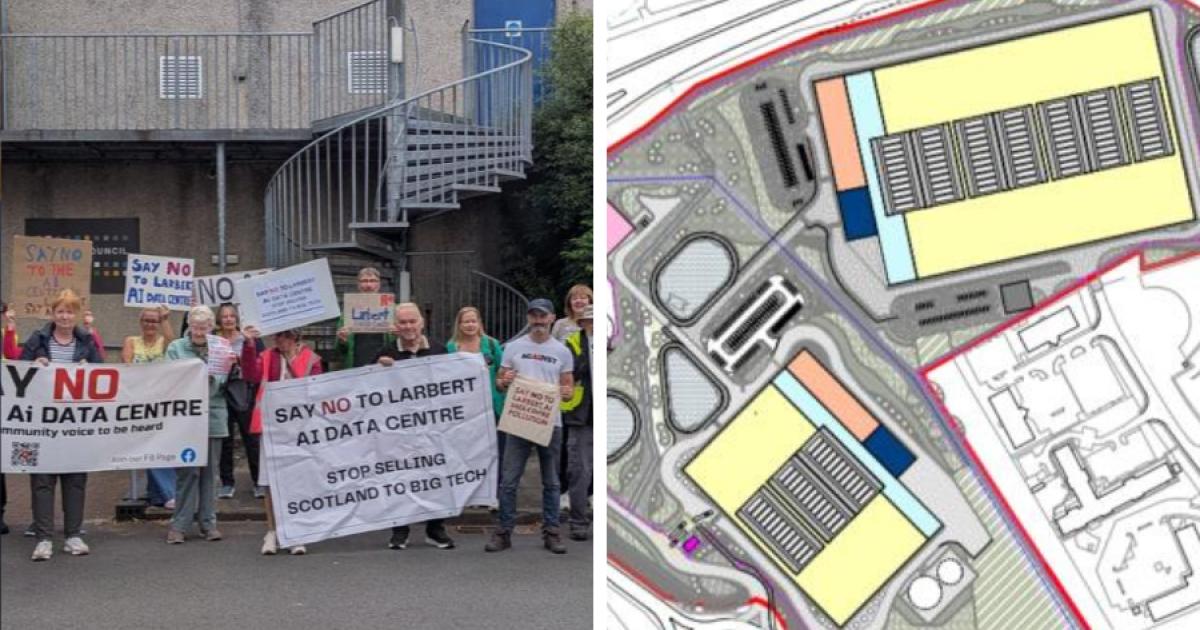
Lidia Mestre, who works at Forth Valley Royal Hospital (FVRH), has written to NHS Forth Valley’s chief executive raising concerns about Apatura’s proposed 300MW facility at Glenbervie Business Park in Larbert.
Developer Apatura has applied for planning permission for the facility on around 55 acres of grassland less than 500 metres from the hospital.
In the email to Ross McGuffie, the NHS nurse claims the data centre – if approved – could pose a previously unassessed risk to the resilience and stability of the electricity supply to the hospital.
“This single data centre would draw 300MW, the equivalent of 155 towns the size of Larbert simultaneously, from the same local grid that powers FVRH,” Mestre wrote.
READ MORE: Far-right group funding Scottish vigilantes sells swords and ‘massive’ battle axes
“When a single industrial consumer of this scale connects to a local distribution network, it creates voltage fluctuations, harmonic distortion and frequency instability that affect every consumer on the same network.”
She added that while this is an “inconvenience” for most, it could present as a “patient safety risk of the highest order” for those reliant on sensitive medical equipment, including people in critical care, neonatal care and operating theatres.
Mestre goes on to claim that these risks have not been independently assessed as part of the planning process – stressing that the pre-determination hearing for the data centre is on Wednesday.
A spokesperson for Apatura said, meanwhile, that the proposed data centre “wouldn’t share the hospital’s electricity network” and that connections of this scale are only made after stringent checks.
But the NHS nurse also brought up a second “significant patient safety concern” – the emissions from the proposed 200 industrial-scale diesel generators which would provide back-up to the data centre in case of a power failure or a lack of electricity.
The site has been marked as likely to have a “major adverse” effect on operational and construction greenhouse gas emissions in its Environmental Impact Assessment (EIA).
Interior of a data centre (Image: PA)
Mestre said that routine testing could produce around 288 tonnes of NOx a year – a figure which Apatura rejected, saying that is “assumes the generators are running far more than they ever would”.
The nurse went on say that the EIA “failed to mention what these emissions mean for patients, staff and vulnerable people” at the hospital.
Mestre went on: “FVRH is a particularly sensitive receptor because it is a major acute hospital. The EIA assessment should therefore include patients with respiratory and cardiovascular conditions, people receiving oxygen ventilation, critically ill patients, children, elderly patients and staff who may be exposed for prolonged periods.”
She concluded the email by calling on NHS Forth Valley to intervene before the planning hearing, including seeking an independent assessment of the potential impact on hospital grid resilience and carrying out its own assessments.
READ MORE: New bullying and racism allegations rock crisis-hit Historic Environment Scotland
A spokesperson for NHS Forth Valley said: “Falkirk Council is responsible for consulting on and assessing the potential impact of the proposed new AI data centre development as part of the planning process and has already commissioned a number of ecological and economic impact reports and assessments. These include specific assessments in relation to noise, light and air quality.
“NHS Forth Valley submitted response to the consultation on behalf of the East Region Health Protection Service. Public health experts from this service also contacted Falkirk Council’s Environmental Health Department and offered to provide any additional specialist public health advice and guidance required in relation to the planning application.
“A number of other organisations, including the Scottish Environment Protection Agency (SEPA) which is Scotland’s principal environmental regulator, have submitted responses.
Falkirk Council is holding a pre-determination hearing on 16 September 2026 to discuss the planning application before taking a decision at a later Planning Committee meeting.”
A spokesperson from Apatura said: “The central claim is mistaken. The data centre campus would not share the hospital’s electricity network. It connects to the national transmission grid through its own new connection. The hospital and local homes are served by the separate local distribution network, and the campus takes nothing from those wires. Connections of this scale are only permitted after independent studies by the National Energy System Operator (NESO) and the transmission owner, whose statutory job is to make sure the network keeps serving every user to the required standards. That regulated process is where grid impacts are assessed, and this connection was secured through it.
“Power comes from the grid and an off-site battery storage system. The generators are back-up only and emit only during maintenance testing and power outages. Testing is fixed and limited: one hour a month at reduced load and four hours a quarter at full capacity, all regulated by SEPA. Outages are rarer still. The GB transmission network, as a whole, which supplies the campus has been available 99.99986% of the time over the past six years, total downtime of minutes, and in an outage the battery would typically carry the load before a generator starts.”
They added: “Our published air quality assessment models the routine testing and finds air quality would stay within the legal standards at every home, school and healthcare site nearby, with Forth Valley Royal Hospital assessed individually. The 288-tonne figure being circulated assumes the generators are running far more than they ever would. The assessment also models a 72-hour outage with every generator running at once, a worst case that regulators require us to test rather than anything anyone expects, and assessed as if no exhaust clean-up equipment were fitted. Even then, most locations stayed within the standards, and where the modelling showed air quality could breach them, the assessment said more must be done. That work is underway, including the fuel the generators use and reducing how many are needed, and the updated results will be published before the council decides on the application.”