
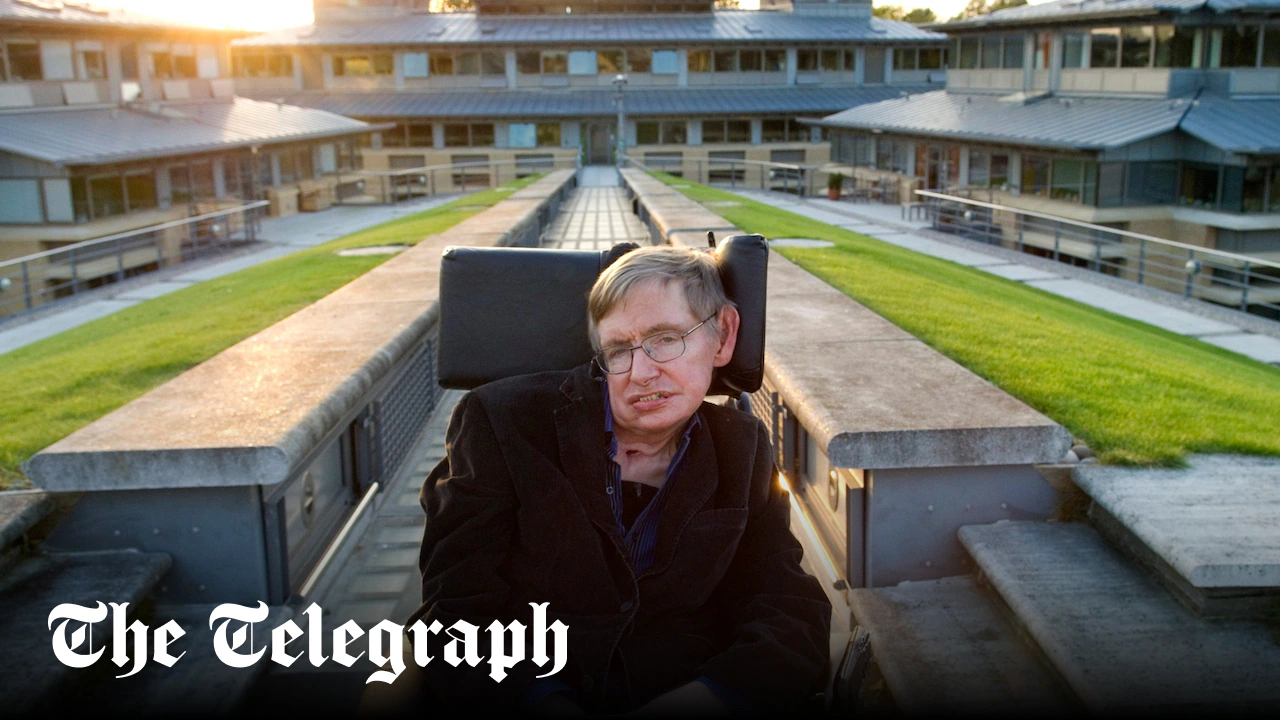
Eight years have passed since the theoretical physicist Stephen Hawking died, aged 76, of complications caused by motor neurone disease (MND). It was a condition that everyone expected would kill him in his mid-20s. Hawking faced down his gathering weakness and paralysis from a “ghastly prison”, as Graham Farmelo puts it in Hawking: His Life and Work, and from there issued, over 50 years, an extraordinary stream of intellectual accomplishments.
At the beginning of his career, in the midst of trying to understand the Big Bang – the “starting singularity” from which both time and space emerged – Hawking also, by-the-by, predicted just about everything we’ve since observed about black holes. His popular science writing made him into a celebrity: A Brief History of Time (1988) was a bestseller, and broke a record for appearing on the Sunday Times charts for 264 weeks. His funeral was attended variously by Eddie Redmayne (who played him in the 2014 biopic, The Theory of Everything), Brian Cox, and, perhaps not so curiously, Elon Musk.
No one has ever been so crass to suggest that Hawking’s accomplishments could ever redeem the ghastliness of his disease – but they serve as testament to the willpower of a man who had every reason to doubt that there was a special meaning to human life.
Hawking was born on January 8 1942 with an “enormous head”, according to his mother, Isobel, and “one of the loudest voices I’ve ever heard”. His sister Mary quickly found him to be “one of the most self-centred people I’ve ever met”. He stood out at St Albans School in 1952, if only for his ineptitude and physical awkwardness, and, at 17, entered University College, Oxford, where he coasted through his three-year degree by doing an average of an hour of work a day.
Hawking’s friends nicknamed him “Moomin”, because he was intensely excited by everything and constantly getting into scrapes. Indeed, in his second year, as the early symptoms of his MND began to manifest, he suffered a terrifying fall down a 30ft wooden college staircase. Hawking was so afraid that he might have sustained brain damage from the incident that he took to falling asleep at night to a tape loop of his own voice endlessly reassuring him: “You are a genius.”
The scientist met his future wife, Jane Wilde, an English teacher, at a New Year’s party in 1962, just as he was beginning postgraduate research at Cambridge and shortly before he was diagnosed with amyotrophic lateral sclerosis (ALS), the most common and least forgiving form of MND. Knowing this, the couple married in 1965 and had three children.