
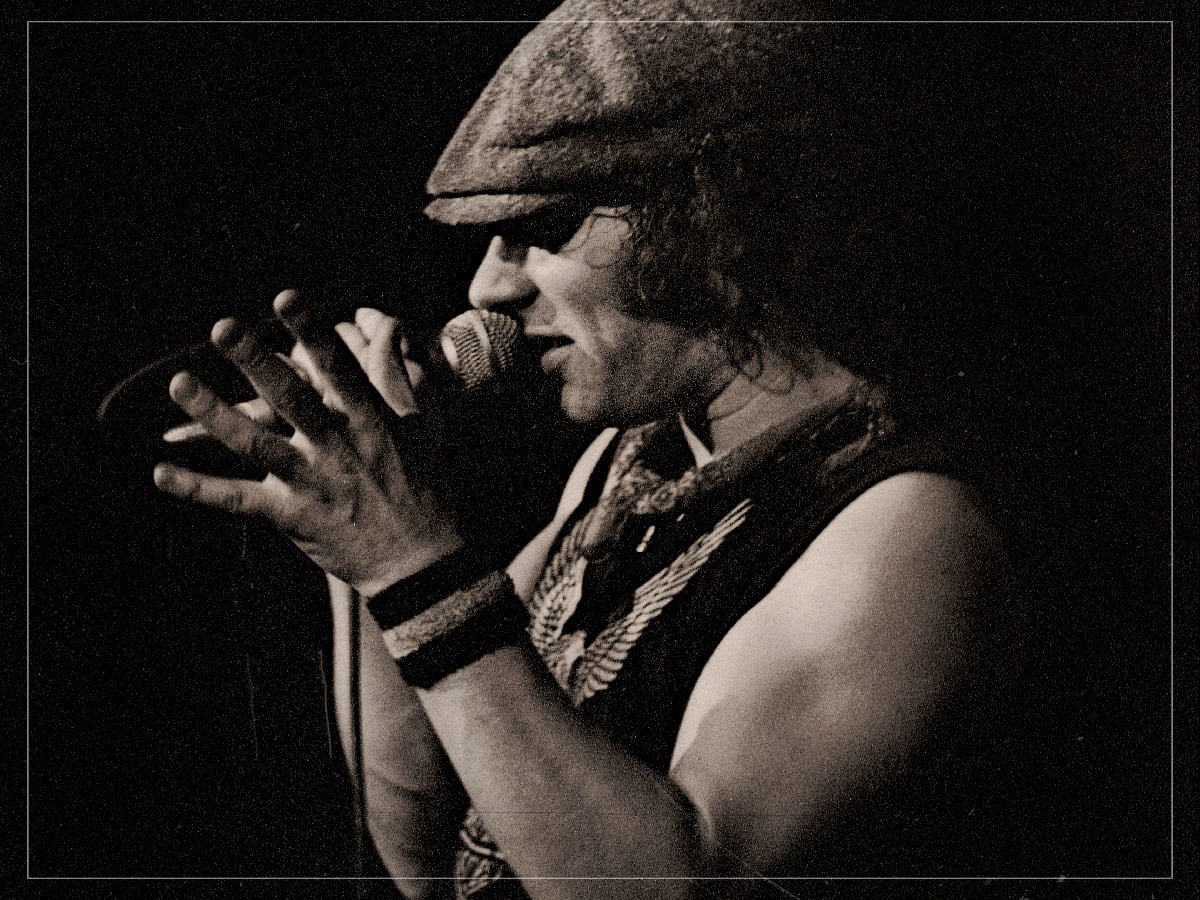
Credit: Far Out / Harry (Howard
Wed 16 September 2026 17:10, UK
The first time Brian Johnson discovered what it truly meant to be rock ‘n’ roll, his jaw dropped. Through the eyes of youthfulness, he watched on as Little Richard performed ‘Tutti Frutti’ live on the BBC. What happened next seems to come straight out of a biopic: saddened about his lack of a record player, he felt he would never relive such magic again.
That was, until a few days later, when he heard the recognisable sounds of the song coming out of somebody else’s house on the street. Knocking on their window, a young, naive Johnson said, “Could you play it again?” The girl in the house might have seemed slightly irked at the intrusion, but before they knew it, they were on the doorstep together, learning the hand jive.
Rock to Johnson could be seen as vital sustenance. You might assume as much, considering the fact that he is part of one of the most legendary rock bands to ever exist, but his love for the craft runs bone deep. “I found out that it was the rock songs that really got me up and going,” the musician told Rolling Stone. His love for music suddenly gained clarity upon discovering bands like The Kinks, and soon, he owned a pair of maracas because “that’s what Jagger used.”
Those early encounters also seem to have established a fairly simple standard that Johnson never had much reason to abandon. Little Richard didn’t require an explanation before sending him running towards somebody else’s record player, just as Jagger made a pair of maracas suddenly seem like essential equipment.
Rock ‘n’ roll worked on him physically before he understood anything about technique, production or songwriting, and the voices he later admired tended to retain that same ability to make everything else briefly feel secondary.
 Credit: Raph Pour-Hashemi
More than just a seasoned professional, Johnson knows exactly what good rock music should sound like, not just because he contributed to some of the most genre-defining songs but because, like a moth to a flame, his life without the music is completely inexplicable. Unfortunately, however, being a monolith in rock also means being prone to tragedy due to the nature of the lifestyle.
For Johnson, great music and suffering often converge. Whether it’s due to the personal experiences of each musician or the sinister drug and alcohol culture, music proves an inextricable backdrop, for better or worse. For this reason, one of his favourite songs came to adopt a considerably poignant meaning.
Discussing ‘Broken Down Angel’ by Nazareth during an episode of BBC’s Inheritance Tracks, the musician said: “It was a song by a friend of mine, Dan McCafferty, who passed on, and I’m gonna miss him. I’m just absolutely devastated to hear of his loss. But we first met at a submarine base in Glasgow. It was the big dance night at the naval base. We got on like a house on fire.”
Due to its personal nature, ‘Broken Down Angel’ yielded meaning beyond just McCafferty’s death, earning its place in Johnson’s heart because it also demonstrates the true power of rock. “I’d like to pass on ‘Broken Down Angel’ not to only one person,” he said, “But down to every young kid that wants to be a singer in a rock and roll band. So just listen to it. You can feel everything in his voice, you know. If you can learn from this, just the basics, you can not go wrong.”
Coming from Johnson, “the basics” is doing a lot of work. McCafferty possessed the rasp and enormous projection expected of a hard-rock singer, but none of it would matter if the voice didn’t sound connected to the person producing it. That’s something Johnson would understand better than most: neither man could reasonably be described as a pristine vocalist, yet both could turn the natural wear in their voices into part of the emotional vocabulary.
The song may adopt all the tropes we’ve come to associate with hard rock, but it also enhances the power of hope and authenticity, even if the subject matter seems somewhat glum. This is reflected in the lyrics, but the riff also injects the song with an undeniable sense of optimism, showing that rock can be both raw and fun.
