
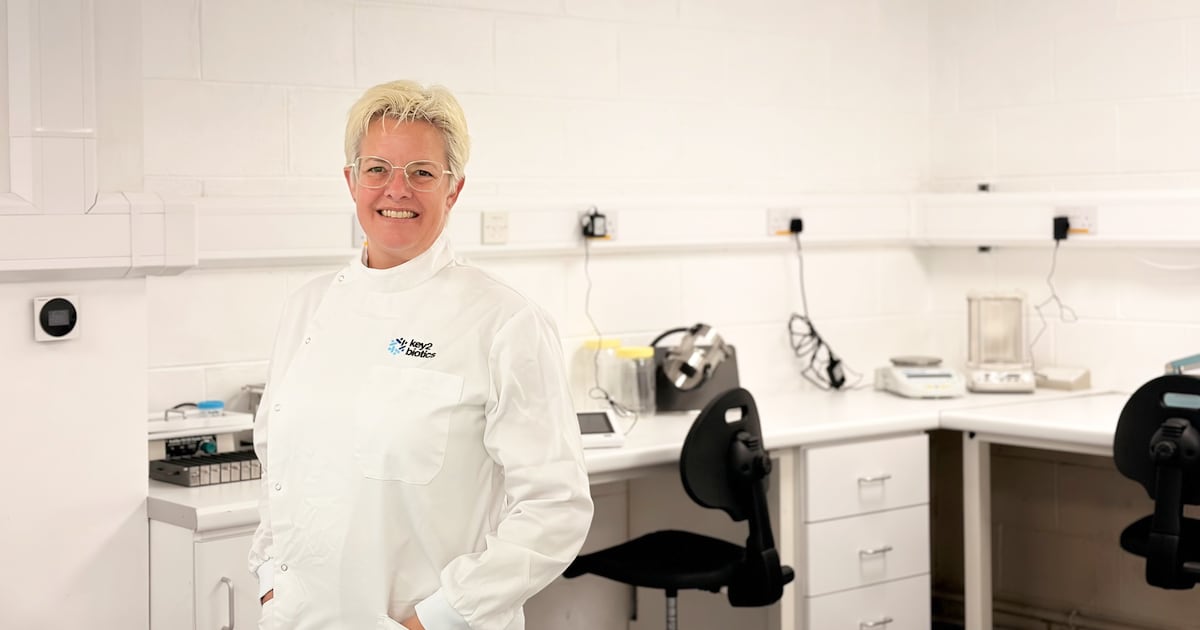
Dr Ali Winger is a life scientist with more than 20 years’ experience in biotechnology, probiotics and product innovation with some of the biggest names in the business, including Leo Pharma, Deerland Probiotics and Enzymes, Novozymes OneHealth and Novonesis.
Her career has spanned both scientific and commercial roles at a senior international level, and she could easily have spent her entire working life in the corporate sector and been well remunerated for it.
Instead, she decided to take the plunge into entrepreneurship, and in 2025 she set up Key2Biotics, which specialises in developing formulations for probiotic and gut-health supplement brands.
“Having spent almost a decade working in probiotics and supplements within two of the world’s largest biotechnology companies, I became convinced that much of the best in health innovation was being held back by the lack of access to the right development capabilities,” Winger says.
“The large nutraceutical companies typically have sophisticated scientific, formulation and quality teams supporting their products, but that infrastructure is largely inaccessible to the rest of the industry, whether that’s established brands and ingredient companies looking for external innovation, emerging brands or academic spin-outs.
“Key2Biotics was founded to bridge the gap and provide a similar depth of product innovation capability to the wider market. Our level of expertise is rarely found within traditional contract manufacturers.
“Anyone can come up with an idea for a supplement, but if it’s going to work and survive a shelf life of maybe two years or more, it needs to be backed by science. It’s not just about what’s in it.
“Many of the larger players are also ingredient suppliers, so they’re often tied to a specific list,” Winger adds. “Key2Biotics is ingredient-independent. This means our scientists can select from the latest clinically researched probiotics and other ingredients to create truly differentiated, efficacious and compliant products for our customers.”
[ Feed the ‘rainforest’ in your gutOpens in new window ]
Winger is from New Zealand, where she initially studied biochemistry. Her PhD is in mitochondrial biology and proteomics, and she earned her postdoctoral research stripes with universities in France, Australia and South Africa before moving to Ireland in 2014 to join start-up company Monaghan Biosciences. There, she led the team developing novel organisms and enzymes for use in industrial applications.
“I came to Ireland as a single mother with an 18-month old in tow and knew no one,” Winger says. “But it was a really cool job, and that’s what attracted me. I thought I’d stay a few years and then go back to New Zealand, but 12 years later and I’m still here, married to an Irish man and living in Cobh.”
Being Cork-based is a happy coincidence given the company’s focus on probiotics, as Prof Ted Dinan from University College Cork is a world-leading authority on the gut-brain axis, and some of the most significant research in this area has been carried out by academics at UCC.
“Because the big companies are focused on their own product development, the powerful and innovative research coming out of the universities, especially in Cork, has nowhere to go,” Winger says.
“Knowing the industry from the inside, I knew this wasn’t going to change any time soon, something I found deeply frustrating as a scientist. I kept feeling: this isn’t right. The science needs to get to the consumer because they deserve access to supplements that stand up to scientific scrutiny. The idea for Key2Biotics basically grew from there.
“Having built product development pipelines and set up processes and lab capabilities from scratch before I knew I could do it again,” says Winger, whose previous scientific roles included director of R&D and clinical trials with Deerland and global head of product development with Novozymes OneHealth.
From the outset Winger decided that Key2Biotics would be a niche player. “We are not a generic vitamin and mineral product development house, but if a product contains a probiotic, then we will get involved because probiotics are live organisms and have to be properly handled. You can’t just take it and put it into a capsule like you can with a vitamin or a mineral because it simply will not survive,” she says.
“Recently, we’ve taken a number of supplements off the retail shelf and tested them in our lab. Over 60 per cent did not meet the number of live probiotics stated on their label. Our expertise lies in getting the strain intact into a supplement so it provides the health benefits shown by the clinical data.”
Key2Biotics already has paying customers in the EU, the UK, North America, Asia-Pacific and Turkey, and it charges according to the service required. Its customers are global and include healthcare brands, functional food and ingredient companies, biotechnology companies, academic spin-outs and start-ups.
“We work with those looking to develop new products, translate novel science into commercial applications or access specialist probiotic and microbiome development capabilities without building them in-house,” says Winger, whose company employs six people, including three PhDs in microbiology.
“We also work with practitioners to help people with IBS [irritable bowel syndrome] or Crohn’s disease, for example, and we provide technical and commercial consultancy as well as testing services to check shelf life or if the probiotic in a product is still alive.”
External investment in the business to date is around €200,000 with support from LEO South Cork and the Enterprise Ireland pre-seed start fund. Early customer revenues have also been reinvested to build out the scientific team and the laboratory infrastructure, which comprises three labs and a clinical trial product manufacturing suite.
“We’ve bootstrapped to date but are now looking to raise a seed round of €1 million to accelerate our development,” Winger says. “We’re building something unique and have big ambitions to scale it to a global level. Our scientific platform is really strong, and we can see from customer pull where we need to go next. I’ve been in the industry for a long time, so I have good contacts, but we don’t have visibility with the supplement brands yet. Getting that is my aim for now.
“Without question finance has been the hardest part of starting the business,” Winger adds. “Building a science-led company is capital intensive, as you need specialist people and laboratory infrastructure before you can fully scale the commercial opportunity.
“The biggest challenge has been balancing the ambition to build the business properly and quickly with the reality of conserving capital at an early stage. We have achieved a huge amount with relatively limited investment so far, but access to growth capital is critical to accelerating what we can build.”