
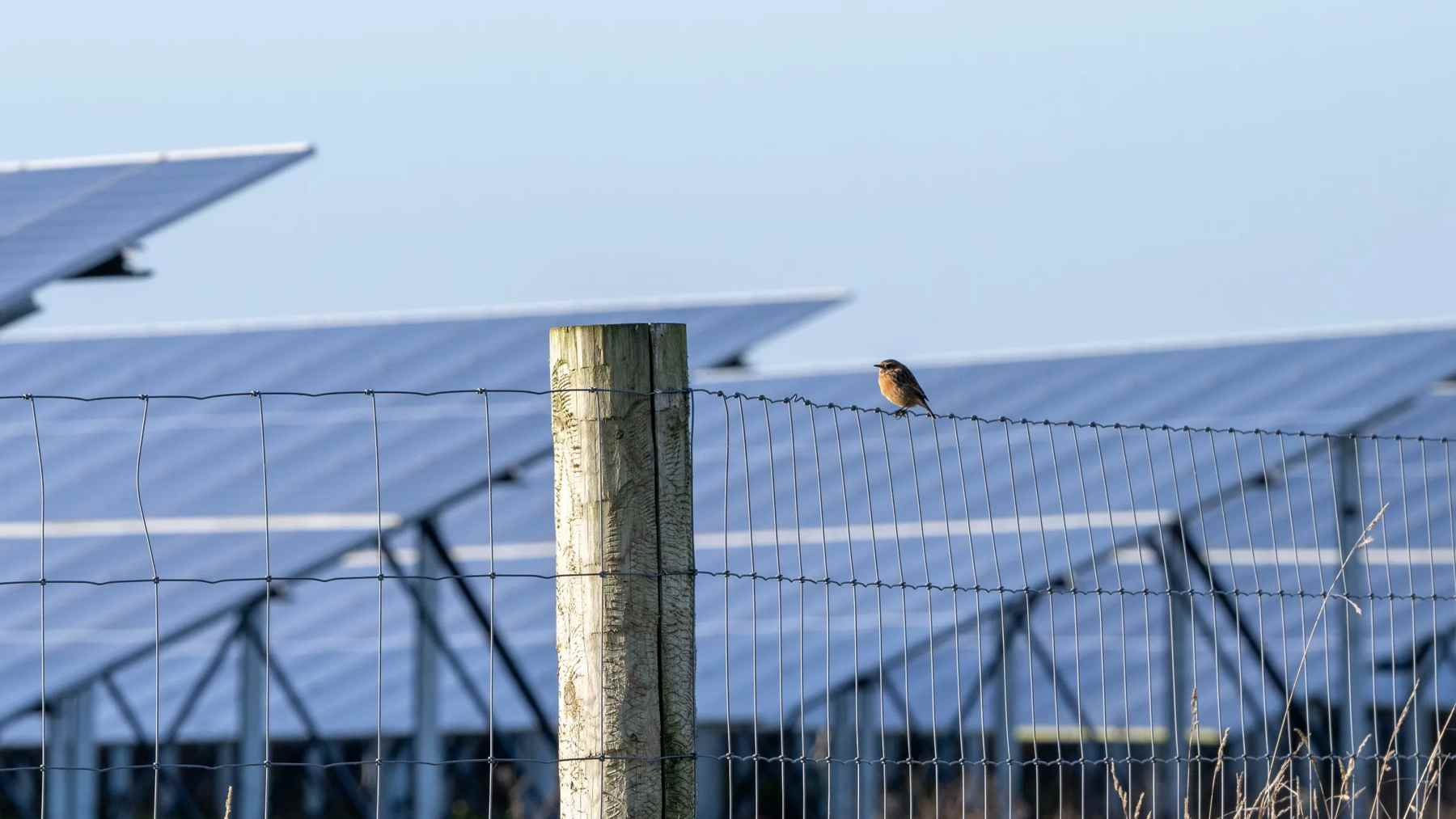
The objection to building solar farms on farmland is usually framed as a loss.
Productive ground goes out of production, gets covered in glass and steel, and whatever lived there is presumed to leave with the crop.
The assumption inside that argument is that a field of wheat is the wildlife baseline.
For most of eastern England it is not. Intensive arable is close to the emptiest habitat in the country, ploughed annually, sprayed and stripped of every field margin that once held anything.
So the comparison a planning committee is actually making is not between nature and industry.
It is between two kinds of managed emptiness.
Birds need structure, and a mower removes it
Almost nothing a farmland bird needs comes from the crop itself.
What they need is structure at ground level. Tussocks to nest inside, seed heads standing into winter, thorny scrub to sit in and bare patches to feed on, all of it within a short flight of the rest.
A solar farm can supply every one of those, since the ground under the panels is never ploughed, never sprayed and never harvested.
That combination is genuinely rare in a modern lowland landscape, and it comes free with the engineering.
It also disappears the moment somebody decides the site should look tidy, because a mower run through it or sheep kept on it year round removes exactly the layer the birds were using.
The panels are not the variable.
Two sites that look nothing alike
Stand in one kind of site and the grass is cut to the fence line, the boundaries are bare wire, and the sward is a uniform green mat with sheep on it in every month.
Stand in the other and the rows are separated by rough grass that has gone to seed, with hedgerows along the edges and small trees coming up where nobody has stopped them.
Flowering plants appear in the second kind because nothing cuts them, and insects follow the flowers, and the birds follow the insects and the seed.
Both sites generate the same electricity from the same hardware under the same sky.
The difference between them is a decision about a maintenance schedule, taken by whoever holds the operations contract.
It costs less to do less.
Other top storyIn under 90 seconds a line at a Sydney airport takes the frame and the glass off a worn solar panel without heat, where the thin fluorinated film on its back still has nowhere to go
Counted in one spring in one landscape
The survey work was done in the spring of 2023, across solar farms in the fens of eastern England, using the standard breeding bird method of walking fixed routes and recording everything seen or heard.
Mixed habitat sites carried roughly twice the birds of the intensively managed ones, and about three times the cropland.
Species richness spread further. The number of different species on the mixed sites came out around 2.5 times higher than on either comparison.
The gap was widest among the birds that have fallen hardest. Yellowhammer, linnet, greenfinch and corn bunting were all considerably more abundant on the mixed sites.
Those four are not incidental. They are the species that farmland bird indexes have been tracking downward for decades.
They turned up under the panels.
One spring is one spring
The limits are worth stating before the result gets used in an argument it cannot carry.
This is a single breeding season, in one region, on one soil type, with a modest number of sites, and the comparison is against high yielding arable, which is a low bar to clear.
Counting birds also measures presence rather than success, so nothing here shows whether the nests on those sites produced fledglings or simply attracted adults away from somewhere else, in the way that a grazed array or a large ground mounted site gets credited with an effect nobody measured.
The authors describe the work as among the first of its kind in the country, which is an accurate framing and also an admission.
Other top storyA gauge in 1 Maui harbor swung 11.44 feet from trough to crest while others in the islands barely moved, but the water that arrived at all of them was the same pulse from the same ocean
Nobody has repeated it yet.
The finding is about mowing, not about solar
Strip the technology out and the result stops being surprising at all.
Leave rough ground alone in a landscape that has almost none and birds use it. That has been known for as long as anybody has counted birds on field margins.
What is new is the scale of the opportunity, because solar farms now cover enough ground to matter and the vegetation between the rows is doing nothing for the generator either way.
The catch is that none of this is in the planning consent. Approval covers panels, fencing, access and decommissioning, and the mowing schedule that decides the outcome is left to whoever runs the site.
The East Anglian fens did not get their birds back from the panels.
They got them from the unmown strip.