
X-ray scans and artificial intelligence could help researchers read more Herculaneum scrolls without opening them. Tiny amounts of lead in ancient ink create a strong X-ray signal.
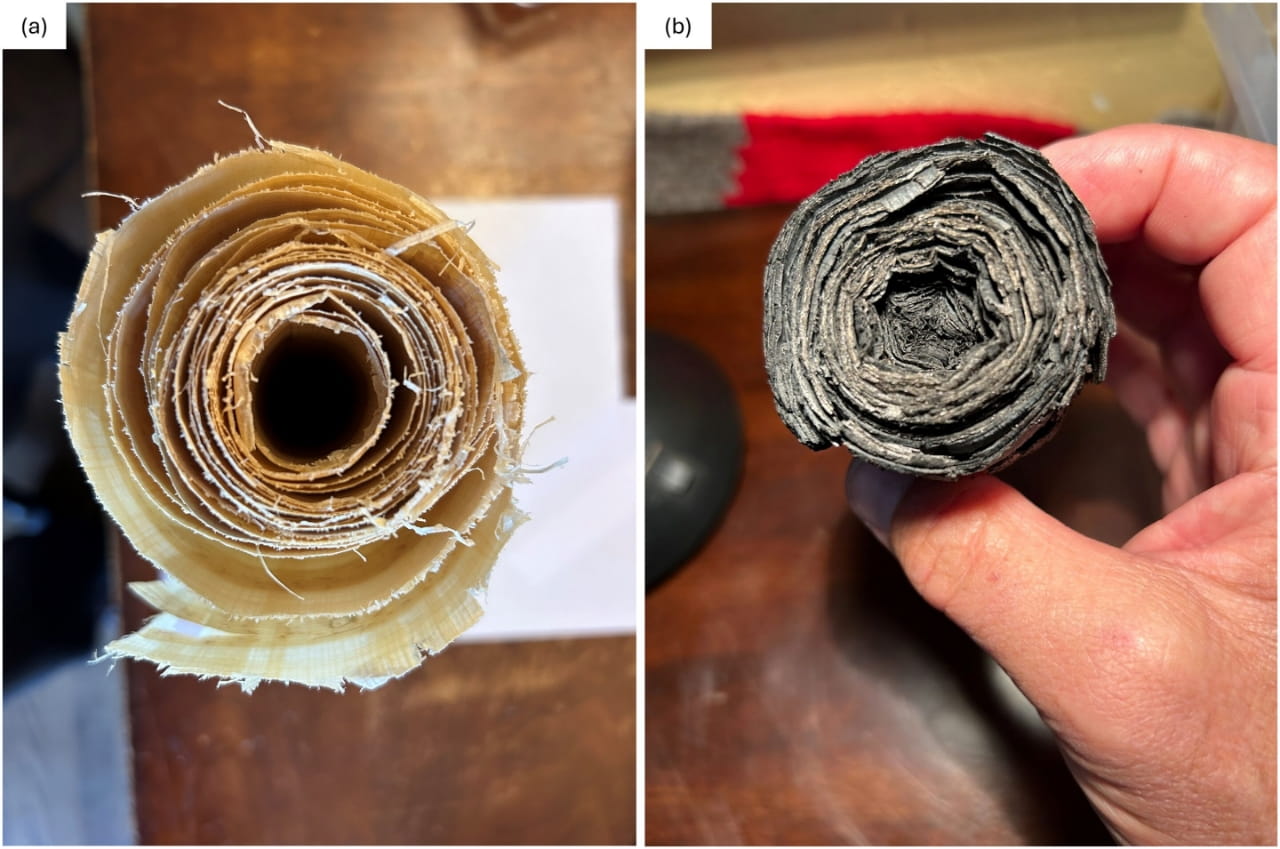
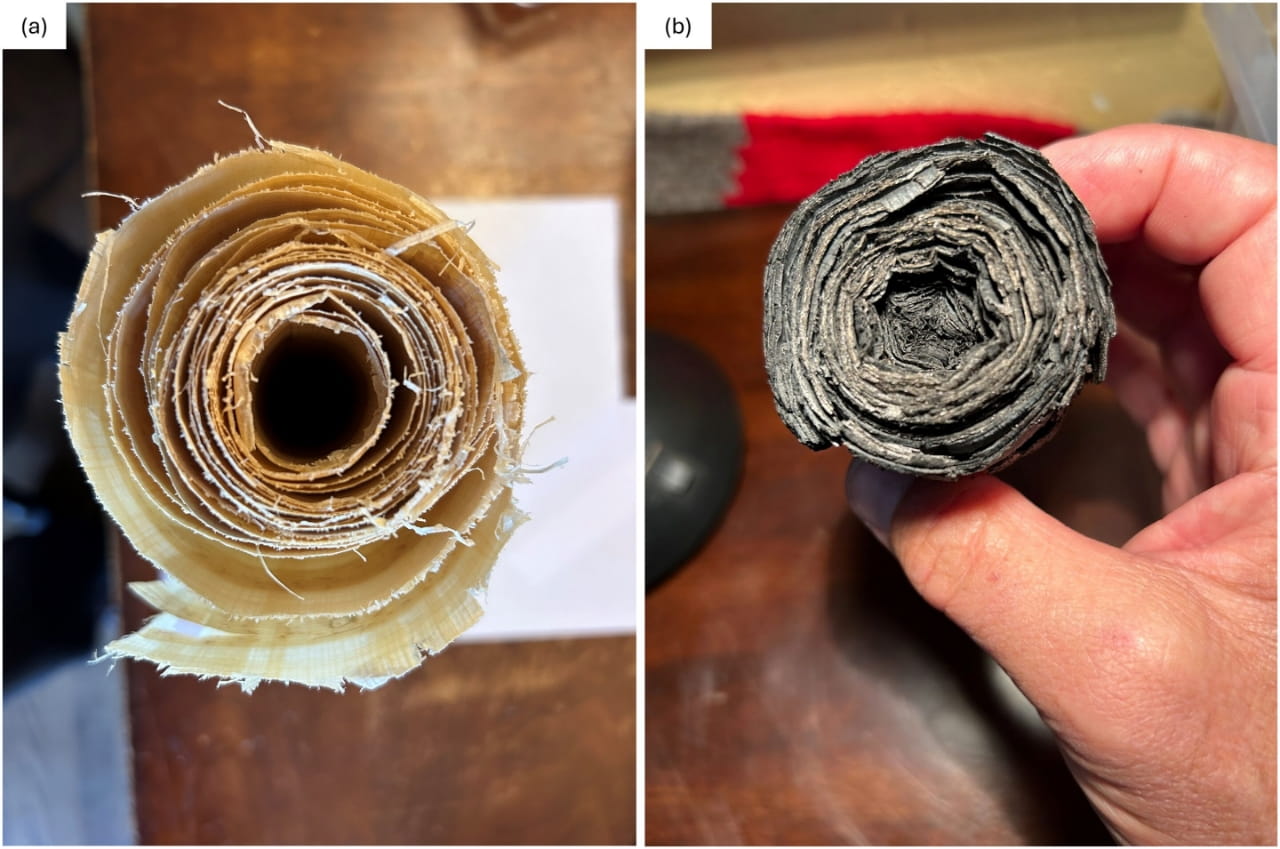 a) One of several papyrus scrolls before carbonization and (b) after carbonization. Carbonized scroll produced with tight packing of layers and waviness that will challenge unrolling algorithms. Credit: Seiler et al., PLOS One (2026), CC0
The Herculaneum papyri were buried during the eruption of Mount Vesuvius in 79 CE. Ash and rock covered the town near modern Naples, Italy, along with a large library of papyrus scrolls. Extreme heat carbonized the scrolls, leaving fragile blackened objects.
More than 1,800 scrolls and fragments from the library still exist. Some contain works by the Epicurean philosopher Philodemus.
Researchers have struggled to read many scrolls because their ink and papyrus both contain carbon. X-ray tomography, or X-ray CT, maps the layers inside a closed scroll. Yet carbon-based ink often produces too little contrast against carbonized papyrus.
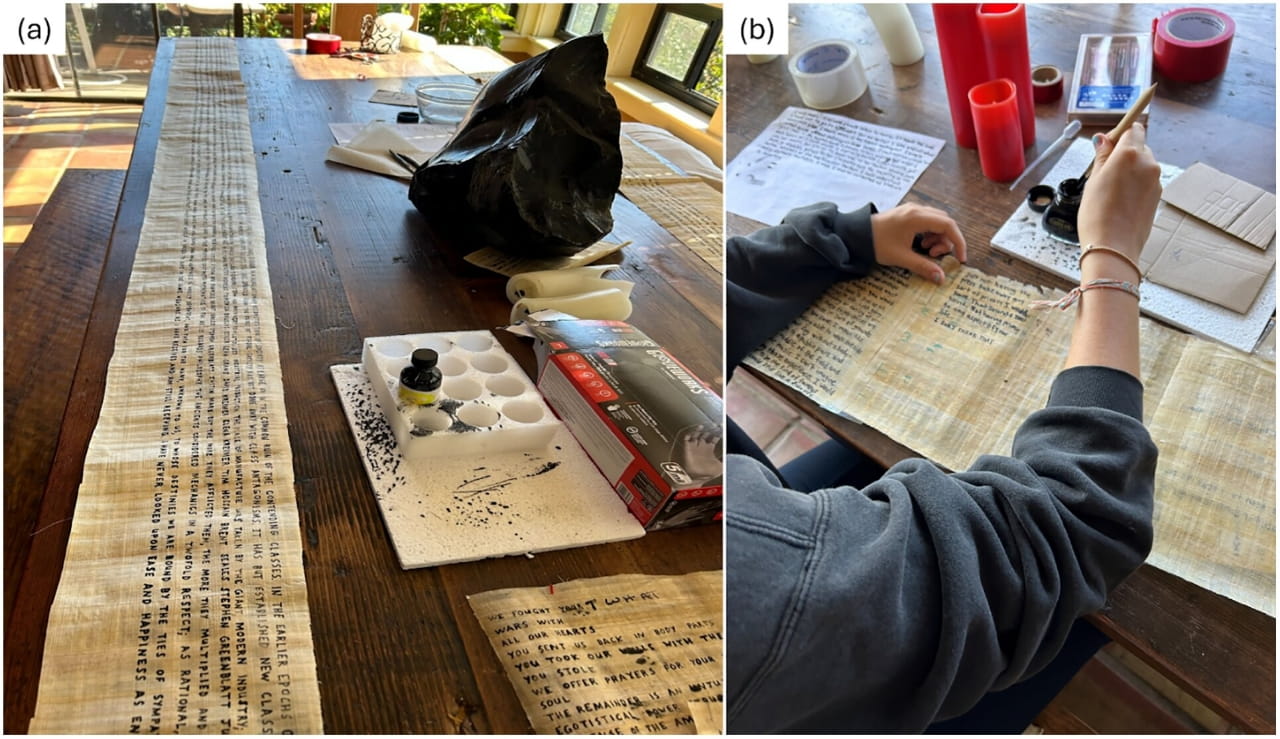 Preparation of papyrus scroll with inks of varying lead concentrations. Credit: Seiler et al., PLOS One (2026), CC0
A team led by Douglas Seiler tested a different approach. The researchers focused on lead, which absorbs X-rays far more strongly than charred papyrus. If ancient ink contains lead, letters should stand out in CT scans.
The team first made model scrolls to test the idea. Seiler prepared lampblack ink with different amounts of lead. High school students used reed pens to write passages on new papyrus. The team then rolled up the scrolls and heated them in a low-oxygen furnace.
X-ray fluorescence and X-ray CT detected lead at every tested concentration. Lead concentrations as low as 25 micrograms per square centimeter were visible in the scans.
The leaded letters appeared much brighter than the surrounding papyrus. Seiler said the letters “lit up like a Christmas tree.”
An inexpensive handheld X-ray fluorescence scanner offers a first step. Researchers could screen Herculaneum scrolls for lead before sending selected pieces for high-resolution CT imaging.
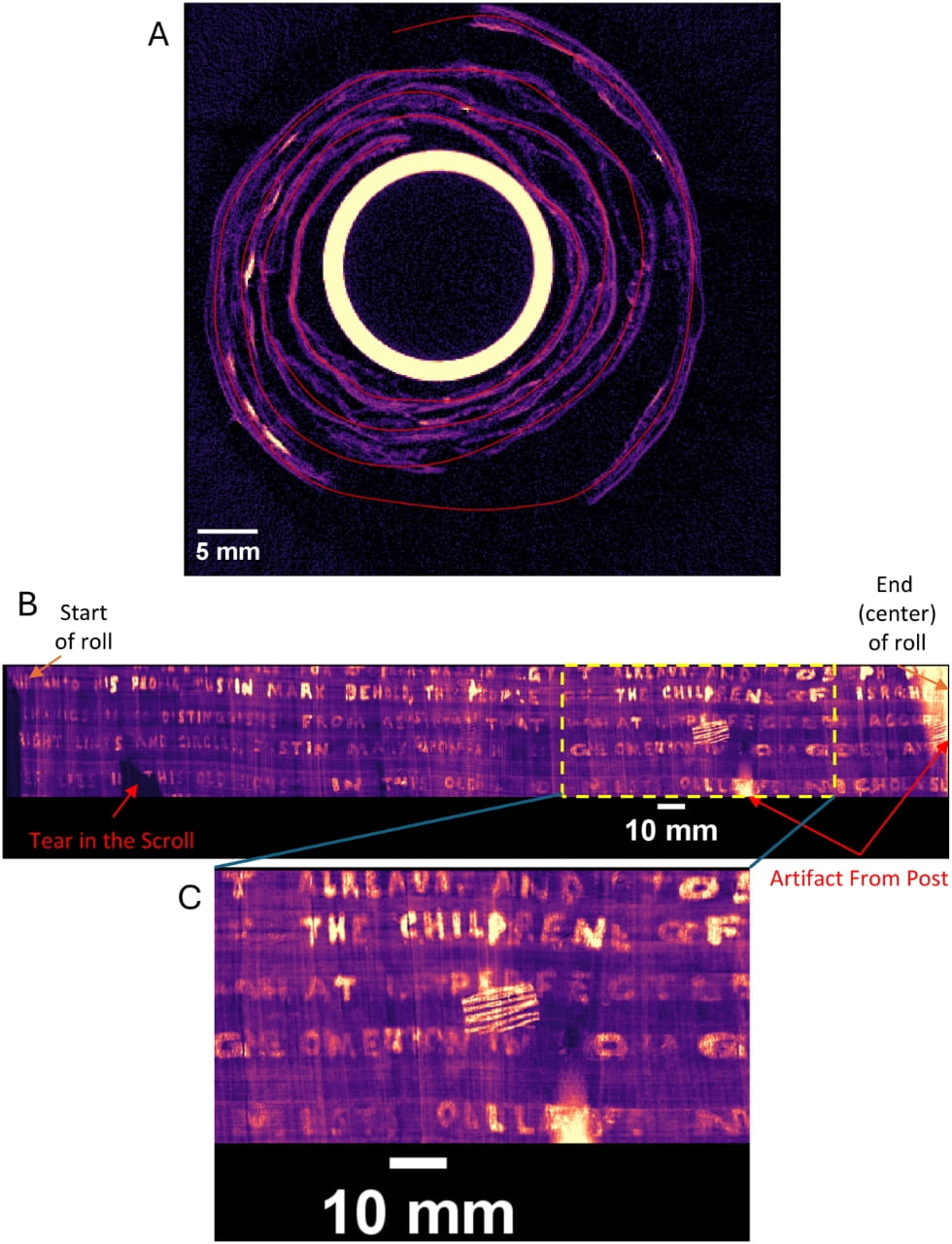 A full virtual unrolling of a model scroll and a closeup highlighting visible text. Credit: Seiler et al., PLOS One (2026), CC0
The team also tested software for virtually unrolling burned scrolls. Michael Cyrus Daugherty adapted code made for mapping inner layers of lithium-ion batteries. The program followed the uneven scroll thickness and produced an unrolled view.
Artificial intelligence already plays a role in reading Herculaneum papyri. The Vesuvius Challenge helped drive efforts to read CT scans of closed scrolls. In 2024, AI helped researchers recover 15 columns from one scroll. The text proved to be an Epicurean work about perception and pleasure.
In 2026, another team used AI to read part of a damaged scroll called PHerc. 1667. The text appears to discuss Stoic philosophy and could date to the second or third century BCE.
Those successes relied on faint differences linked to ink within scanned papyrus. Lead offers a much stronger signal. According to the researchers, leaded ink absorbs up to 25 times more X-rays than the charred papyrus around it.
The model scrolls also offer a safer way to improve virtual unrolling software. Researchers know exactly what text is inside each model. They can compare computer results with the original writing and use those results to train better algorithms.
The study does not show how many Herculaneum scrolls contain leaded ink. Only a few scrolls have been virtually opened and read so far, and none had been systematically tested for lead before this work.
Researchers suggest screening the surviving scrolls for lead. This could identify texts where X-ray CT and AI have a stronger chance of recovering hidden writing. Even a small number of newly readable scrolls could add lost works to the record of ancient Greek and Roman thought.
Publication: Seiler, D., LaManna, J. M., McOsker, M., Kreimer, D., Daugherty, M. C., & Dopke, J. (2026). A model carbonized papyrus scroll opens a novel path to identifying readable scrolls of the Herculaneum Library. PloS One, 21(9), e0353485. doi:10.1371/journal.pone.0353485