
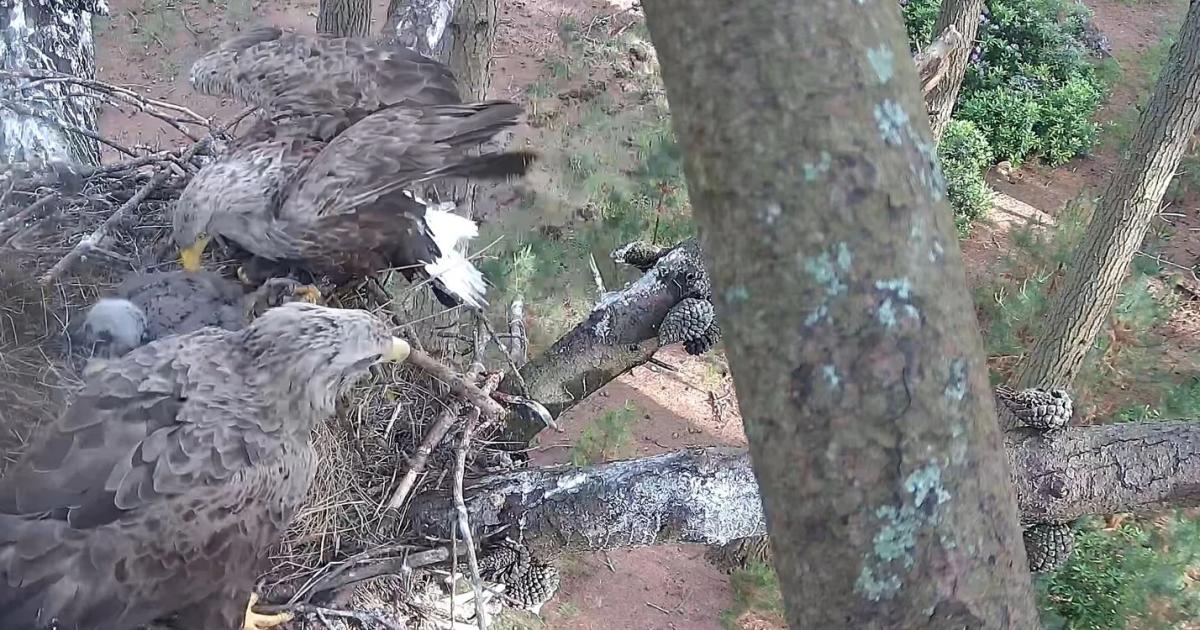
This marks the fourth consecutive year of successful fledging in England.
The chick, known as GE38, is the offspring of G463 and G466, two eagles introduced through a reintroduction project led by Forestry England and the Roy Dennis Wildlife Foundation.
The project began in 2019 and aims to re-establish the species in southern England after more than two centuries of absence.
Roy Dennis OBE of the Roy Dennis Wildlife Foundation said: “This year’s breeding success is another important milestone in the return of this lost species to England; it shows what can be achieved by very skilled wildlife managers.
“This is now the fourth year where these released eagles have raised and fledged chicks.
“With a further three pairs of eagles also well-established, we should see this progress continue in the next few years.”
White-tailed eagles, also known as sea eagles, are Britain’s largest birds of prey, with wingspans reaching up to 2.5 metres.
The species was once widespread across England but became extinct in the 18th century due to human persecution.
The Dorset nest marks the second successful breeding for the parent birds.
The male eagle, G463, is especially notable for having successfully raised a chick despite having only one leg—a loss sustained five years ago.
All three chicks fledged in England this year have been fitted with satellite tags to allow conservation teams to monitor their movements.
Tracking data from previous years has shown that young eagles range widely across the UK after fledging.
Steve Egerton-Read, white-tailed eagle project officer for Forestry England, said: “It’s been another long summer of watching and hoping that the eagles would be successful in breeding and raising young.
“There is nothing quite like that moment of seeing the chicks hatch and first appear in the nest.
“It is then a waiting game while we watch their progress.
“We are delighted that these three chicks made it through and will be closely watching their progress as they begin to explore the landscape.”
This year, the project team also gathered detailed data on the breeding eagles’ diet using cameras installed near the nests.
More than 300 food deliveries were recorded, with fish making up the majority of the diet.
The reintroduction of white-tailed eagles is carried out under licence from Natural England.
The Roy Dennis Wildlife Foundation collects birds from wild nests in Scotland under licence from NatureScot.
To date, 56 young eagles have been released in southern England, including five birds this summer from the Isle of Wight.
For the first time, six additional eagles were released at Exmoor National Park in partnership with the Exmoor National Park Authority.