
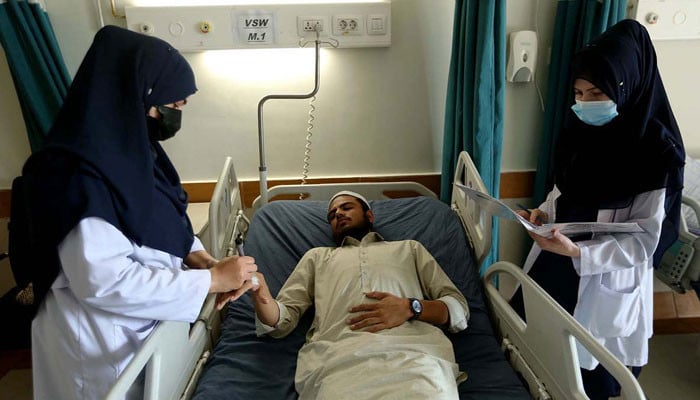
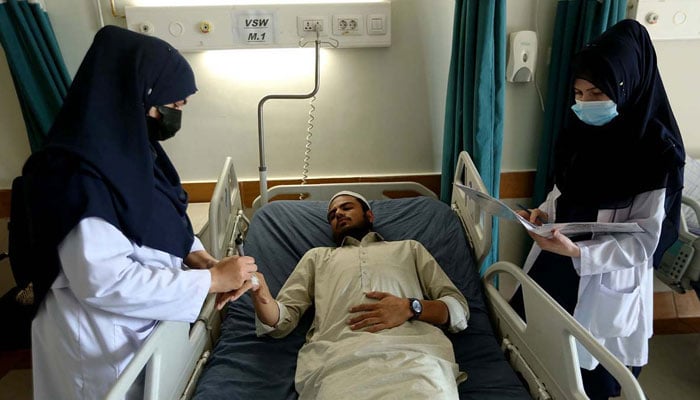
Nursing staff attend to a patient as part of their duties on International Nurses Day at a hospital on May 12, 2025. — APP
Healthcare is evolving at an unprecedented pace. Advances in technology, increasingly complex patient and family needs, workforce challenges and changing models of care are transforming nursing practice, particularly across low- and middle-income countries (LMICs).
In Pakistan, nurses continue to demonstrate remarkable resilience while navigating workforce shortages, increasing service demands, resource limitations, respect and compensation issues and rapidly evolving healthcare expectations. Given these realities, investing in professional development is essential to ensure nurses are equipped to meet today’s challenges and lead tomorrow’s healthcare transformation.
While competence remains the foundation of safe practice, modern healthcare requires nurses to manage increasingly complex clinical situations, anticipate risks, communicate effectively and make timely decisions in rapidly changing environments. This is particularly evident in critical care and high-acuity settings, where clinical vigilance, sound judgment and early intervention can significantly influence patient outcomes.
Professional development must therefore go beyond what nurses know and include how effectively they apply that knowledge. Strong clinical judgment, communication and decision-making are essential safeguards for patient safety.
Nurses are also uniquely positioned to drive innovation. As the professionals closest to patients, families and care processes, they are often the first to identify opportunities for improvement. Innovation in nursing is not always about sophisticated technology. It may involve improving communication, reducing inefficiencies, streamlining workflows, enhancing patient experiences or strengthening safety practices.
Across healthcare organisations, nurses have led initiatives such as reducing hospital-acquired infections, implementing safety huddles, improving clinical handovers, introducing early warning systems and developing standardised care pathways. These initiatives demonstrate how frontline insight can translate into meaningful improvements in quality and safety.
Digital transformation is also reshaping healthcare delivery. Electronic health records, telehealth, artificial intelligence and clinical decision-support systems are becoming integral to patient care. As the largest segment of the healthcare workforce, nurses are central to the successful adoption and optimisation of these technologies. Future-ready nurses must be digitally confident, with competencies in informatics, data literacy, virtual care and responsible use of emerging technologies.
Importantly, nurses should not be viewed merely as end-users, but as key partners in designing and improving digital solutions. Nurse-led innovations, including electronic early warning systems, clinical escalations and digital patient education platforms, are already producing measurable benefits for both patients and healthcare organisations.
Healthcare delivery increasingly depends on interdisciplinary collaboration, with nurses acting as the web that connects them while also advocating for patients and facilitating communication.
Professional development must therefore strengthen teamwork, systems thinking, communication and collaborative decision-making. Equally important are clinical educators, who translate knowledge into practice by mentoring nurses, facilitating evidence-based care, supporting competency development and fostering lifelong learning.
Nursing is built on trust, accountability and ethical practice. Professional development enhances not only capability but also professional responsibility. At the same time, workforce wellbeing must remain a priority. Psychological safety, supportive leadership and opportunities for growth enable nurses to thrive personally and professionally. Supporting nursing also cannot be separated from patient safety, as it is fundamental to it.
Leadership is the final and essential element. Today’s nurse leaders influence far more than daily operations. They shape strategy, advance quality and safety, drive digital transformation, contribute to workforce planning and help lead health system improvement. Their perspectives ensure that healthcare transformation remains patient-centred, evidence-based and sustainable.
As healthcare continues to evolve, so must nursing. Professional development is not simply about helping nurses perform today’s work more effectively. It is about preparing them to lead tomorrow’s healthcare. By investing in nursing development, we strengthen patient safety, foster innovation, support workforce wellbeing and build the leaders who will shape healthier communities and stronger health systems for generations to come.
The writer is chief nursing officer at Agha Khan University Hospital.