
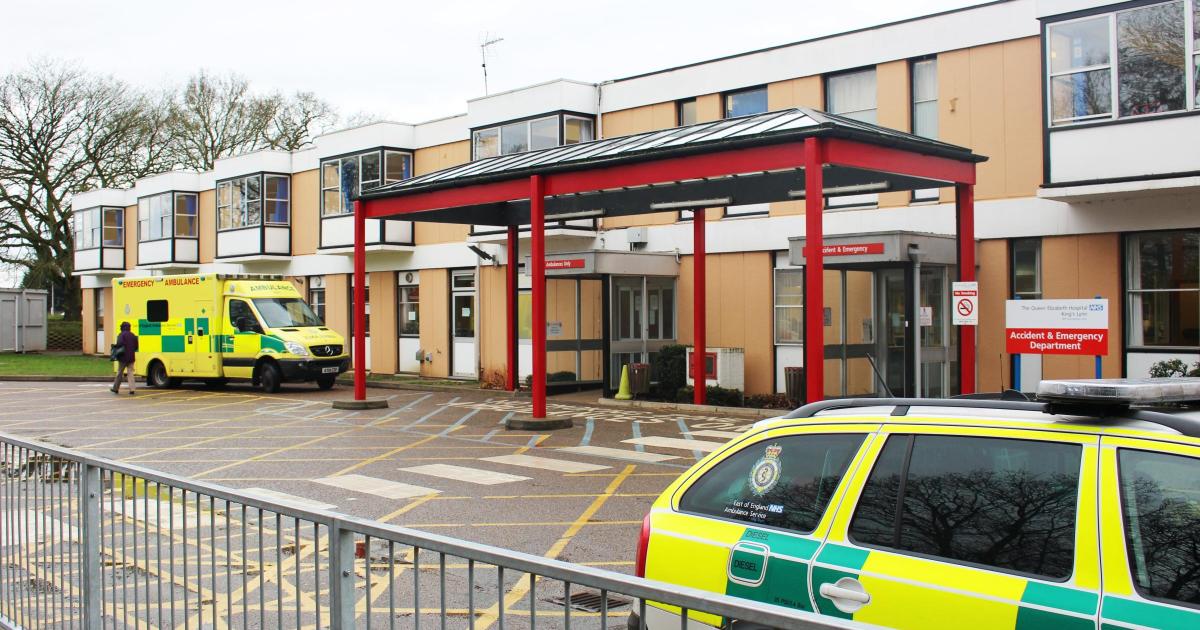
In a leaked letter obtained by the EDP, senior medics at the Queen Elizabeth Hospital (QEH) have accused its leadership of causing “immense distress” among staff and patients following reports that the units could be downgraded.
Earlier this month, this newspaper revealed that the Norfolk and Waveney University Hospitals Group – which oversees the QEH, the Norfolk and Norwich Hospital and Gorleston’s James Paget – was carrying out a review of clinical services that risked downgrading provisions.
The group has insisted that “no decisions have been made” and that urgent and emergency care will remain in King’s Lynn at the QEH around the clock.
The Queen Elizabeth Hospital in King’s Lynn (Image: QEH)
However critics have pointed out that this pledge leaves open the possibility of a scaled-back service, such as a smaller emergency department unable to handle trauma, cardiac arrest or stroke.
The QEH serves a large and sparsely populated area, and there are concerns locally about what a downgrade would mean for patients needing to reach hospitals as far as Norwich, Peterborough or Cambridge in a life-threatening emergency.
Amid growing concern among locals in west Norfolk, the damning document seen by the EDP sets out the impact the reports have had within the hospital itself.
The letter was sent by the chair of the Local Negotiating Committee, the body that represents consultants in discussions with management, and called for urgent clarification from the group.
It reads: “We must express our profound discomfort regarding the current handling of the clinical strategy review and the serious threat it poses to our core services.
The hospital is the second biggest in Norfolk (Image: Supplied)
“The recent media coverage reporting the potential closure or severe downgrading of our Accident & Emergency (A&E), Intensive Care Unit (ITU), and Maternity services has caused immense distress among our staff, our patients and the wider community.
“We must ask whether some form of public consultation or disclosure led to this media reporting, as the sudden public exposure of these options has severely shaken local confidence.
“Furthermore, the responses given by our executive leadership suggest extensive clinical input into the discussions around future service planning. This gives the mistaken impression to our patients that we are in support of these changes, which we are not.”
The consultants have called for urgent clarification over the group’s plans, adding: “To be clear, the refusal to actively deny these reports or explicitly state that there is no plan to close these services is being interpreted by both staff and the public as a tacit admission of intent.
A slide about the review of services which is under way (Image: QEHKL)
“The lack of a clear, robust refutation has fundamentally undermined our ability to reassure those we care for and work alongside.”
The letter also warns of the growing impact on staffing claiming the “persistent uncertainty” is already having a “devastating impact on our recruitment and retention”.
It adds: “Senior clinicians and vital support staff are questioning their future at the trust, while potential applicants are understandably hesitant to join an organisation where core acute services are under threat.
“If these destabilising rumours are not quashed, we risk a severe workforce crisis that will compromise service viability long before any formal strategy is even finalised.”
The letter comes as the group confirmed the opening of the QEH’s planned £1.4 billion replacement hospital is now expected to slip by at least a year to 2033.
It has also emerged that the opening of the new James Paget Hospital – which is also set for a rebuild – has been pushed back a year.
A further concern raised by the consultants is that the Norfolk and Norwich Hospital could increasingly become the group’s focal point at the expense of the other two sites as part of the new clinical strategy.
“The optics of this situation are incredible damaging” (Image: QEH)
Finally, it adds: “As senior clinicians, we are on the frontline of a highly rural catchment area with significant health inequalities, poor public transport links, and vast travel distances.
“It is vital to emphasise that downgrading our acute capabilities is an existential threat to patient safety, impacting not only West Norfolk but also thousands of patients across North Cambridgeshire and South Lincolnshire who rely heavily on the QEH as their closest acute hospital.
“These border populations have few realistic alternatives, and their displacement would place unmanageable pressure on surrounding regions.”
‘DEEPLY CONCERNING’
Rob Colwell, a local Liberal Democrat councillor, has launched the petition “Save the QEH” in response to the reports, which has since received more than 10,000 signatures.
He said: “The contents of this letter are deeply concerning. What stands out is that these warnings are not coming from political campaigners or outside commentators, but from senior clinicians working on the frontline at the Queen Elizabeth Hospital.
Councillor Rob Colwell at the QEH meeting (Image: Chris Bishop)
“They describe profound anxiety about the future of A&E, intensive care and maternity services, and raise serious concerns about the effect the continuing uncertainty is already having on staff morale, recruitment and retention. Those concerns deserve to be heard and answered clearly.
“For the communities that depend on the QEH, these are not optional extras. They are life-saving services. King’s Lynn serves a large rural population, including people across West Norfolk and beyond, where distance and poor transport links mean that simply expecting patients to travel elsewhere could have very serious consequences.”
“The public now needs clarity. ‘No decisions have been made’ does not resolve the understandable fear about what options are actually being considered.”
He urged those responsible for the review to be “transparent about the options under consideration” by publishing the clinical evidence and engaging openly with affected clinicians and communities.
“The new QEH was promised as an investment in the future of healthcare in West Norfolk,” he added.
“Local people understandably expect that new hospital to retain the life-saving services on which they depend.
“The concerns raised by these clinicians reinforce just how important it is that their voices, and those of patients, are at the heart of the decisions that follow.”
James Wild, the Conservative MP for North West Norfolk, said: “The clinical strategy review was being run behind closed doors until proposals were leaked about possible downgrading of QEH services which caused strong local concern and opposition.
(Image: Richard Townshend)
“It is striking that some of the clinicians involved this work are explicit they did not ever have expect lifesaving departments such as A&E, ICU, and maternity would be considered for removal and oppose such plans.
“As I put it at QEH’s annual members’ meeting last week, how can local people have confidence patient needs are being put first when such a move would not reflect our population, geography, deprivation, safety, and need?
“The Norfolk and Waveney NHS Group leadership should now provide the commitments that I and others have called for and provide an assurance these services will be retained”.
WHAT DO THE BOSSES SAY
When approached about the letter, professor Lesley Dwyer, the group’s chief executive, said the group was taking the “concerns raised seriously”.
Lesley Dwyer, the group’s chief executive (Image: Chris Bishop)
She said: “On September 11, I met with representatives of the consultant body alongside a board member to discuss the issues they raised. A formal written response has now been issued on behalf of the board.
“As set out in that response, no decisions have been made to close or downgrade any services at the QEH. Because of unprecedented investment in our hospitals, we have a once in a generation opportunity to transform the care we provide.
“We very much want our staff to be part of shaping that future and remain committed to working closely with our consultants, strengthening clinical involvement in the development of our plans and continuing constructive dialogue as this work progresses.”