
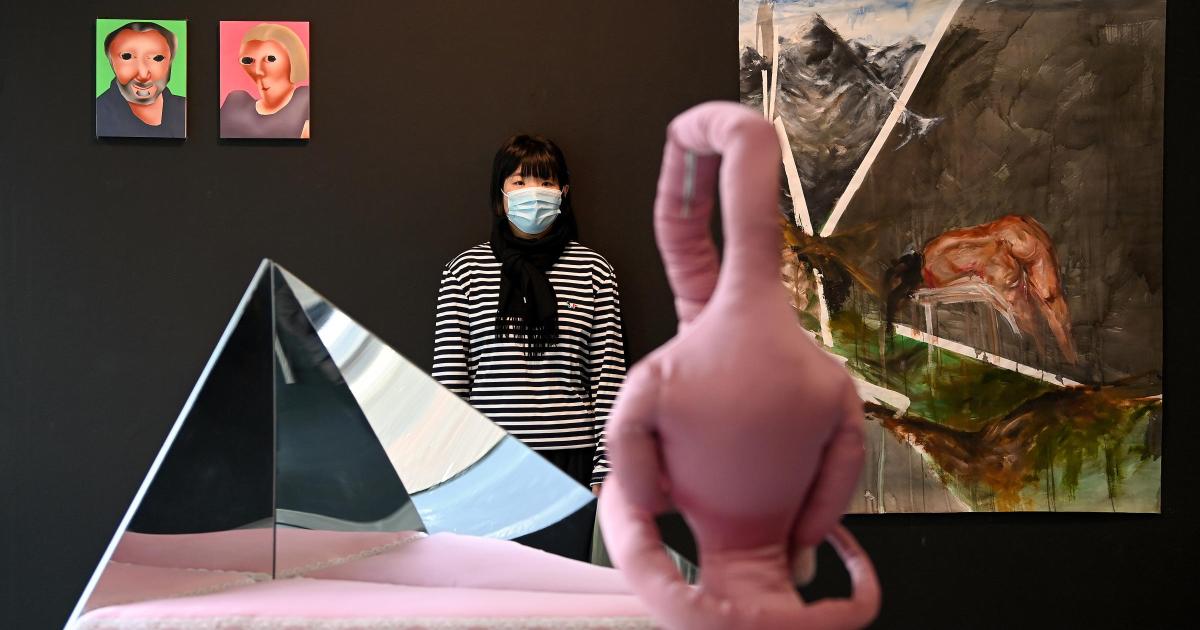
Established in Glasgow in 1983, Transmission is Scotland’s longest-standing artist-run space. Created to support emerging artists, it provides a space where they can develop and show new work.
Glasgow artist John Rogan, who was involved with Transmission during its early years, said: “At the time, many people left art school in the early eighties, and it was kind of grim even to get a normal job.
“I was the treasurer in charge of trying to raise some money. We ran a number of dances and events just to have a bit of fun, raise some money, and have a collective getting together.
“People were able to have a place to exhibit their work in Glasgow so that other young artists and older artists could see it,” said Rogan.
Read more:
Over four decades, artists connected with Transmission have gone on to achieve international recognition, including winning or being shortlisted for the Turner Prize.
Douglas Gordon, who won in 1996; Simon Starling in 2005; Richard Wright in 2009; Susan Philipsz in 2010; Martin Boyce in 2011; Duncan Campbell in 2014; Charlotte Prodger in 2018; and, most recently, Jasleen Kaur in 2024, are Turner Prize winners connected to Transmission.
Other Transmission-connected artists shortlisted for the award include Christine Borland in 1997, Jim Lambie in 2005, Nathan Coley in 2007, Cathy Wilkes in 2008, Lucy Skaer in 2009 and Karla Black in 2011.
At its core, Transmission was founded to give artists a place to show their work.
John Donaldson, a philosophy lecturer at the University of Glasgow, joined the committee in June. Together with fellow committee members Negin Saeed Jordan, Kimia Witte and Tim Kelly, he organised the celebratory event, three years after Transmission’s actual 40th anniversary.
“We represent quite a new direction for Transmission,” said Donaldson.
“Some of the exciting new work that we’re doing involves transgressing the disciplinary boundaries that often exist,” said Donaldson.
Artist Tabitha Hall with her work 5”3 FEET on show in Open Cut at Transmission Gallery (Image: Jeff J Mitchell)
One example is a funding call for artists to take part in the Lovelace Hodgkin Symposium at the University of Glasgow. Working in teams comprising a scientist, a philosopher and an artist, participants will develop work exploring how AI influences our lives in ways that are not immediately visible.
Committee member and artist Negin Saeed Jordan said: “We’re not trying to be like a normal gallery, so everything can be very experimental, and we support artists that want to do something different and try it.”
“We came in with some new energy and some new ideas, and we wanted to mark the important anniversary but at the same time communicate that Transmission is back,” said Donaldson.
Curated by musician Jer Reid, the programme brought together emerging artists from Glasgow’s creative scene for live performances and visual art.
The line-up included Comfort, a queer alternative band; multi-instrumentalist and songwriter R. Aggs; musician and sound designer Joe Howe; Chizu Nnamdi, whose practice experiments at the intersection of music, video and site-responsive performance; and Rachel Ní Chuinn, whose work with sound, movement, text and electronics explores ideas of touch and physicality.
Alongside the performances, attendees could see installations by local artists Paige Silverman, Toby Messenger, Raymond MacDonald, Saul Auty and Fritz Welch.
The programme offered a lively mix of sound, performance and visual art, with attendees enjoying an evening of thought-provoking work.
It was a reminder of what has kept Transmission going for four decades: giving artists the freedom to experiment, collaborate and take risks.
“When we started Transmission, we wanted to have as wide a variety of artwork as possible,” said Rogan.
“There’s artwork that went up that was exhibited that I helped to invigilate and look after that I hated, but that didn’t matter.
‘Transmission Gallery celebrated its 40th birthday with over 100 guests attending an evening of sound and art from Glasgow-based creatives’ (Image: Supplied)
“The fact is other people had a vision and we gave them space to show that stuff.”
Reflecting on the work that had been put into keeping Transmission alive and its continued support for local artists, Rogan said:
“It’s lovely to see that it still exists and that some people were able to use it as a starting point for a career in the art world.”