
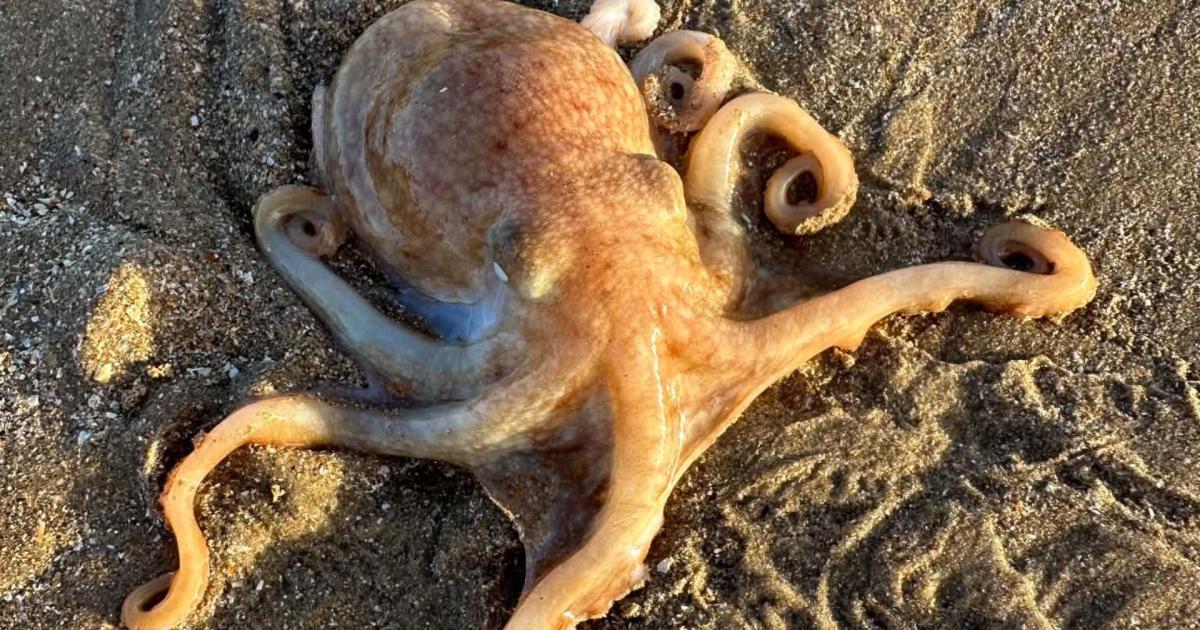
Dez Thomas made the discovery on the beach in Benllech at about 7.30am on Sunday (September 20), when he went for his daily session of cold water swimming.
Mr Thomas found a curled octopus (Eledone cirrhosa), which also goes by various other names, including the horned octopus, lesser octopus or northern octopus.
He said: “It tensed up and changed colour as soon as I touched it. I’m used to seeing lots of wildlife, but never one of these.
“It caught my eye as I was going into the water. After touching it, I happily realised it was still alive. It was amazing seeing it tense up and change colour.
“I first put it in the shallow part of the sea, but it was getting rolled around with the waves, so I put it deeper and didn’t see it after that, so I’m hoping it was OK.
“I first thought it was a lion’s mane jellyfish, but I was very surprised to find what it actually was! It was a nice experience.”
The curled octopus found washed up on Benllech beach (Image: Dez Thomas)
Frankie Hobro, director and owner of Anglesey Sea Zoo, said the curled octopus is much more frequently seen in Wales than the common octopus, which is the only other octopus species in the UK.
The sea zoo has its own curled octopus on display at its premises.
She said: “Adults like this one can grow to a total length of 50cm, and their arms are often tightly curled.
“It is not uncommon to find octopuses on the beach, both alive and dead. Although they are usually most active at dusk and dawn and during the night (making them crepuscular), they can be encountered during daylight hours, moving around between rock pools on beaches, and they are able to move very speedily on land.
“In fact, it can prove to be a very efficient way of maximising access to prey, as long as they are not out of the water for long enough to dry out.
The curled octopus found washed up on Benllech beach (Image: Dez Thomas)
“They are amazingly intelligent creatures and fascinating to watch while in motion – they often escape detection due to their unrivalled ability to instantly camouflage by changing both their skin colour and texture to perfectly match their surroundings.
“The curled octopus immobilises and eats large crustaceans by drilling a hole through their shell with its strong and sharp beak.
“When caught, it is usually as accidental by-catch in commercial fisheries of the north eastern Atlantic and Mediterranean, where the common octopus is the preferred and targeted species for human consumption.”