

UK economic outlook brighter as new government measures will boost growth, says OECD
The outlook for the UK economy has brightened, according to the Paris-based OECD, with inflation lower than expected while new government support measures are likely to boost growth.
The think tank has significantly cut its inflation forecast for this year, from 3.7% to 3.1%, after prices rose less dramatically than expected.
Economic growth for the UK is forecast at 1.1% for 2026, up from the 0.9% it had forecast in June and 0.7% in March, “with consumption expected to be supported by newly announced government support measures”.
In response, the chief secretary to the Treasury, Emma Reynolds, said:
double quotation markDespite unprecedented pressures and conflict in both the Middle East and in Europe, the UK economy is showing strong resilience.
We will face these challenges together and we are already giving families space to breathe. We had the fastest growth in the G7 in the first half of the year and we are starting the big, long-term changes needed to create good jobs and growth in every postcode.
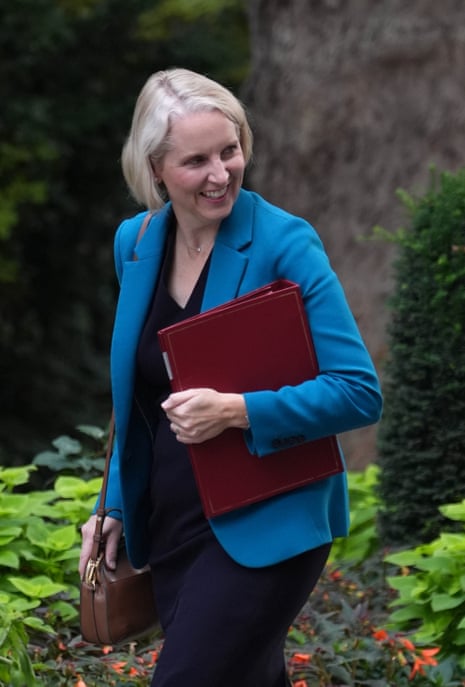 Chief Secretary to the Treasury Emma Reynolds arrives for a Cabinet meeting in Downing Street, London, on 15 September. Photograph: Gareth Fuller/PA
Andy Burnham, who became the UK prime minister on 20 July, announced a cut in VAT on electricity bills as one of his first policy measures on coming to power in July, and has suggested there may be more measures to give consumers “breathing space” in next month’s budget.
Burnham and his chancellor, John Healey, have seen UK borrowing costs rise sharply amid turmoil in global bond markets as ongoing conflicts have disrupted the oil supplies, driving up inflation.
The world’s advanced economies have been warned they need to take action to reduce their borrowing and bring down debt levels, at a time of surging government borrowing costs, according to the head of the International Monetary Fund.
Kristalina Georgieva told the BBC that global economic shocks had been “pushing debt levels up like a staircase not to heaven” despite governments taking “no action to contain that service cost. [It’s] time to take that action,” Georgieva said, adding that courage was needed by politicians to take the necessary steps.
Key events
Closing summary
Wall Street shares have fallen moderately and government bond yields rose, as crude oil prices reversed earlier falls and rose above $100 a barrel again.
Brent crude, the global oil benchmark, has been on a rollercoaster today and is now up 2.5% at $101.61, a gain of $2.3 a barrel, after five days of declines.
Chip-related companies saw their shares slide, with AMD down 2.1%, Nvidia losing 1.1% and Intel 3.2% lower.
Meta Platforms shares rose 1.3%, adding to its 10% plus jump this week as its new personal AI agent Muse has been a hit.
Over here, the FTSE 100 index in London is holding on to modest gains, trading 0.25% higher at 10,736. Other major European indices are trading lower.
Our main stories today:
Thank you for reading. We’ll be back tomorrow. Take care ! – JK
Share‘US business continues to boom’ – PMI survey
Business growth in the US has picked up to its fastest pace in more than five years and hiring also rose sharply in September, while price pressures also intensified.
The composite PMI output index from S&P Global, a closely-watched monthly survey, rose to 58.4 from 56 in August.
The services business activity rose to 58.7 from 56.5 while the manufacturing output index leapt to 56.7 from 53.1. Any reading above 50 indicates expansion.
Employment rose sharply, with jobs added at a pace not seen for over four years, as firms sought to meet rising demand. Backlogs of work continued to rise at an increased rate and supply chain delays intensified, pointing to a lack of operating capacity which fed through to higher prices.
Input costs surged on the back of the recent spike in energy prices, adding to a worsening inflation picture.
Chris Williamson, chief business economist at S&P Global Market Intelligence, said:
double quotation markUS business continues to boom, with output growing at the fastest rate for over five years in September. Historical comparisons suggest that the latest survey data point to annualized growth of around 5% with a 4% gain now signalled for the third quarter as a whole.
To put the growth surge in context, barring the spike in demand following the opening up of the economy after the COVID-19 lockdowns, the latest improvement in business activity is the greatest recorded since early 2015. Business is clearly booming now in both manufacturing and services.
However, this growth is being accompanied by some of the most severe supply chain bottlenecks seen in the near-two-decade survey history if the pandemic is excluded, with companies also reporting increasing problems finding suitable staff.
Backlogs of work are consequently rising sharply. While this accumulation of uncompleted orders bodes well for the further expansion of output and capacity in the coming months, it also indicates that companies are developing more pricing power, and hence is a worry for the inflation outlook.
Firms’ input costs have meanwhile jumped in September at the steepest rate for four years, with fuel and transport costs spiking higher thanks to the rise in oil prices seen during the month, which will add further to the upward pressure on selling prices and inflation in the coming months.
Updated at 10.15 EDT
Ryanair: Air fares in Europe will rise by up to 10%-20% next summer Gwyn Topham
Air fares in Europe will rise “dramatically” next summer, by as much as 10%-20%, Ryanair has forecast, with airlines unable to absorb continued high oil prices.
Ryanair chief executive Michael O’Leary said a lack of refinery capacity meant jet fuel was likely to stay 40% higher than crude oil, and predicted several airlines could go bust this winter.
He said Ryanair itself would trim its capacity in the coming months, sending fares upwards, to avoid the high cost of unhedged fuel, around 20% of its fuel needs.
He added:
double quotation markIf I was planning a holiday I’d be booking [flights] today. There is only one way air fares in Europe are going next summer and that is dramatically upwards.
Ryanair CEO Michael O’Leary. Photograph: Kuba Stężycki/Reuters
Speaking at a press conference in London, O’Leary repeated his calls for the sacking of Nats chief executive, Martin Rolfe, after the latest outages of air traffic control services in September.
He said Ryanair was calling for “urgent reform of failing UK Nats. What we mean by urgent reform: sack Martin Rolfe.”
The government has tasked the CAA to investigate Nats’ explanations for the major outage on 8 September, blaming a “millisecond’s software fault” for disruption to hundreds of thousands of passengers’ flights. The CAA is due to report next March.
O’Leary said:
double quotation markWe don’t need six months to learn lessons. The fundamental lesson to learn about Nats is it has an incompetent, overpaid CEO who needs to be dismissed.
He said Ryanair’s costs had run to 4-5million euros, and the airline was still seeking compensation in court for the 2023 Nats outage.
O’Leary meanwhile addressed his own recent €150m bonus deal, which was opposed by 40% of shareholders at Ryanair’s AGM this month. He said they would be consulting with shareholders to understand their concerns, but would not be changing the terms.
Asked if it was a pointless consultation, he agreed and said “Welcome to the world of ESG,” [environmental, social, and governance rules].
ShareGold and silver prices fall
The price of gold and other precious metals has fallen, under pressure from a stronger dollar and hawkish remarks from US Federal Reserve officials that reinforced expectations of near-term interest rate hikes.
Spot gold fell 1.2% to $4,303 an ounce, while silver dropped 3% to $65.05 an ounce, platinum lost 2.8% to $1,779 and palladium declined 2.1% to $1,279.
The dollar rose to its strongest level in two months, as traders priced in a 53% chance of an interest rate hike in October, according to the CME FedWatch Tool.
Richmond Fed president Tom Barkin said on Tuesday that rate hikes could temper business inflation expectations and cool price increases without slowing down economic activity.
The Fed last week lifted its benchmark rate by 25 basis points to a range of 3.75% to 4% – its first rate rise since 2023 – and signalled another increase could come before year-end.
Although gold is seen as a hedge against inflation, rising interest rates can reduce its attractiveness as investors pivot towards interest-bearing assets.
On the geopolitical front, Donald Trump warned yesterday that he could “annihilate” Iran if there is no deal to end the war, but also suggested an agreement could come soon amid a diplomatic push at the United Nations general assembly in New York.
BMI analysts said:
double quotation markIn the long term beyond 2026, we expect gold prices to ease. The main driver of easing gold prices in the long term will be greater risk-on sentiment as the global economy recovers in the later part of the decade.
ShareAI looms large over Trump-Xi meeting amid deep distrust between US and China
When Xi Jinping, China’s leader, touches down in Maryland on Wednesday, he will step out into the arms – perhaps a hug, if Donald Trump’s wishes come true – of a US president who has shown China more bonhomie than any of his recent predecessors.
The meeting between Xi and Trump this week will be the second time that the leaders of the world’s two biggest economies have talked face to face this year. At the previous summit, held in Beijing in May, there was much talk of building a “strategic stability” between the two powers. But there was little by way of concrete outcomes: the countries remain at loggerheads over trade, export controls and geopolitics.
Despite the goodwill built in May, few anticipate any major breakthroughs this week when Xi makes his first state visit to the US since 2015. “Expectations are very low,” said Bonnie Glaser, a managing director at the US thinkthank the German Marshall Fund. “Nobody is using the term ‘deliverables’.”
One area in which Trump and Xi may reach some consensus is on artificial intelligence safety. Tech executives including Jeff Bezos of Amazon, Sundar Pichai of Alphabet, Sam Altman of OpenAI, Tim Cook of Apple, Elon Musk of Tesla, Mark Zuckerberg of Meta and Jensen Huang of Nvidia will reportedly attend a state dinner at the White House on Thursday evening.
‘Whoever wins AI, wins’
In the past few weeks, the US has been beset by worries that AI is progressing too fast, but that the US must strive to defend its lead over China in the frontier technology – and Trump has pushed back hard against calls to slow its development. “We’re leading China in AI,” Trump said recently. “And frankly, I want to keep it that way, because whoever wins AI, wins.”
On Sunday, Scott Bessent, the US treasury secretary, concluded talks with the Chinese vice-premier He Lifeng by proposing an AI safety mechanism to be established between Washington and Beijing. The mechanism appears to stop short of a major safety agreement.
ShareJD sales fall with young people ‘waiting for promotions to come’ Sarah Butler
Young people are now now “waiting for promotions to come” rather than looking out for trainer brands’ latest footwear launches, the boss of JD Sports has said, as the retailer’s core customers remaiun under pressure from rising unemployment and an increase in the cost of living.
Half-year sales at the group fell 0.8%, excluding exchange rate fluctuations, to £5.9bn, led by a 4% drop at established stores in North America where food prices have soared.
Sales were down 3.3% in Europe and 1.4% in the UK as JD’s chief executive Régis Schultz said retailers around the world were having to discount sports footwear to clear stock having not recognised that the market was maturing as shoppers reined in spending and the global shift from wearing leather shoes to trainers had worked its way through.
View image in fullscreenJD Sports Fashion has blamed cost-of-living pressures for weighing on demand among its younger customers as it reported weaker sales and profits. The sportswear chain said it was operating against a “tough global consumer backdrop” which was particularly prominent among US shoppers. Photograph: Christopher Thomond/The Guardian
He said average selling prices were down in both the UK and Europe as shoppers were
double quotation markwaiting for promotions to come.
Three years ago customers were looking for a new launch, now they are looking for a new promotion and that’s having a negative impact on the industry.
He said UK sales had been better than elsewhere as young people were buying more performance sportswear as “running clubs are the new nightclubs” and he said JD was rapidly adapting by adding more clothing in the US, including own-label, and bringing in new brands such as On and Salomon in footwear as the bigger brands such as Nike face new competition.
Schultz called on the UK government to cut the cost of employing young people and to maintain flexibility on short-hours contracts as he said former chancellor Rachel Reeves’ increase on National Insurance contributions for employers and increase in the minimum wage for under 21s had been “really a wrong movement” and only pushed retailers to use more technology and hire fewer young people.
While he said JD did not use self checkouts, he added:
double quotation markThe more the cost of labour increases and the less flexibility [on working hours] the more retailers are inclined to invest in technology.
Updated at 08.37 EDT
London buses in decline? Why public transport in global cities is slowing to a crawl
Have a look at our visualisation of London buses, which have become slower and fewer in recent years. This is, unfortunately a global trend.
As experts fear for future of UK capital’s bus network, some commuters are giving up entirely. London is not alone – with worrying implications for the poorest in society.
ShareAirtel Money to float on London stock exchange
A payments business that operates across Africa and is ultimately controlled by an Indian billionaire has announced its intention to float on the struggling London Stock Exchange.
Airtel Money, the mobile money arm of Airtel Africa, is planning one of the biggest UK listings in years, in a boost for the shrinking London market that has faced a string of recent departures.
The company is understood to be looking to raise about $800m (£601m) from the IPO and is targeting a valuation of $8bn to 9bn, which would make it one of London’s largest listings in recent years.
Airtel Money has 53 million monthly active users across 13 countries in sub-Saharan Africa, including Uganda, Zambia and the Democratic Republic of Congo.
It operates through a network of branches and kiosks, which enable customers to load money on to their phones, withdraw cash and access other money services, and the company generated revenues of just under $1.4bn in the last financial year.
A Chadian woman walks past a closed kiosk of Airtel Africa, the telecommunications and mobile money services provider in the capital city of N’Djamena, Chad, last November. Photograph: Amr Abdallah Dalsh/Reuters
Airtel Money’s parent company is Airtel Africa, a telecoms provider that is part of the Indian conglomerate Bharti Enterprises, which is ultimately controlled by the billionaire Sunil Bharti Mittal. Airtel Africa is already listed on the FTSE 100 but said it wanted Airtel Money to be listed separately.
Airtel Money’s chief executive, Ian Ferrao, said:
double quotation markFrom a company perspective, [the listing] gives us flexibility for the future.
We evaluated multiple [stock] exchanges, including the Middle East because we’ve got a headquarters in Dubai, along with European and North American exchanges. Ultimately, shareholders felt that London was the right choice. We still believe there is deep capital available … all the global institutional investors are here.
Ferrao added:
double quotation markMost importantly there’s a deep understanding of emerging markets in the London market and Africa specifically.
ShareL&G confirms will cut 1,000 jobs
Legal & General has confirmed that it is cutting 1,000 jobs, with a voluntary-first approach in the UK, and excluding asset management.
António Simões, the chief executive, said in an email to employees as he announced the voluntary redundancy programme:
double quotation markOver the past two and a half years, we have made significant progress executing our strategy, simplifying L&G, establishing three core businesses, and creating a more focused business.
However, over the last decade, different structures, processes and ways of working have developed across L&G, making us more complex than we need to be. To deliver our strategy successfully, we now need to make sure the way we work reflects the business we are becoming. Across L&G, we need to change how we work today and, through this, become a leaner organisation. By the middle of next year, we expect to reduce the size of our organisation by around 1,000 roles.
An L&G spokesperson said:
double quotation markSince 2024, L&G has become a simpler, more focused business. These changes represent the next stage of that transformation, ensuring that our organisation and ways of working reflect the business we are now building and the rapidly changing environment in which we operate.
They will also help us focus our resources and investment on the areas where we see the strongest opportunities for long-term growth. We recognise and take seriously the impact on colleagues and are committed to supporting our people throughout the process and consulting with our unions.
The British insurance and pensions firm Legal & General reportedly wants to cut 1,000 jobs by the middle of next year, amounting to a tenth of of its workforce.
António Simões, the chief executive, is wielding the axe as he tries to simplify the company’s operations.
The London-headquartered firm has kicked off a plan to eliminate about 1,000 roles by mid-2027, according to an email sent to employees on Wednesday seen by Bloomberg News.
The programme will initially be voluntary redundancies in the UK but L&G will consider mandatory cuts depending on take-up, Bloomberg said, citing a source. The investment management division, which oversees £1.2 trillion in assets, is excluded as it already has its own restructuring plan underway.
Updated at 06.31 EDT