
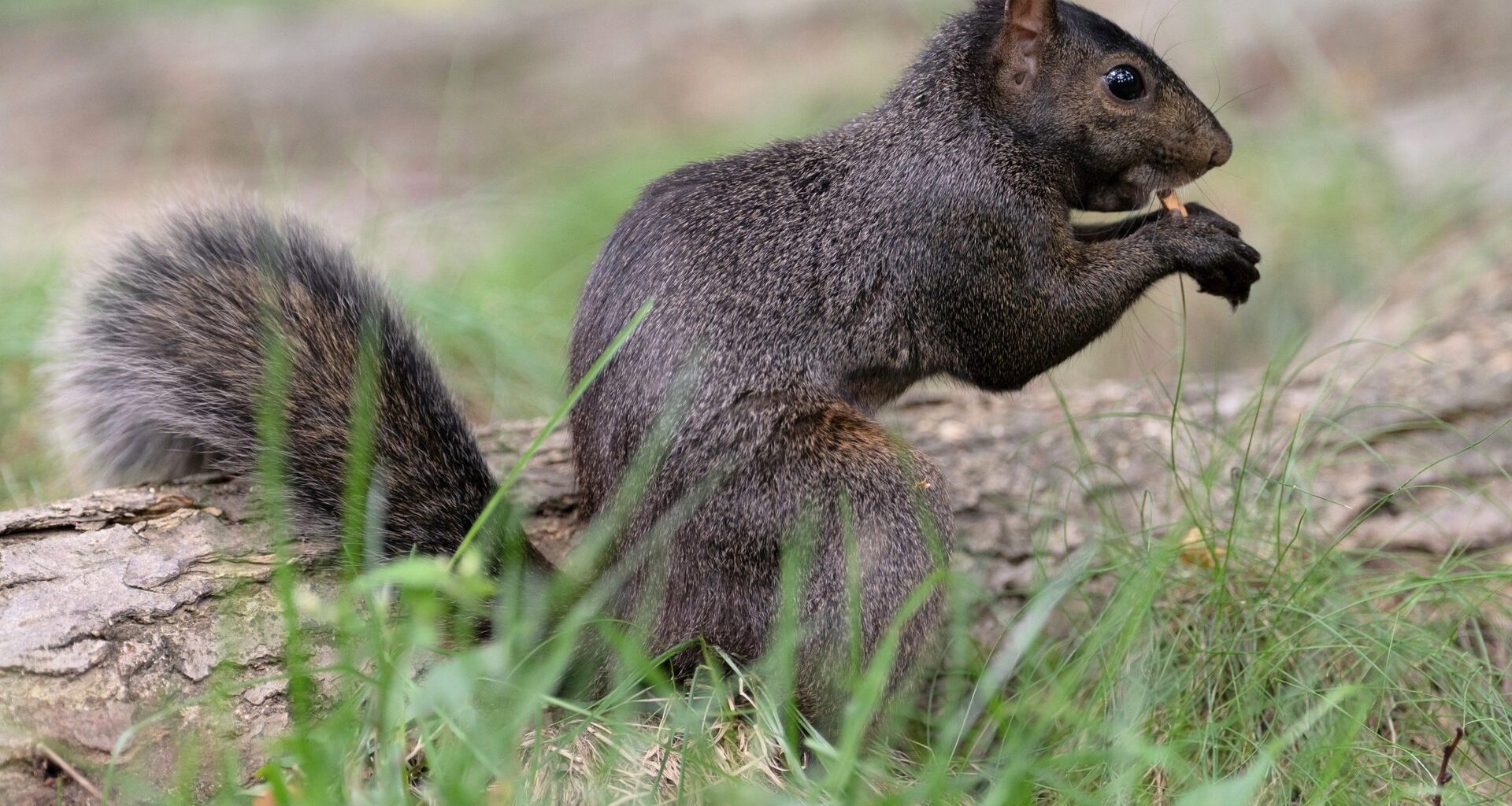
Eastern gray squirrels can be black or gray, and new research reveals how surprisingly local conditions are linked to their coat color.
A black squirrel in a city park may seem like a small detail. But its coat color can reveal something bigger about how animals live in cities.
Cities change nature in many ways. Buildings trap heat, trees disappear in some areas, and rivers can separate animal populations that live only a short distance apart.
New work on eastern gray squirrels in Montreal shows that these local differences matter.
Black squirrels were much more common in some parts of the region than others, and the pattern was most strongly linked to winter temperature, tree cover, and geography.
For people, the finding offers a simple lesson about urban wildlife. A city is not one environment, and animals living in different neighborhoods may face very different conditions.
Why squirrel color tells a bigger story
Eastern gray squirrels do not always have gray fur. Some are dark brown or black because of a known genetic change that affects coat color.
This darker form is called melanism. Because coat color is easy to see, squirrels give researchers a useful way to track how a visible trait changes across one metropolitan area.
Francis Quang-Hai Dinh, the paper’s first author from McGill University, collected observations across Montreal.
“I visited almost 200 parks around the city on my bicycle during my free time the first summer that I was at McGill, and observed over 800 squirrels, some of whom were gray and others were black,” Quang-Hai Dinh said.
Tracking squirrels across Montreal
The published analysis included surveys from 197 parks, along with public observations from iNaturalist and SquirrelMapper.
Altogether, the researchers analyzed 1,734 squirrel observations from across the Montreal metropolitan area.
About 12.8% of the squirrels were black or very dark. That citywide average hid major differences from one part of Montreal to another.
Near the city center, black squirrels made up only about 5% of the animals recorded. Their numbers rose strongly toward the north and west, but not toward the south and east.
In northern rural areas, about 58% of squirrels were melanic, while the figure was about 37% in western areas. Some southern and eastern areas stayed close to 5%.
Colder and greener places stood out
The team compared squirrel color with features of the parks, including winter temperature, tree canopy, park size, roads, buildings, paved surfaces, and distance from downtown.
Two features stood out most clearly: colder winter temperatures and greater tree cover. Black squirrels were more common in places that had both.
A dark coat can help squirrels hold onto heat in cold weather, which could help explain why black squirrels remain common in colder areas.
The researchers did not measure body temperature, survival, or reproduction, so they cannot say that cold weather caused more black squirrels to survive.
Tree cover may also matter because animals with different coat colors can be easier or harder to see against different backgrounds.
The analysis found a connection, not proof that trees directly determine which coat color does better.
Urbanization was not the whole answer
Urbanization itself was not the strongest predictor of squirrel color. More urbanized areas tended to have warmer winters and less tree cover.
Those local conditions were more closely linked with melanism than the broad measure of urban development.
This suggests that city life may matter partly because development changes the conditions animals experience.
Two parts of the same city can therefore be very different for wildlife. One area may be warmer and heavily built, while another may have more trees and colder winters.
Looking only at “urban” and “rural” can miss the smaller environmental differences that animals actually experience.
Rivers may keep populations apart
Montreal is divided by major waterways, including the St. Lawrence River and its tributaries.
The researchers found sharp changes in the proportion of black squirrels between some regions separated by these waterways.
Professor Allison Roth, the paper’s senior author, is now at the University of Missouri.
“People often think of cities as a single type of environment, but our findings show that the conditions animals experience can vary dramatically from one neighborhood to another,” Professor Roth said.
“These local differences, along with barriers such as rivers, can shape how wildlife populations evolve, which means we need to look beyond simple urban-rural comparisons to understand adaptation in cities.”
Large rivers could make it harder for squirrels from different areas to mix. Over time, that could help keep coat-color differences between populations on opposite sides.
The team did not track squirrels crossing rivers or collect genetic samples for this project. The idea that rivers limit movement is therefore a possible explanation, not something this work proved.
Limitations of the study
The results do not prove that Montreal’s squirrels are evolving right now.
The researchers mapped where coat colors occur, but they did not measure whether black or gray squirrels survive longer or produce more offspring.
Their field surveys focused on parks, so squirrels living around houses, streets, or commercial areas may experience different conditions.
The surveys also took place during the middle of the day, when squirrel activity can be lower.
Coat color can also affect how easy an animal is to notice.
Dark squirrels may be harder to see in shaded places, while people using citizen science apps may be more likely to photograph a black squirrel because it looks unusual.
The three datasets showed broadly similar coat-color patterns, but the researchers could not completely rule out these possible biases.
Why local differences matter
The larger message goes beyond the color of Montreal’s squirrels. Animals living in one city do not all experience the same heat, tree cover, barriers, or access to surrounding habitat.
“This project shows how discoveries can be accessible and that you can do science in your backyard,” Francis Quang-Hai Dinh said.
That makes familiar urban animals useful for understanding how human-built landscapes interact with nature.
A change visible in squirrel fur can reveal environmental differences that broad citywide labels may miss.
The findings do not show that one type of city environment always favors black or gray squirrels.
Instead, they show that local conditions and geography are both linked with where the different coat colors occur.
The study is published in the Journal of Animal Ecology.
—–
Like what you read? Subscribe to our newsletter for engaging articles, exclusive content, and the latest updates.
Check us out on EarthSnap, a free app brought to you by Eric Ralls and Earth.com.
—–