
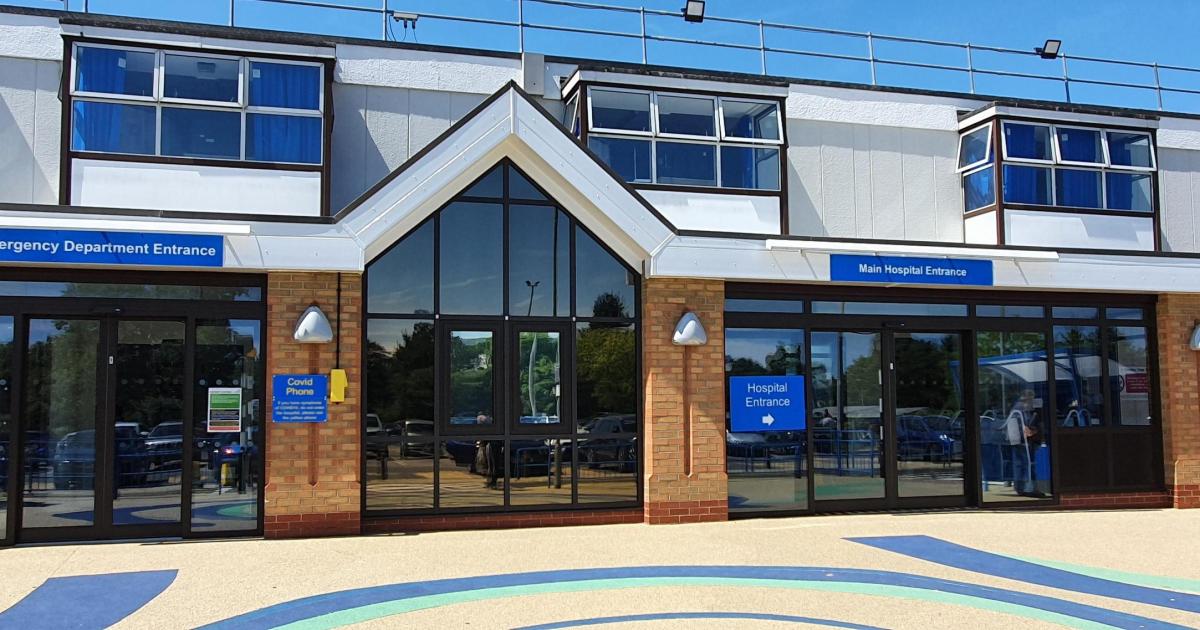
Confidential documents seen by this newspaper show that the departments at both the James Paget Hospital in Gorleston and the Queen Elizabeth Hospital in King’s Lynn could be closed.
This would leave Norfolk and Norwich’s A&E to cover the entire county.
Talks over the future of the QEH’s emergency and intensive care departments were first revealed by the EDP earlier this month.
Discussions are being held over the future of A&E at both the JPH and the QEH (Image: Google Maps)
It has now emerged that the same discussions are being held over the future of the same units at the JPH.
Both the QEH and the Paget are due to be rebuilt within the next decade as part of a £2.8 billion project, and officials have been reviewing which services each hospital will offer.
However, the possibility that both might lose their A&E units has prompted alarm in both towns.
Concerns have also been raised about the plans resulting in a “massive pile-on” at the Norfolk and Norwich, which would be left to shoulder the burden of the county’s emergency care.
The Norfolk and Norwich University Hospital (Image: Archant)
The discussions have provoked a furious response from MPs of the towns, who have called on the group to keep their A&E units open.
They have also urged the Norfolk and Waveney University Hospitals Group, which runs the county’s three hospitals, to come clean about their plans.
The group has insisted the documents are preliminary and that no final decisions have been made.
They have said that people will continue to have access to urgent and emergency care at both the QEH and JPH 24 hours a day.
However, this does not specifically address whether the A&E unit will remain open.
When asked directly whether the two hospitals would keep their A&Es, the group refused to rule out their loss, saying it had “not decided what that future model will look like at either hospital”.
PLANS REVEALED
The discussions over the future of the three hospitals emerged in confidential documents produced by the group and seen by this newspaper.
They contain three options for the emergency healthcare in Norfolk.
The Queen Elizabeth Hospital in King’s Lynn (Image: QEH)
Just one would retain A&E provision at all three sites in their current form.
The most drastic option would axe the units at the JPH and QEH.
A third proposal suggests maintaining a downgraded emergency department at both JPH and QEH, but with the most serious cases, such as strokes and major traumas, sent to Norwich.
The group has admitted some of the approaches being explored “could provide a different range of services from a traditional emergency department”.
NO A&E ALTOGETHER
As part of the most radical option, both hospitals would lose their emergency departments.
Instead, each would be reduced to a 24-hour urgent treatment centre, designed for non-life-threatening conditions, alongside same-day emergency care and general medical wards.
Same-day emergency care, where patients are assessed and treated before being sent home, would run from 8am to 10pm.
The QEH is Norfolk’s second largest hospital (Image: QEH)
The hospitals would also switch to a “selected medical take”, meaning they would only admit patients picked out as suitable, rather than anyone who comes through the door or arrives by ambulance.
Any complex cases or patients who are critically ill would go to Norwich, along with most patients expected to need more than two days in hospital.
That means the hospitals would largely handle short stays, with longer admissions moving to the Norfolk and Norwich.
THE MIDDLE GROUND
Under the second option, both the JPH and QEH would keep an emergency department with ‘majors’ and ‘resus’ areas.
However, they are not described as a “Full Type 1” A&E, the label given only to the Norfolk and Norwich.
A Type 1 A&E is a consultant-led, 24-hour department with full resuscitation facilities, equipped to deal with the most serious emergencies, including strokes and major injuries.
This raises the prospect that the most serious cases could be sent to Norwich even under the less drastic plan.
NO CHANGE
A third option would leave the hospitals in their current form, maintaining a full A&E, intensive care and emergency surgery.
‘VERY WORRYING’
Professor Suzanne Mason, professor of emergency medicine at the University of Sheffield, examined the options for the EDP.
She warned that the plans to axe A&E at both hospitals could mean ambulances stop going to King’s Lynn and Great Yarmouth altogether.
Professor Suzanne Mason (Image: Supplied)
“It’s highly likely that the James Paget and the QEH might not even take ambulances,” she said.
“You’re not going to take anyone who’s really sick to the James Paget or the QEH, because they haven’t got the facilities there.
Prof Mason warned that could have major repercussions on such a rural area.
“For somewhere like Norfolk, where people do live 20 or 30 miles away from their nearest hospital, it could mean quite a significant impact if they ended up with a time-critical problem that needed some urgent response,” she said.
She added the changes may also have the harshest impact on the poorest in Norfolk, who may not have easy access to transport.
“It can create more division in the haves and the have-nots,” she said.
“If you haven’t got access to a vehicle, if you haven’t got a family that can visit you if you’re in hospital nearby, all those things impact on patient outcomes.”
The plans would place likely place huge pressure on the Norfolk and Norwich.
“Is it all going to end up just being a massive pile-on to the Norfolk and Norwich, and then they’re going to become overwhelmed and not be able to deliver the service that they should be able to, which is already really difficult.” Prof Mason said.
“BETRAYAL”
The MPs for both hospitals have hit back furiously at the revelations.
Rupert Lowe, the MP for Great Yarmouth, described the proposal as an “absolute betrayal”.
Rupert Lowe, the Great Yarmouth MP (Image: Jordan Pettitt/PA Wire)
“I will do everything in my power to fight for the full A&E to remain at the James Paget.
“To worsen NHS services in an already depleted area would be an absolute betrayal for the people of Great Yarmouth, Gorleston and the surrounding areas.
“I am astonished it is even being considered.
“It is a betrayal, and if they think they can force this plan through without an almighty fight, they are mistaken.”
James Wild, the MP for North West Norfolk, has already raised concerns about the QEH in Parliament following the EDP’s initial report.
James Wild, the North West Norfolk MP (Image: Chris Bishop)
Following the latest revelations, he said: “The lack of transparency around the clinical services review is causing real concern among staff, patients, and our community.
“There is deep scepticism about this process and as I have repeatedly said there should be much greater openness including publishing the data which is being used to develop options.
He added: “While the Group has said no decisions have been taken, further reports of options being considered that could see QEH downgraded are destabilising.
“They fail to reflect the population, rural travel times, deprivation, and demographic makeup across West Norfolk, North Cambridgeshire, and South Lincolnshire and should be ruled out now – rather than allow damaging speculation to continue.
“I will continue to make the case for retaining key services at QEH.”
His comments come amid growing concern in King’s Lynn.
Since the EDP first revealed the threat of closure, a petition to “Save the QEH” has passed 10,000 signatures.
Last week, West Norfolk Council also voted to oppose any downgrade of the hospital.
WHAT DOES THE GROUP SAY?
The group did not dispute the document, saying the material “forms part of preliminary work”.
Dr Rob Sherwin, the group’s chief medical officer, said: “As we have consistently explained, we are at an early stage of our work to develop a long-term clinical strategy.
“With our three hospitals working together and unprecedented investment in new hospitals at QEH and James Paget, we have a once-in-a-generation opportunity to improve care across Norfolk and Waveney.
An artist’s impression of the new QEH (Image: QEH)
“Speculation understandably creates concern for our staff and for local people, and our clinicians need time to explore ideas, challenge assumptions and test different approaches.
“Some ideas will be discounted, and any that remain under consideration will need to be fully assessed.
“The material referenced by the EDP forms part of preliminary work. An idea being discussed is not a proposal, and a proposal is not a decision.’
“Underpinning all our work is an absolute commitment to patient safety. We also want to provide as much care as possible locally or even closer to home, while ensuring patients who need specialist care can access the right expertise when they need it.
“That is why, with the support of Healthwatch Norfolk, we are involving our patients and communities as this work develops, to understand what matters most to them.
“Any proposals that might arise, for significant service changes, would be subject to the appropriate scrutiny, engagement and consultation before any decisions are made.”