

Introduction: UK economy bigger than first thought after GDP revised higher
Good morning, and welcome to our rolling coverage of business, the financial markets and the world economy.
The UK economy grew faster than first estimated in the second quarter of the year, despite the disruption caused by the Iran war.
UK growth in April-June has been revised to 0.5%, up from the previous estimate of 0.4%, in the latest National Accounts.
That’s a welcome piece of good news for chancellor John Healey, as he draws up the budget due in four weeks’ time, and means his predecessor Rachel Reeves handed over a slightly larger economy than previously recognised.
Growth in Q2 2026 was driven by the services sector (where activity increased by 0.6%) and the construction sector (which grew by 0.8%), while the production sector shrank by 0.1%.
However…the Office for National Statistics, which publishes the data, has also revised down its estimate for growth in 2025.
ONS director of economic statistics Liz McKeown said:
double quotation mark“Today’s figures include our annual improvements to the measurement of the economy, incorporating new information that provides a better picture of activity across the UK’s service sector, alongside the usual inclusion of updated and improved data sources.
“Growth for 2025 as a whole was a little lower than previously estimated, with the profile of growth across the quarters also revised.
“However, stronger services growth in the latest quarter means the economy is now slightly larger than previously estimated.”
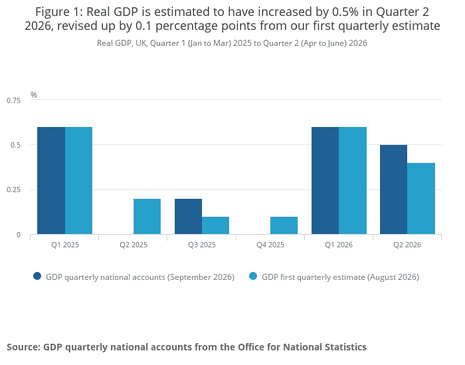 A chart showing today’s GDP revisions Photograph: Office for National StatisticsThe agenda
7am BST: UK national accounts for April-June 2026
7.45am BST: French inflation report for September
10:30am BST: BoE Financial Policy Committee minutes
1.30pm BST: US PCE inflation index for August
Updated at 02.43 EDT
Key events
Closing post
Time to wrap up..
The US and UK economies have strengthened their position as the fastest-growing G7 countries so far this year.
Estimated UK growth in April-June was revised up to 0.5% this morning, following 0.6% growth in January-March. The Office for National Statistics reported that exports had been stronger than previously thought.
The ONS also reported that UK household income grew at a stronger pace than previously estimated during the first six months of the year.
The rise in income per head to 1.1% between January and June followed an increase in the level of economic growth that illustrated the resilience of the UK economy since the outbreak of hostilities in the Middle East more than seven months ago.
The US followed suit, with new data showing its economy grew at an annualised rate of 2.2% in April-June, or 0.55% in the quarter.
Both economies also face the burden of higher motor fuel prices; in the UK, diesel is approaching £2 a litre for the first time.
Elsewhere….Greggs has announced plans to close four of its factories, in a move that could result in 740 job losses over the next two and a half years.
The bakery chain said it was consulting on the closures, which would initially cost £60m when including disruption costs and redundancy payments but then could create £20m of savings each year by 2028.
Household energy bills in Great Britain are predicted to reach almost £2,000 a year for the typical household from January as the impact of the Middle East war continues through the coldest months of winter.
The governor of the Bank of England has called for the “right to intervene” in the AI industry amid growing fears that rogue models could take the financial system hostage.
ShareFTSE 100’s worst month since March
And finally, London’s stock market has posted its worst monthly performance since March.
The FTSE 100 fell by 2% this month, including a small dip of 30 points or 0.3% tonight, to see the blue-chip index close at 10,606 points.
Over in Germany, inflation has accelerated to its highest level since December 2023.
On an EU-harmonised basis, inflation in Germany rose to 3.3% year-on-year in September, preliminary data from federal statistics office Destatis showed, up from 2.9% in August.
Inflation was driven by energy prices, which Destatis estimates were 14.9% higher than a year earlier.
In another blow, seasonally adjusted unemployment rose back above 3 million in September.
The slowdown in US PCE inflation last month lowers the risk of a rise in interest rates in October, reports James Knightley, US chief international economist at ING.
Knightley points out that a quarter-point (25 basis point) hike in rates at the Federal Reserve’s next meeting now looks less likely:
double quotation mark“Today’s outcome supports the NY Fed’s John Williams’ comments yesterday that there is no immediate urgency for another rate hike and we now have only 9bp priced for the October FOMC meeting versus 18bp at the beginning of yesterday.”
“Overall, the report shows a better balance to the US economy and suggests that the middle and lower income households, for whom income is so critical to spending power given the lack of financial assets, have been under less financial pressure than feared.”
At the state level, real GDP across the US ranged from a 4.0% annualised increase in New York to a 2.3% decrease in West Virginia.
Wall Street has opened slightly higher as traders welcome today’s lower-than-forecast PCE inflation reading.
The Dow Jones industrial average has gained 37 points to 51,387 points in early trading, with the broader S&P 500 index up 0.3%.
Investors may be hoping that it lowers the risk of a further rise in US interest rates soon.
However, Adam Hetts, global head of multi-asset at Janus Henderson Investors, says:
double quotation mark“Inflation pressures continue, albeit slightly below expected levels, with monthly headline PCE inflation at 0.3% and core PCE at 0.2%. Annual headline PCE, reading 3.4%, continues well above the Fed’s 2% target. The underlying economy proves resilient once again, with Q2 GDP growth revised up to 2.2% alongside a particularly strong Q3 GDP nowcast.
While today’s inflation data is somewhat better than expected, strong labor and GDP data suggest the print is unlikely to derail consensus expectations for another rate hike before the end of the year.”
American companies added more employees this month than forecast.
Private-sector employment increased by 90,000 jobs in September, according to the ADP National Employment Report released today.
That’s up from just 36,000 in August, and higher than the 70,000 economists had expected.
Hiring was led by education and health care and leisure and hospitality.
“It’s a strong report,” said Dr. Nela Richardson, chief economist at ADP, adding:
double quotation mark“After a three-month slowdown, job creation rebounded and pay growth remained solid.”
In a second piece of good US economic news, inflation was lower than forecast last month.
The Personal Consumption Expenditures Price index rose by 0.3% in August, lower than the 0.4% increase expected by economists.
Core PCE inflation, which strips out food and energy, only rose by 0.2% in the month.
ShareUS economic growth in Q2 revised up
Newsflash: The US economy grew faster than previously thought in the second quarter of this year.
New data just released shows US GDP grew at an annualised rate of 2.2% in April-June, up from a previous estimate of 1.5% growth.
The upgrade is due to upward revisions to investment, consumer spending, and government spending.
UPDATED: 2.2% is the equivalent of quarterly growth of 0.55%, so slightly faster than the UK which expanded by 0.5% in Q2 (we learned this morning).
The industries which drove the US economy in the last quarter were real estate and rental and leasing, information, durable goods manufacturing, and finance and insurance, according to the US Bureau of Economic Analysis (BEA).
Updated at 08.47 EDT
The diesel crisis could get even worse if Donald Trump decides to introduce an export ban on the fuel.
The price of diesel has been pushed to record highs this year as supplies have swindled, due to the Iran war disrupting oil exports from the Middle East, and Ukranian attacks on Russian oil refineries.
Trump has held crisis talks with advisers over whether to impose a diesel export ban, the Financial Times reports today, adding:
double quotation markAides had presented the president with options including curbs on international diesel sales, people familiar with the discussions said, and administration officials have briefed foreign allies including the UK about possible disruption to their supplies.
A White House official said Trump was “evaluating all the options on the table” to lower domestic fuel prices and that no decision had been taken on whether to suspend exports.
ShareZambia bucks trend with rate cut
While many central bankers are considering raising interest rates, Zambia’s central bank cut its benchmark lending rate by 250 basis points to 10.75% today.
The reduction was much larger than the 25-basis-point cut forecast by economists polled by Reuters.
The move came after Zambia’s annual inflation rate softened to 6.1% in September, from 6.2% the previous month.
It is near the bottom of the central bank’s 6%-8% target range and at its lowest level since 2018.